The Bulgarian Revival trail: Koprivshtitsa, Tryavna, and the 19th-century villages
The Bulgarian National Revival — Vazrazhdane in Bulgarian — is the name given to a period spanning roughly 1700 to 1878 when Bulgarian language, culture, and political identity reasserted themselves after five centuries of Ottoman rule. It is not a single event but a long, uneven cultural and economic awakening that produced some of the most distinctive architecture in the Balkans, a body of literature in the modern Bulgarian language, and ultimately an armed uprising that led to modern Bulgaria’s creation.
The villages of this period are still standing. Koprivshtitsa is the most intact and most visited. Tryavna and Arbanasi are less known internationally and worth understanding in context. This guide covers the history, the architecture, and the practical logistics of visiting each.
| Where | Koprivshtitsa (114km east); Tryavna & Arbanasi (near Veliko Tarnovo) |
| Cost | around €8 combined ticket (6 house museums), Koprivshtitsa |
| Time needed | half day (Koprivshtitsa alone) to 2 days (full loop) |
| Getting there | car or guided day tour from Sofia; train station is 12km out |
| Best time | April-May or September-October; avoid Monday closures |
If you want the architectural vocabulary before you go, the Bulgarian Revival architecture guide explains the building types in more detail, and the Koprivshtitsa destination page collects the practical basics for the village itself. Readers who prefer to start from Sofia can also see the wider day trips from Sofia overview to place this trail among the other options.
The history: five centuries of Ottoman rule and the culture that survived
Bulgaria was absorbed into the Ottoman Empire between 1393 and 1396, when the Second Bulgarian Empire fell to Ottoman forces. What followed was not cultural annihilation — Bulgarian Orthodox Christianity continued, Bulgarian craftsmen worked throughout the empire, and Bulgarian merchants traded from the Black Sea to Vienna — but it was genuine subjugation. Political autonomy was gone. The Bulgarian church fell under the Greek Patriarchate in Constantinople, which Bulgarians resented intensely. The Bulgarian nobility as a class effectively ceased to exist.
The Revival emerged first through the Church and education. Paisiy Hilendarski, a Bulgarian monk at Mount Athos in Greece, wrote his “Slavic-Bulgarian History” (Istoriya Slavyanobolgarskaya) in 1762 — a polemical work arguing for the distinctiveness of Bulgarian identity against Greek cultural dominance. It circulated in hand-copied manuscripts for decades before printing. Neophit Rilski codified modern Bulgarian grammar in 1835. The first secular schools in Bulgarian, the first Bulgarian-language newspapers, and the first theatres all appeared in the early 19th century.
Economic success funded the cultural project. Bulgarian merchants and master craftsmen (called chorbadji or ustabashi) grew wealthy supplying the Ottoman economy. Some used that wealth to build. The houses they constructed — the defining physical artifact of the Revival — were statements of wealth, identity, and aesthetic ambition.
What Revival architecture actually looks like
The Bulgarian National Revival house has several consistent features that distinguish it from Ottoman domestic architecture on one side and European neoclassical on the other.
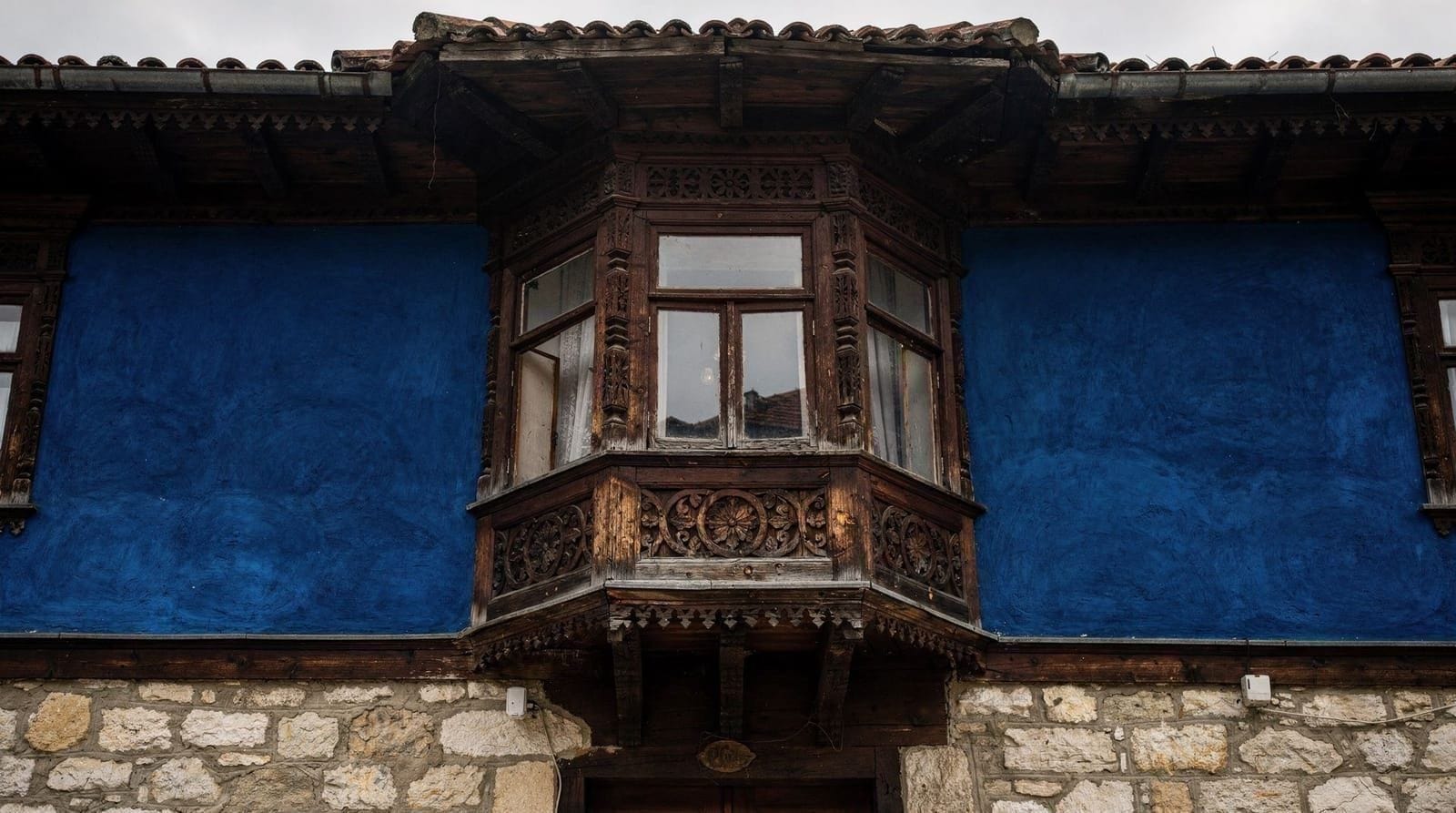
The oriel bay window (erkera) projects outward from the upper floor, overhanging the street. This was partly practical — it expanded living space without taking more street-level plot — and partly a display of status. The exterior of the oriel was often decorated with carved woodwork or painted plaster.
Carved wooden ceilings are the interior signature. Master craftsmen, particularly from the woodcarving school at Tryavna, created intricate geometric and floral ceiling panels for the guest reception room (odaya). The Oslekov House in Koprivshtitsa and the Daskalov House in Tryavna have two of the finest examples in Bulgaria.
The layout follows a consistent pattern: a ground floor of stone (often used as storage or stabling), a projecting upper floor of wood and plaster with the family living quarters, and a courtyard. The courtyard was private — hidden behind high stone walls from the street — which reflects both security concerns under Ottoman rule and a cultural preference for inward-facing domestic space.
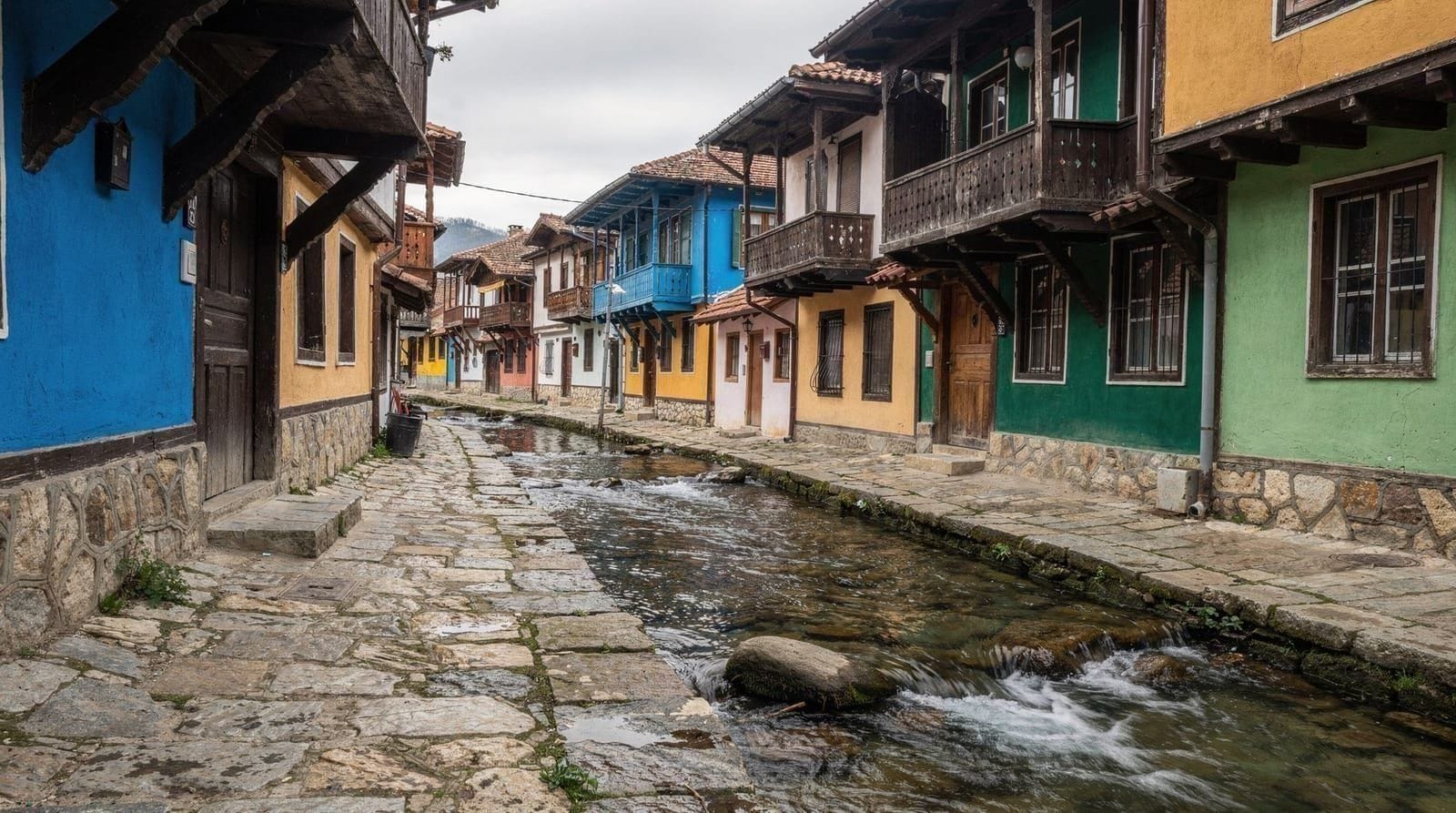
Color is another marker. The facades are painted in deep ochres, blues, reds, and greens that would look extraordinary even in southern Italy. The Koprivshtitsa houses retain much of their color because the village was relatively spared from modernization in the communist era — it was preserved as a museum village partly because it was politically useful as the site of the April Uprising.
The April Uprising of 1876 and why it matters
The political culmination of the Revival was the April Uprising (Aprilsko Vastanie) of 1876. Organized by Bulgarian revolutionary committees operating partly from exile in the Danubian Principalities (modern Romania) and partly from within Bulgaria, it was intended as a coordinated national revolt. In practice, it was premature, poorly coordinated, and crushed within weeks by Ottoman regular forces and irregular Bashi-Bazouk militia.
The suppression was brutal. Several thousand Bulgarians were killed, some entire villages burned, and the town of Batak became synonymous with mass killings of civilians. The events were reported in the Western European press — partly through the American journalist Januarius MacGahan’s dispatches in the London Daily News — and caused genuine public outrage in Britain, where Gladstone published his pamphlet “Bulgarian Horrors and the Question of the East” against Disraeli’s pro-Ottoman policy.
The diplomatic and military consequences were significant. Russia, which had interests in the Balkans and a domestic pro-Slavic political movement, declared war on the Ottoman Empire in 1877. The Russo-Turkish War ended in Ottoman defeat and the Treaty of San Stefano (1878), which created a large Bulgarian state. That state was almost immediately reduced at the Congress of Berlin under pressure from Austria-Hungary and Britain, but the Principality of Bulgaria was established nonetheless. This is the Liberation (Osvobozhdenie) that Bulgarians commemorate on March 3rd each year.
Koprivshtitsa was where Todor Kableshkov, a local revolutionary, sent the April Uprising’s declaration — the “Blood Letter” — by telegraph on April 20, 1876. The house from which he operated is now one of the six house museums.
Koprivshtitsa: the main destination
Koprivshtitsa sits 114 km east of Sofia in the Sredna Gora mountain range at around 1050 meters elevation. The drive takes approximately 2 hours on the main Plovdiv road and the turn south through Zlatitsa. The direct road bypasses the nearby railway station — note that the Koprivshtitsa train station is 12 km from the village itself, so a train trip without a car waiting requires a taxi from the station.
The village has around 3000 permanent residents and is fully functioning — people live in many of the Revival-era houses. It does not feel like an open-air museum, though parts of it operate as one. The central area is car-free in the immediate vicinity of the main square and the river bridge.
The six house museums
Koprivshtitsa has six official house museums, each maintained by the National Museum of History. A combined ticket for all six costs approximately €8. Individual museums are €2 each. The museums open at 9:30am and close at 5:30pm (last entry 5pm). They close on Mondays.
Kableshkov House (Kableshkovata Kashta): Where Todor Kableshkov wrote the Blood Letter that started the April Uprising. Two-story Revival house with original furniture, documents, and period objects. The telegraph room is the central exhibit.
Oslekov House (Oslekovata Kashta): The finest merchant’s house in the village and one of the best examples of Revival domestic architecture in Bulgaria. Built 1856 for the merchant Nencho Oslekov. Three floors, carved wooden ceilings in the reception rooms, a summer hall with large arched windows, and a painted reception room. The size of the carved wooden ceiling rosette in the main salon gives a direct impression of how much a successful merchant was willing to spend on display.
Lyutov House (Lyutovata Kashta): A late Revival house (1854) with an unusual ground-floor arrangement. The paintings on the walls include early attempts at landscape and architectural motif — showing Western influence arriving via Plovdiv.
Benkovski House: Former home of the revolutionary Georgi Benkovski, who led the Fourth Revolutionary District (Plovdiv region) during the uprising. Smaller and less architecturally significant than Oslekov, but important for understanding the uprising.
Karavelov House: Associated with the Karavelov family, one of whom (Lyuben) was a novelist and activist. The house demonstrates the literary aspect of the Revival — books, manuscripts, early newspapers.
Topalova House (Debelyanovata Kashta): Home of the poet Dimcho Debelyanov, who lived here in the late 19th and early 20th century. Less directly about the Revival but gives context for what came after.
You do not need to do all six. The essential ones are Oslekov (for architecture) and Kableshkov (for history). Add Benkovski if you want the full April Uprising narrative. The circuit of the village itself, walking the stone-paved streets between the museums, takes another 1-2 hours.
Beyond the six official houses, Koprivshtitsa has two churches worth a brief stop: Sveta Bogoroditsa, with an unusually elaborate carved iconostasis, and the smaller Sveti Nikola, both within a few minutes’ walk of the main square. Neither requires more than 10-15 minutes and both are free to enter, making them an easy add-on between house museums rather than a separate stop on the itinerary.
Full-day guided tour to Koprivshtitsa from SofiaA guide is most useful in the houses themselves, where the objects and rooms make much more sense once someone explains who lived there and why they built the way they did. For a step-by-step walk through the village, see the dedicated Koprivshtitsa day trip guide. The Revival houses also make more sense if you have first seen how the same period shaped the capital: the Sofia old town walk and the Sofia churches guide show the urban side of the story, while Koprivshtitsa shows the village side.
Logistics for Koprivshtitsa
The easiest approach is a guided day tour from Sofia, which handles transport and provides historical context. If going independently by car, allow 2 hours each way and at least 3-4 hours in the village. The village has several mehani (traditional restaurants) for lunch — Dyado Liben Inn (Хан Дядо Либен) is the most atmospheric, set in a Revival-era building on the river. Expect €10-14 for a full meal.
Tryavna and the woodcarving school
Tryavna is 230 km northeast of Sofia, typically visited as a day trip from Veliko Tarnovo (30 km). It is worth including in any discussion of the Revival because it is the origin of the Tryavna woodcarving school — the craftsmen who produced the elaborately carved ceilings and iconostases found throughout Bulgarian Revival buildings.
The central attraction is the Daskalov House (Daskalovata Kashta), a museum containing two rival carved wooden ceilings in adjacent rooms — allegedly the products of a competition between master woodcarver Dimitar Oshanetsa and his student Simeon Kostadinov Tanchov. The “sunflower ceiling” (slancheto) in one room has 140 petals radiating from a central sun motif. Entry is approximately €2.
Tryavna also has a small historic center with a medieval stone bridge and the Church of the Archangel Michael (carved iconostasis, 15th-16th century).
Getting to Tryavna independently from Sofia in a day is demanding (4-5 hours of driving each way if you include a stop in Koprivshtitsa). It makes more sense as part of a longer trip that includes Veliko Tarnovo overnight.
Arbanasi: merchant houses near Veliko Tarnovo
Arbanasi is a village 4 km from Veliko Tarnovo, at 500 meters elevation on a plateau overlooking the Yantra River valley. Unlike Koprivshtitsa, Arbanasi’s Revival houses date from the 16th-18th centuries — earlier than the main Revival wave — reflecting the wealth of Bulgarian merchants operating under Ottoman patronage during an earlier period.
The Konstantsalieva House (Konstantsalievata Kashta) is the outstanding example. Built in the late 17th or early 18th century, it is a fortress-like structure with thick stone walls, iron-reinforced door, and interior rooms of extraordinary sophistication — carved ceilings, painted walls, a women’s quarters separated from the reception area. Entry approximately €3.
The Church of the Nativity of Christ in Arbanasi contains some of the most elaborate fresco cycles in Bulgaria, covering every surface of the interior with biblical scenes. Unlike the more austere medieval churches, these 17th-century frescoes are narrative and colorful. Entry approximately €3.
Arbanasi is typically visited in combination with Veliko Tarnovo — the town is 10-15 minutes by taxi from the Tsarevets Fortress.
Full-day tour to Veliko Tarnovo and Arbanasi from SofiaVeliko Tarnovo is the natural base for this northern part of the trail, and the Veliko Tarnovo destination page covers the town, the fortress and where to stay. If this northern stretch appeals more than the Sofia side, the medieval Bulgaria loop itinerary strings these stops together with other historic sites in a longer route.
How to plan a Revival trail trip
Option 1: Day trip to Koprivshtitsa only
From Sofia, 114 km each way, 2 hours drive. Feasible in a day — leave by 8:30am, arrive by 10:30am, spend 4 hours in the village, lunch at a mehana, drive back. This is the most accessible Revival destination and the most historically significant.
Option 2: Two-day loop (Koprivshtitsa + Veliko Tarnovo/Arbanasi)
Day 1: Sofia → Koprivshtitsa (half day) → continue northeast to Tryavna (1.5 hours from Koprivshtitsa) → Veliko Tarnovo (30 min from Tryavna). Overnight in Veliko Tarnovo.
Day 2: Tsarevets Fortress in the morning, Arbanasi in the afternoon, return to Sofia (230 km, 3 hours).
Option 3: Add to a Plovdiv trip
Koprivshtitsa is 55 km from Plovdiv, making it a reasonable stop between Sofia and Plovdiv on the way to or from. Plovdiv’s Old Town also contains Revival-era houses (the Hindliyan House, Balabanov House) that complement the Koprivshtitsa visit. The Plovdiv destination page and the Plovdiv day trip guide explain how to organize that side of the journey, and they pair naturally with the Koprivshtitsa visit if you want both in one outing.
If you are still deciding how much time the whole trail deserves, the day trips from Sofia ranked article compares it honestly with the alternatives, and the Sofia itinerary planning guide helps you slot a Revival day into a longer stay.
Best times to visit
Spring (April-May): roses and fruit trees in bloom around Koprivshtitsa; cool temperatures; fewer crowds than summer. Note that Easter in Bulgaria (Orthodox calendar, usually 1-5 weeks after Western Easter) brings processions and traditional food events.
Autumn (September-October): golden light, lower temperatures, the surrounding Sredna Gora forests turning color. The village is significantly less crowded than August.
Summer (July-August): the village hosts the National Folklore Fair (Natsionalen Folkloren Sbor) every five years in Koprivshtitsa — the next is 2030 — but smaller events happen annually. The downside is crowds and heat (up to 30-35°C in the valley). Visit early morning.
Avoid: Monday (museums closed). National holidays when traffic on the Sofia-Plovdiv highway is heavy.
What to eat along the trail
Revival-era village food is heartier than Sofia’s café-and-mehana rotation and worth building into the day rather than treating as an afterthought. In Koprivshtitsa, mehani serve slow-cooked bean stews (bob chorba), grilled meats, and local white cheese, often with bread baked on-site — the setting inside a genuine Revival-era house is part of the appeal. Dyado Liben Inn, mentioned above, is the best-known option, but the smaller family-run mehani a street or two off the main square are frequently just as good and quieter. In Arbanasi, several restored merchant houses double as restaurants, serving regional Veliko Tarnovo specialties alongside the standard shopska salad and grilled meat. Expect €10-16 for a full meal with a drink at any of these — noticeably more atmospheric than an equivalent meal in Sofia, at a similar price.
For more on what to order, the Bulgarian dishes to try guide explains the names you will see on village menus.
Local honey, rose products (if you are also near Kazanlak), and homemade rakia sold informally at village markets make reasonable souvenirs to combine with the architecture and history focus of the trip.
Combining with Rila Monastery or Plovdiv
None of the three Revival villages sit directly on the road to Rila Monastery, so combining them in a single day is not realistic — Rila is a southbound trip while Koprivshtitsa is east. But a longer Bulgaria itinerary can sequence them sensibly: Sofia, then Rila as a separate day, then a Koprivshtitsa-Plovdiv-Bessa Valley loop as described in Route 3 of the Bulgarian wine day trips guide, which shares the same eastbound road as far as the Koprivshtitsa turnoff. The Bulgaria highlights 7-day itinerary sequences all of this logically if you have a week rather than a weekend.
Sofia, Plovdiv and Koprivshtitsa full-day tourTravelers who like the historical thread of this trail may also enjoy the Thracian heritage guide, which looks at far older layers of the same landscape, and the communist Sofia deep dive for the century that followed the Revival. The Sofia museums guide is useful for a rainy day back in the capital.
Frequently asked questions about the Bulgarian Revival trail
What is the Bulgarian National Revival (Vazrazhdane)?
The Vazrazhdane was a cultural and political movement spanning roughly 1700-1878 when Bulgarian language, church, education, and identity were reasserted after five centuries of Ottoman rule. It produced a distinctive architectural style, a modern literary language, and ultimately the April Uprising of 1876 and Bulgarian independence in 1878.
Can I visit Koprivshtitsa in one day from Sofia?
Yes, comfortably. The drive is 2 hours each way. Allow 3-4 hours in the village, with lunch. Leave Sofia by 8:30-9am and you will be back by 7-8pm. A guided tour is the easiest option; car rental or a private hire is the flexible alternative.
Which house museum in Koprivshtitsa is best?
Oslekov House for architecture — the carved ceilings and scale of the reception rooms are extraordinary by any standard. Kableshkov House for history — it directly contextualizes the April Uprising. If you only have time for two, these are the ones.
Is there a train to Koprivshtitsa?
Yes, but the railway station is 12 km from the village. Trains from Sofia’s Central Station take about 2 hours. From the station, you need a taxi (usually available, €5-8) or to prearrange transport. It is possible but slower and less convenient than driving or a tour.
How does Bulgarian Revival architecture differ from Ottoman architecture?
Ottoman domestic architecture tended toward simpler exterior facades with ornament concentrated inside. Bulgarian Revival buildings are identifiable by projecting oriel windows, vivid exterior paint, and elaborate carved wooden interiors — particularly the ceiling rosettes in reception rooms. The scale of the interiors in wealthy Revival houses is also typically larger than Ottoman equivalents.
Is Tryavna worth visiting separately?
Tryavna’s main attraction — the Daskalov House sunflower ceiling — is genuinely remarkable, but the town itself is modest. It works best as a stopover on the way to Veliko Tarnovo rather than as a destination in its own right. If you are already in Veliko Tarnovo, the 30-minute drive to Tryavna is worth the 2-3 hours you will spend there.
Can I combine the Revival trail with Rila Monastery in one trip?
Not in a single day — Rila is south of Sofia while the Revival villages are east and northeast, so combining them means a multi-day loop rather than a day trip. If you have 4-5 days, doing Rila Monastery as one day and the Koprivshtitsa/Veliko Tarnovo loop as a separate two-day segment works well and avoids excessive backtracking.