Communist Sofia deep dive: monuments, museums, and the stories behind them
Between 1944 and 1989, Bulgaria was a one-party state under the Bulgarian Communist Party, closely aligned with the Soviet Union and, for most of that period, led by Todor Zhivkov — the longest-serving communist leader in Eastern Europe. The physical mark of that period on Sofia is extensive and sometimes contradictory: grand civic architecture that expressed ambition and control, monuments that have become contested public spaces, and a museum built specifically to hold art that was once mandatory and is now historical.
This is a guide to navigating that landscape honestly — what survives, what was removed, what the debates are, and how to see it independently versus with someone who knows the context.
| Where | The Largo & NDK (center); Museum of Socialist Art (Iztok, taxi ride) |
| Cost | around €3 museum entry; free for the Largo, NDK plaza, monuments |
| Time needed | half day (center) to full day (add Museum + Liulin) |
| Getting there | walkable center; metro Line 1 for Liulin panel districts |
| Best time | any season; indoor museum is a good rainy-day option |
The Largo: the communist city center
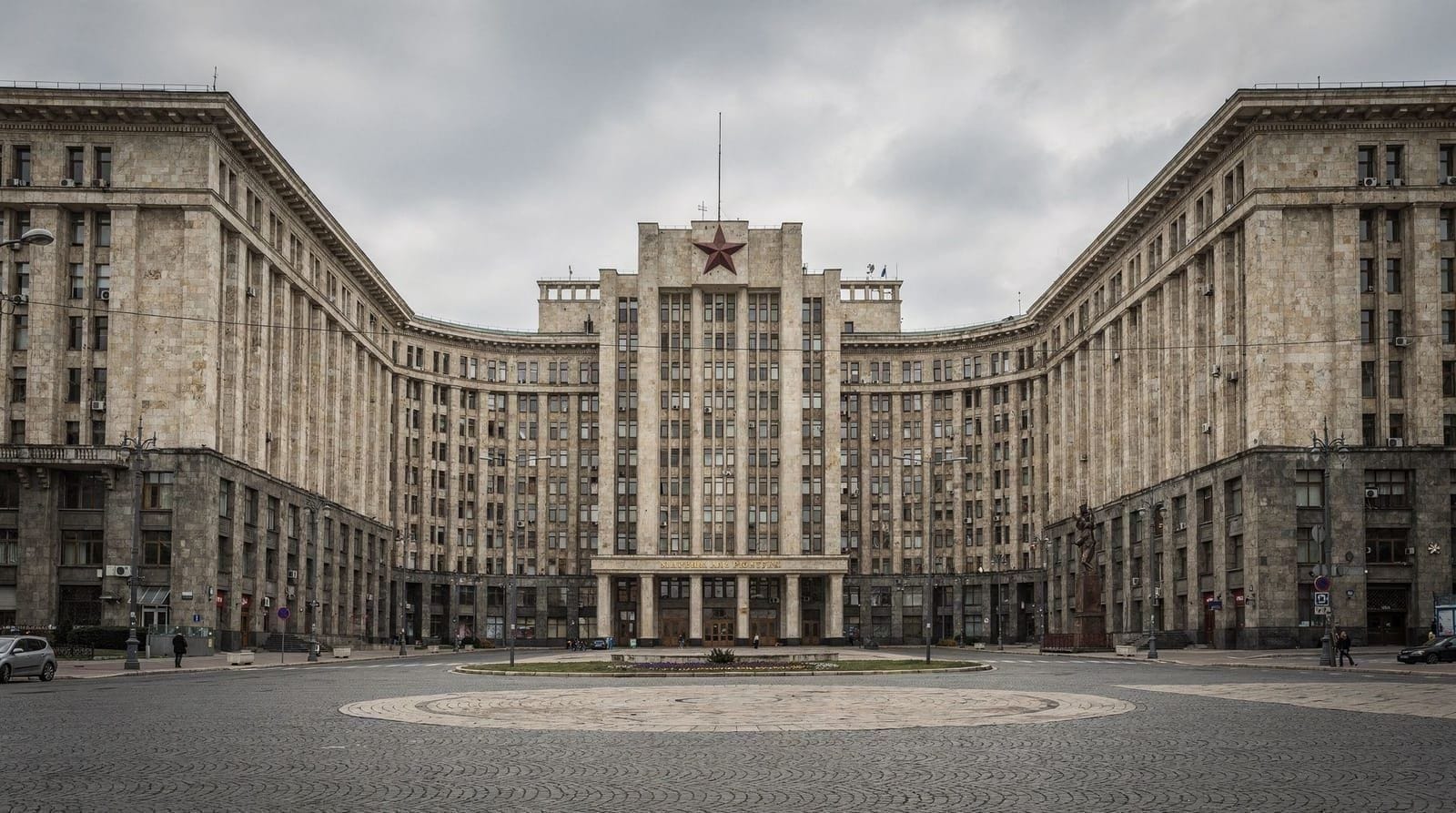
The most visible legacy of communist-era planning in Sofia is the Largo — three large buildings arranged around a ceremonial space near Sveta Nedelya Square. The complex was designed in the late 1940s and early 1950s in a Soviet neoclassical style sometimes called “Stalin baroque”: heavy, symmetrical, decorated with socialist ornament, built to project state power through scale.
The central building of the three was the former Communist Party headquarters. The red star that sat on its roof was removed in August 1990 — one of the symbolic acts of the transition period. The building now houses the Council of Ministers and the Presidency. You can walk through the arcade at street level, which passes through the underbelly of the complex and connects different parts of the center. This is a daily thoroughfare for Sofia residents, and most people walk through it without pausing.
Look up at the decorations on the facades: the motifs shift between national symbols (Bulgarian lions, wheat sheaves) and more generic Soviet imagery. This layering — Bulgarian nationalism channeled through a Soviet aesthetic framework — is characteristic of communist-era Bulgarian architecture generally.
Beneath the Largo, excavations during construction in the 1950s exposed the same Roman Serdica that sits under the metro station. The communist planners were aware of this; they documented it and built over it. Some of those finds are now in the Archaeological Museum, a few hundred meters away in a former mosque. For context on the full Roman layer beneath the city, see the Serdica Roman ruins guide.
The National Palace of Culture (NDK)
The NDK — Natsionalen Dvorets na Kulturata — was built in 1981 for the 1300th anniversary of the Bulgarian state, a major symbolic moment for the Zhivkov government. It is the largest congress center in Southeast Europe: 123,000 square meters of floor area, 16 halls, and a main conference hall that holds 3,700 people.
The building is a piece of late-socialist architecture that reflects a different moment than the Largo. By 1981, socialist modernism had replaced the earlier Stalinist classicism. The NDK is vast and angular, clad in concrete and glass, with a monumental plaza in front. It still functions as a congress and cultural venue — concerts, film festivals, conferences.
The plaza in front of the NDK has a large central fountain and, further along the park, the Monument of the Founders of the Bulgarian State. This monument — a complex of abstract forms and bas-reliefs — commemorates medieval Bulgarian history rather than communist ideology specifically, which reflects how the Zhivkov government positioned Bulgarian nationalism as continuous through the communist period.
The NDK and its park are covered in the broader communist Sofia tour guide.
The Monument to the Soviet Army
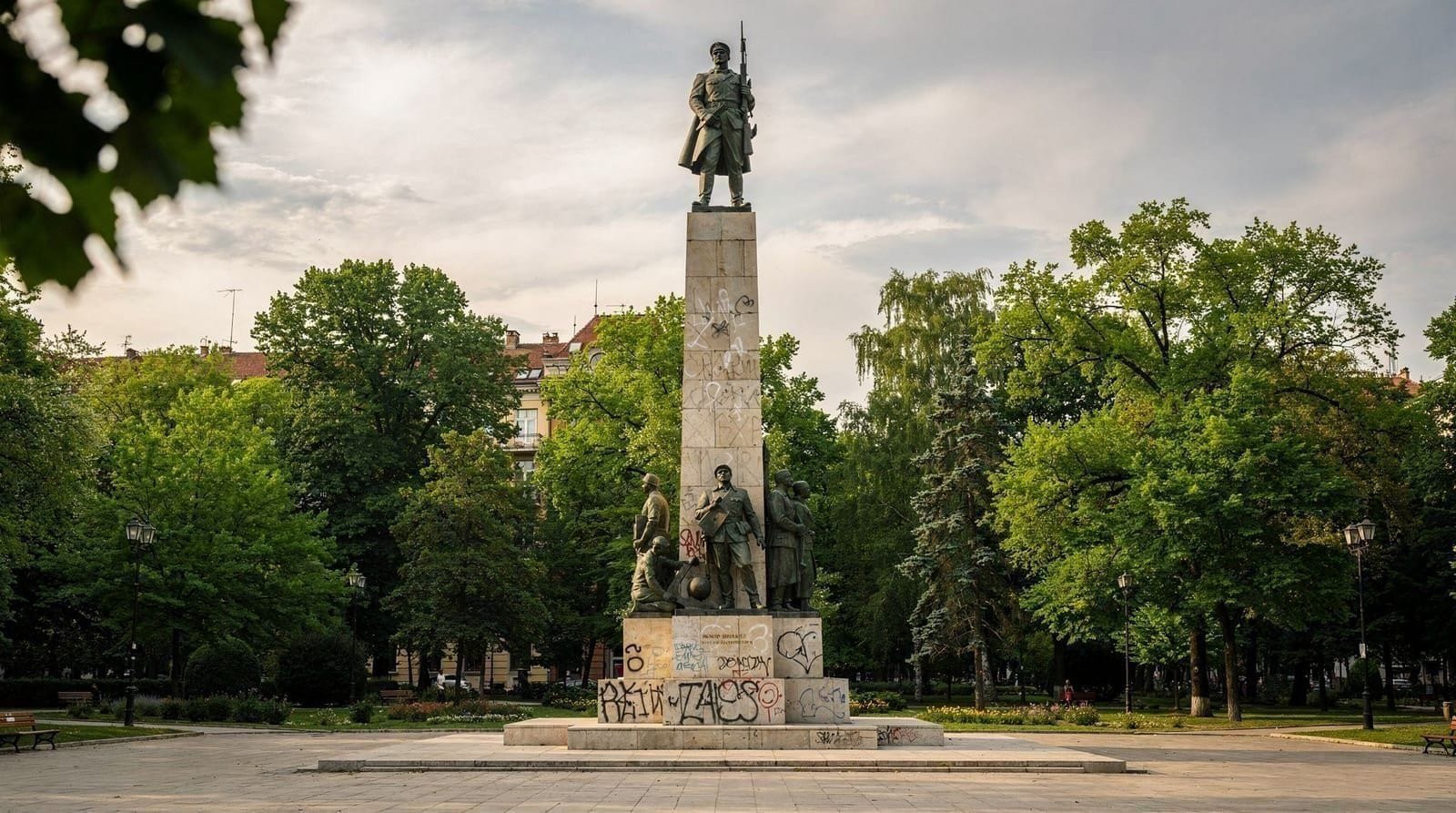
In the park behind the Cavalry Monument, about 15 minutes’ walk from the NDK, stands the Monument to the Soviet Army — a large ensemble of bronze figures on a tall stone pedestal, erected in 1954. It commemorates Soviet soldiers who died fighting in Bulgaria during the Second World War.
The monument has been repainted multiple times by activists — most famously in 2011, when it was painted to depict Soviet soldiers as American superhero characters. That repaint was covered internationally. The monument has since been repainted in its original bronze color, repainted again in other ways, and has been a recurring site of protest and counter-protest.
The debate around the monument is not simple. For some Bulgarians, it represents occupation and the imposition of a communist government. For others — particularly older Bulgarians and the organized left — it represents genuine Soviet sacrifice and Bulgarian-Russian historical ties. The Bulgarian government has discussed relocation; nothing has been decided as of 2026.
The park around the monument is pleasant and used by locals. The monument itself is large and worth seeing, both for its scale and for understanding the ongoing politics around Soviet-era commemoration in Eastern Europe.
The full context for this and other monuments is in the socialist monuments of Sofia guide.
Buzludzha: the monument 220 km away
Buzludzha is not in Sofia, but it appears in almost every discussion of Bulgarian communist architecture and deserves a mention here. The monument — a flying saucer-shaped structure at 1,441 meters altitude in the Balkan Mountains — was built in 1981 as the meeting hall of the Bulgarian Communist Party. It is one of the most extraordinary pieces of socialist architecture in Europe.
Since 1989, Buzludzha has been abandoned and has deteriorated significantly. The interior murals are visible through broken windows and gaps in the walls, but the building has been closed to the public for safety reasons for most of the period since the transition. Access status changes year to year; as of 2026, the interior remains officially closed.
Getting to Buzludzha without a car requires planning. It sits between Kazanlak and Shipka, about 220 km from Sofia — a long day trip. If you are traveling through the Kazanlak rose valley region, the Buzludzha monument can be added to a route that also includes Shipka Pass and the valley itself.
Museum of Socialist Art
The Museum of Socialist Art opened in 2011 and is the most focused collection of communist-era Bulgarian art in the country. It is in the Iztok neighborhood, a short taxi ride from the center.
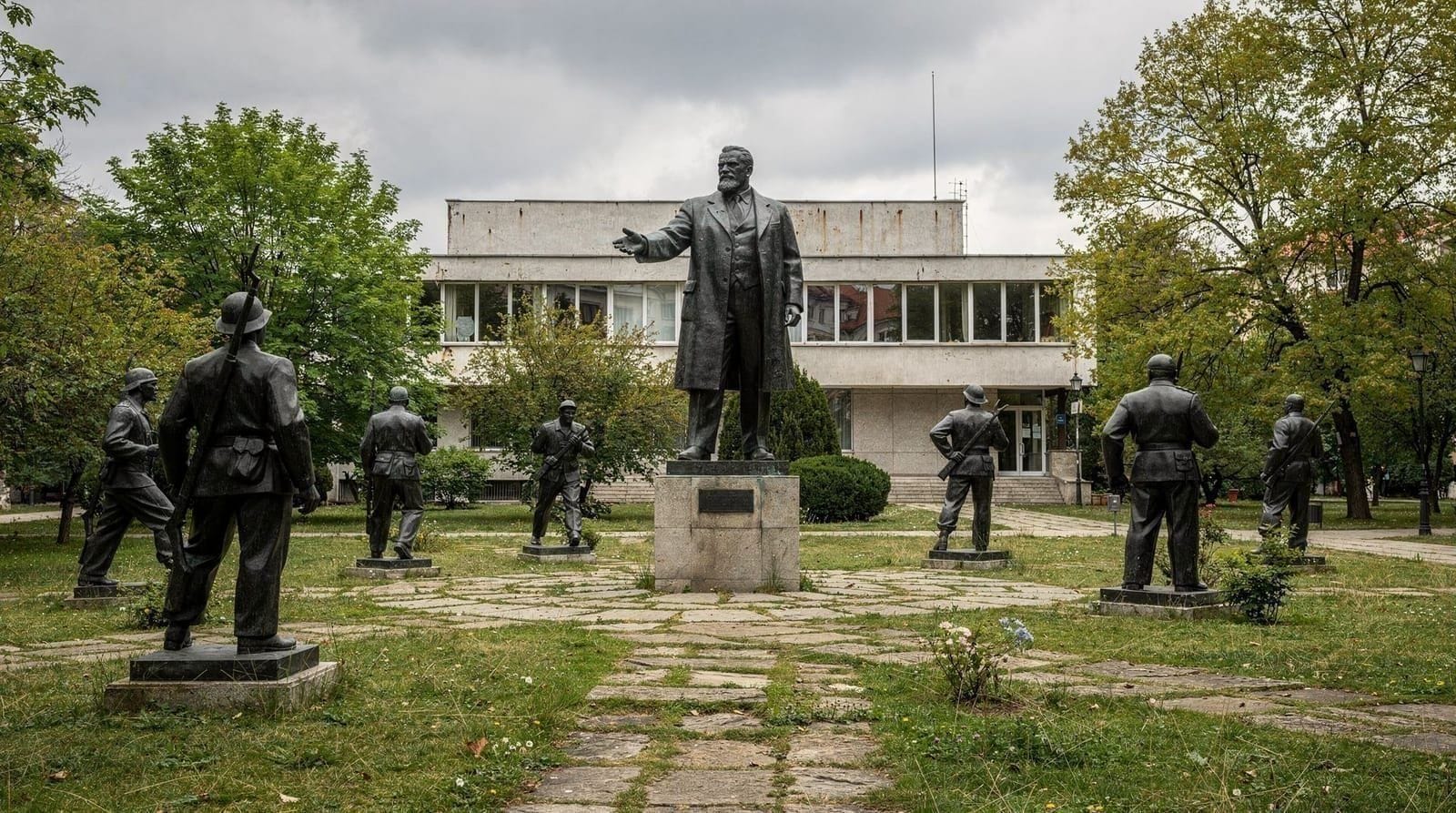
The outdoor section is the most striking part: roughly 35 large-scale sculptures in a garden, including statues of Georgi Dimitrov (the first communist leader of Bulgaria, whose mausoleum in central Sofia was demolished in 1999), Lenin, and various thematic works from the socialist-realist tradition. These were removed from public spaces throughout the country after 1989 and gathered here rather than destroyed.
The indoor galleries hold paintings, posters, and decorative objects from the same period. The socialist-realist aesthetic — heroic workers, productive landscapes, political leaders as visionary figures — is presented with enough historical framing that the collection functions as documentation rather than glorification.
Admission is around €3. The Museum of Socialist Art guide has hours and the most accessible route to get there.
Residential architecture: the panel blocks
The monumental communist-era buildings in the center tell one part of the story. The other part is in the residential districts on the edges of Sofia — Liulin, Mladost, Lyubotenets — where hundreds of thousands of people live in prefabricated concrete apartment blocks (panelki) built rapidly from the 1960s through the 1980s to house a quickly urbanizing population.
Liulin, on the western edge of Sofia, is the largest of these districts. The scale is striking if you are used to western European residential architecture: identical towers repeated across a flat landscape, with small commercial units at ground level and an informal urban life that developed around the buildings rather than being planned into them.
Visiting one of these districts is straightforward on the metro (Line 1 reaches Liulin). There is nothing to visit in the conventional tourist sense — it is a neighborhood where people live. But seeing it gives essential context for understanding what communist-era urbanism meant at scale, beyond the showpiece buildings in the center.
What to see independently vs with a guide
Most of the communist-era sites are accessible without a guide. The Largo, the NDK, the Monument to the Soviet Army, the Museum of Socialist Art, and the panel districts all work as self-directed visits. The communist Sofia tour guide provides walking routes and historical context that you can use independently.
A guided tour adds value primarily for the interpretive layer — particularly the stories of individuals, the details of daily life under communist rule, and the debates that continue in Bulgarian society about how to remember this period. A good guide will tell you about the apartments above the Largo where party officials lived, or about the specific political crises that shaped particular monuments.
Two options for guided coverage of this material:
Sofia Communist Walking Tour Sofia Communist History Jeep TourThe jeep tour covers a wider geographic range in less time, which is useful if you want to see the residential districts and more peripheral sites without a full day of walking. The walking tour goes deeper into the center’s architecture and is better for understanding the Largo and NDK in detail.
The Boyana Government Residence
The Boyana residence — a government complex at the foot of Vitosha used by Bulgarian state leaders since the communist period — is not open to the public, but it is adjacent to Boyana Church, which is one of the most important medieval sites in Bulgaria. If you are visiting the church (which you should), the residence is visible from the road and the contrast between the medieval church and the communist-era government complex is historically legible.
The transition and what happened after 1989
The physical changes to Sofia after 1989 were selective. The Dimitrov Mausoleum — a prominent structure near the Largo that held the embalmed body of Bulgaria’s first communist leader — was demolished in 1999 after several failed attempts (the building proved unexpectedly difficult to bring down). The red star came off the Party HQ in 1990. Street names were changed throughout the city.
But many buildings remained, including all the major structures described above. The NDK still functions. The Monument to the Soviet Army still stands. The panel districts remain home to hundreds of thousands of people. The communist period left a physical mark that Sofia has integrated rather than erased, and the ongoing debates about monuments like the Soviet Army memorial reflect a society still working out what relationship it wants to have with that history.
For a broader view of Bulgaria’s historical layers — from Thracian through Byzantine and Ottoman to communist and post-communist — the Thracian heritage guide and the Bulgarian revival architecture guide provide context on the longer arc.
The Sofia travel guide covers how to structure a visit to Sofia that takes in this history alongside the city’s other layers.
Photography and etiquette at contested sites
Photography is generally unrestricted at all the sites in this guide — the Largo arcade, the NDK plaza, the Monument to the Soviet Army, and the Museum of Socialist Art sculpture garden are all public spaces or a paid museum that permits photos. The one site where discretion matters is the Monument to the Soviet Army itself: it remains an active site of protest and counter-protest, and treating it purely as a photo backdrop without acknowledging the ongoing political weight it carries reads as tone-deaf to Bulgarians who have strong feelings on either side. A respectful approach — observing rather than posing dramatically — is appropriate.
At the Museum of Socialist Art, the framing is explicitly historical rather than celebratory, and the museum itself makes this clear through the exhibition text. Visitors sometimes arrive expecting either nostalgia or condemnation and are better served approaching it as documentation of a specific historical period, consistent with how the museum presents it.
Combining communist Sofia with other historical layers
Sofia’s communist-era sites sit directly on top of, or beside, much older history, which makes a single day genuinely multi-period if you plan it that way. The Largo sits above the Roman Serdica ruins, visible in the same underpass as the metro station excavations covered in the Serdica Roman ruins guide. Alexander Nevsky Cathedral, completed in 1912, predates the communist period but sits within easy walking distance of the Largo, making a morning that spans Roman, pre-communist Bulgarian, and Soviet-era Sofia entirely plausible on foot. For a fuller day that adds the Revival period as well, see the Bulgarian revival trail guide for how the 19th-century villages fit into the broader arc.
Sofia Soviet historical jeep tourFrequently asked questions about communist Sofia
What are the best communist-era sites to visit in Sofia without a guide?
The Largo (former Communist Party headquarters complex) and the NDK plaza are the most accessible and can be explored on foot from the city center. The Museum of Socialist Art is a short taxi ride away and the most focused collection of communist-era objects in the country. The Monument to the Soviet Army is in a nearby park. All of these work without a guide using the communist Sofia tour guide for context.
Is Buzludzha worth visiting as a day trip from Sofia?
It depends on your interest level and transport. Buzludzha is 220 km from Sofia and requires either a rental car or a tour that specifically includes it. The building is extraordinary — nothing else in Bulgaria looks like it — but the interior has been closed for years. If you are traveling through the Kazanlak rose valley area, it makes sense to include it. As a standalone day trip from Sofia, it is a long drive for an exterior-only visit.
What is the Museum of Socialist Art and how long does it take to visit?
The Museum of Socialist Art holds around 35 outdoor sculptures and indoor galleries of paintings, posters, and objects from the 1944-1989 period. A thorough visit takes about 90 minutes. The outdoor sculpture garden is the main draw. Admission is around €3. The museum guide covers the route there and what to prioritize inside.
Were any communist monuments removed after 1989?
Yes. The Dimitrov Mausoleum near the center was demolished in 1999. Statues of Lenin and other figures were removed from public squares. The red star was removed from the Communist Party headquarters in 1990. However, large structures like the NDK, the Largo buildings, and the Monument to the Soviet Army remained, and debates about whether and how to address them continue.
Can I visit the communist-era residential districts?
Yes — they are ordinary neighborhoods accessible by metro. Liulin, on Line 1, is the largest. There is nothing to enter in a tourist sense; it is simply worth seeing the scale of prefabricated housing that the communist period produced. A 30-minute metro ride out and back gives you a sense of the district without requiring a guided tour.
How long should I budget to see communist-era Sofia?
A focused half-day covers the central sites: the Largo, the NDK, the Monument to the Soviet Army, and the immediate surroundings. Adding the Museum of Socialist Art turns it into a full day. Adding Buzludzha requires a separate day trip. The sofia-in-3-days itinerary integrates the communist circuit with other parts of the city.
What is the current political status of the Soviet Army monument?
As of 2026, the monument remains in place. There have been repeated discussions in the Bulgarian parliament about relocation to the Museum of Socialist Art or another site, but no final decision has been made. The monument continues to be a site of occasional protest and counter-protest. The socialist monuments guide covers the debate in detail.
Can I combine communist Sofia with the Serdica Roman ruins in one visit?
Yes, and it is one of the more efficient half-days in the city. The Largo sits directly above the excavated Roman Serdica visible through glass in the Serdika metro underpass, so the Roman and communist layers can be seen within a five-minute walk of each other. Add Alexander Nevsky Cathedral a short walk further and you cover roughly 1,900 years of Sofia’s history in a single unhurried morning.