Bulgarian National Revival architecture: a complete guide
Koprivshtitsa Full-Day Tour - Back to the 19th Century
What is Bulgarian National Revival architecture?
An 18th–19th century style developed as Bulgarian identity reasserted itself under late Ottoman rule. Distinctive features include colorful facades, projecting upper floors (chardaks), ornately carved wooden ceilings (tavanitsi), and enclosed inner courtyards. Best seen in Koprivshtitsa (110 km from Sofia) and Plovdiv's old town.
The Bulgarian National Revival produced one of the most recognizable vernacular architecture styles in southeastern Europe — and most visitors to Bulgaria walk right past it without understanding what they are seeing. The projecting balconies, the exuberant carved ceilings, the bold facades in ochre and terracotta: these are not decorative whims. They are the physical expression of a civilization reasserting itself after centuries of deliberate suppression.
This guide covers the style itself, where to see the best surviving examples, and how to plan your visits from Sofia.
| Where | Koprivshtitsa (110km) and Plovdiv old town (150km) from Sofia |
| Cost | Koprivshtitsa combined house-museum ticket around €5 |
| Time needed | Full day per destination |
| Getting there | Direct bus (Koprivshtitsa) or express train (Plovdiv) from Sofia |
| Best time | Shoulder season — May–June and September–October |
The historical context: what the Revival actually was
The term “Bulgarian National Revival” (Българско национално възраждане, roughly 18th to 19th century) refers to a period of cultural, educational, and ultimately political awakening among Bulgarians living under Ottoman rule. For nearly five centuries — from 1396 to 1878 — Bulgarian was not a language of administration, Bulgarian Orthodox churches operated under Greek ecclesiastical authority, and Bulgarian intellectual life had to fight for existence.
The Revival was the response. It began with education: the first secular Bulgarian school opened in 1835. It continued with literature, the standardization of the Bulgarian language, and eventually the April Uprising of 1876 — crushed violently, but the international outrage it provoked led directly to the Russo-Turkish War and Liberation in 1878.
Architecture was part of this reassertion from the beginning. As Bulgarian merchants, craftsmen, and guilds accumulated wealth through trade with both the Ottoman interior and Western Europe, they built houses that made a statement. The ornate, colorful, multi-story town house was simultaneously practical (housing extended families), expressive of new wealth, and a declaration of cultural identity.
Understanding this context transforms what you see. The carved wooden ceiling in a Koprivshtitsa house is not merely craftsmanship — it is evidence of a community investing its prosperity in permanence, beauty, and Bulgarian identity at a moment when all three were contested.
What defines the style
External features
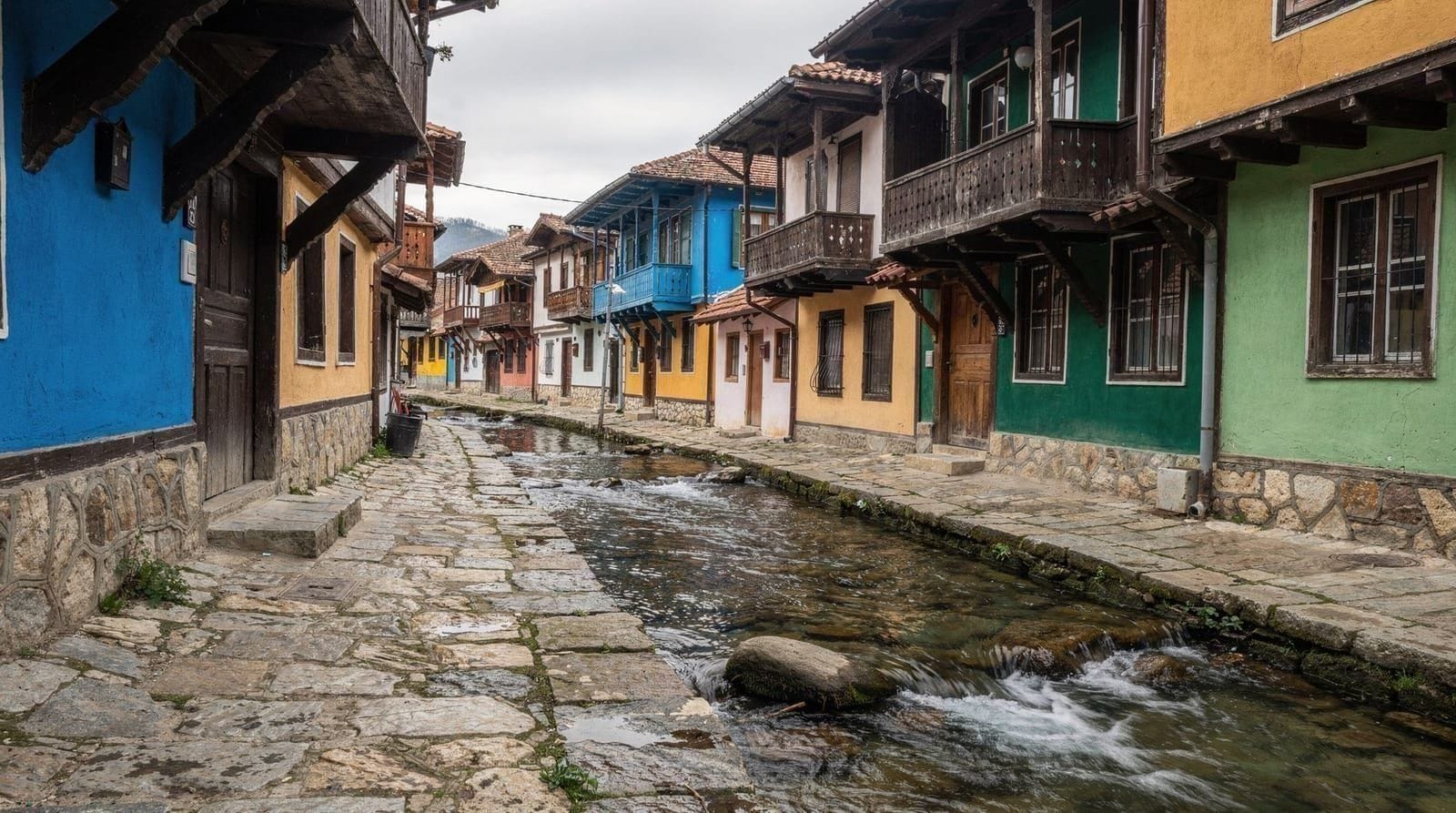
The most immediately visible element is the chardak: a projecting upper floor or enclosed balcony that extends over the street, supported on decorative wooden brackets. In the best examples, the chardak wraps around two or three sides of the house, creating covered outdoor space while also dramatically enlarging the upper floor relative to the footprint.
Facades are typically whitewashed or plastered in warm colors — ochre, terracotta, occasionally blue or green — with contrasting window surrounds and decorative painted borders. Windows multiply as prosperity increases: a modest family might have a house with small, high windows; a wealthy merchant’s home might have rows of tall windows with intricate wooden frames.
Roofs are steeply pitched with wide overhanging eaves, functional in heavy snow and visually emphatic.
Interior features
The interior is where Revival architecture becomes genuinely extraordinary. The tavanitsa — the carved wooden ceiling — can range from simple geometric patterns to baroque compositions of interlocking rosettes, star forms, and floral motifs, occasionally painted in blues, greens, and gold. The most ambitious examples, like those in Koprivshtitsa’s Oslekov House or Plovdiv’s Hindlian House, are virtuosic demonstrations of woodcarving that took years to complete.
Rooms radiate from a central sofa (hall), which often has built-in seating along the walls. Storage is integrated into the architecture through built-in wardrobes, niches, and under-floor cellars. The overall organization prioritizes family gathering and reception of guests over private compartmentalization — a different domestic logic from Western European contemporaries.
Ground floors were frequently used for animals or storage; the family lived above, elevated and overlooking an enclosed courtyard.
The courtyard house
The typical Revival house is organized around a walled inner courtyard (in Bulgarian, ограда or двор). This provides privacy and security, organizes access from the street, and contains a well and often a garden. The street-facing exterior is relatively modest; the ornamentation faces inward. In towns like Koprivshtitsa and Plovdiv’s old town, strolling the alleys between high stone walls gives you glimpses through gates into these private interior worlds.
Koprivshtitsa: the unmissable destination
If you visit only one place to understand Revival architecture, make it Koprivshtitsa. Situated in the Sredna Gora mountain range 110 km east of Sofia, it is the best-preserved Revival-period town in Bulgaria, with over 350 surviving 18th and 19th century houses.
What makes Koprivshtitsa exceptional is not just the density of surviving architecture but the coherence of the urban fabric. The town was never extensively rebuilt in the 20th century — it was too small, too remote, and the communist government eventually recognized its preservation value. Walking the cobbled streets between high walled gardens, crossing the red bridge over the Topolnitsa River, you are moving through a landscape that has changed remarkably little in 150 years.
Six house-museums are open to visitors, each illustrating a different aspect of 19th-century Bulgarian life and architecture. The Oslekov House is the most architecturally impressive, with its exceptional tavanitsa and the largest façade in the town. The Kableshkov House commemorates the leader of the April Uprising — Koprivshtitsa was the town where the signal was fired on April 20, 1876. The Lyutov House shows an exceptionally lavish interior with European-influenced furnishings alongside traditional woodwork.
A combined ticket (around €5) covers all six house-museums and is the right approach — each takes 20–30 minutes and they complement each other rather than repeating.
GetYourGuideKoprivshtitsa Full-Day Tour - Back to the 19th CenturyCheck availability → GetYourGuidePlovdiv: Old Town Self-Guided Audio TourCheck availability →Practical logistics: Koprivshtitsa is 110 km from Sofia, roughly 1.5 to 2 hours by car. The most straightforward option is a guided day trip from Sofia, which handles transport and typically includes a guide who can explain the political and social context — important for making sense of what you see. If driving independently, park near the information center and walk; the town is small enough to cover on foot in half a day, with the other half for lunch and the house-museums. Direct buses run from Sofia Central Bus Station, but service is infrequent (2–3 daily), so check the schedule before committing.
Koprivshtitsa is also directly relevant to the April Uprising: the town’s role in the 1876 rebellion gives it a layer of historical weight beyond the architecture. The combination of architectural beauty and historical significance is rare.
Plovdiv: Revival architecture in an urban setting
Plovdiv’s old town (Стария Град) is the other major destination for Revival architecture, and it offers a fundamentally different experience from Koprivshtitsa. Where Koprivshtitsa is a small town frozen in time, Plovdiv is a thriving modern city of 350,000 people — one of the oldest continuously inhabited cities in Europe, and European Capital of Culture 2019.
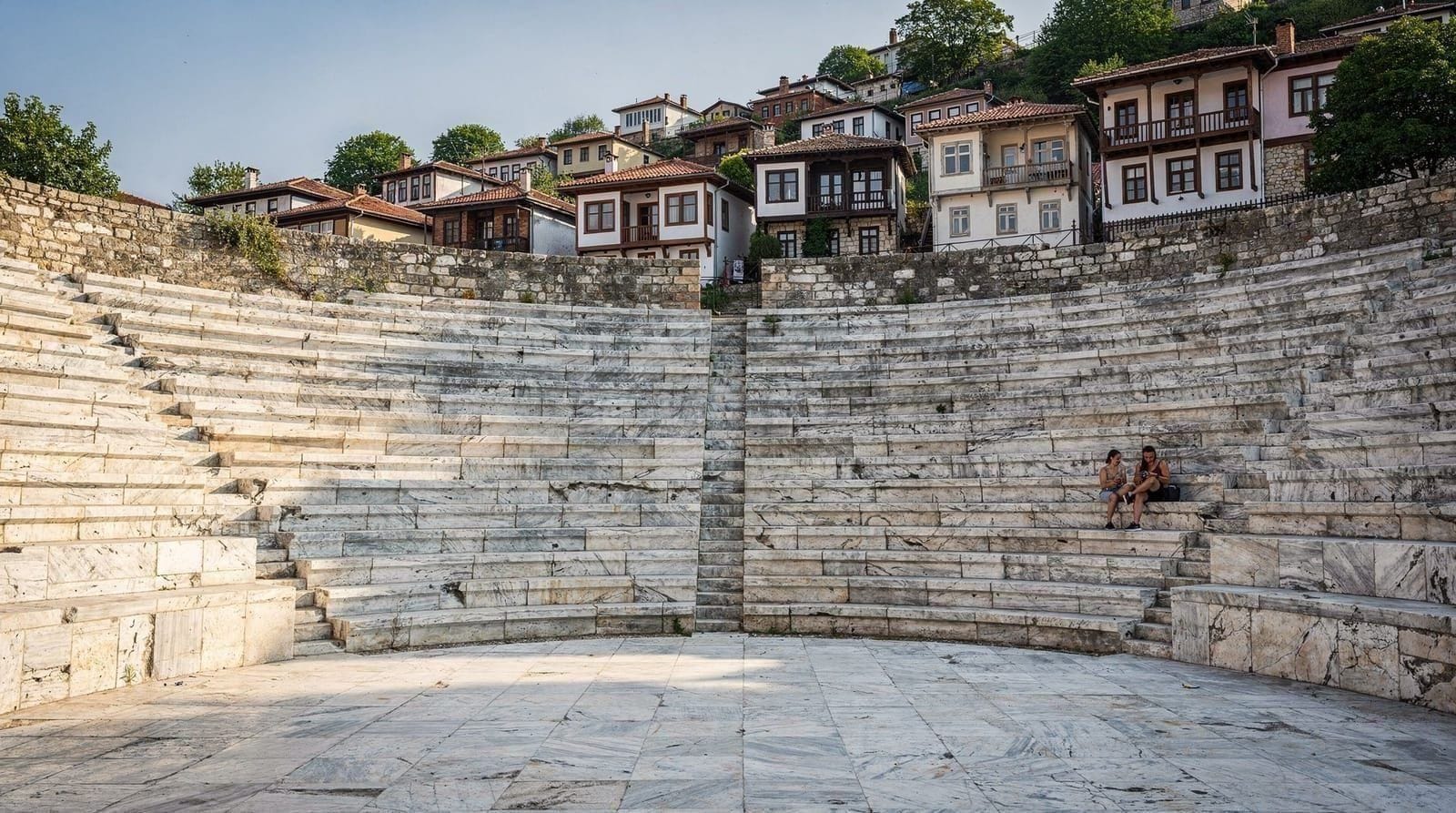
The old town occupies three of Plovdiv’s famous hills (the ancient city had seven) and contains dozens of Revival-period mansions interspersed with Roman ruins, medieval churches, and contemporary galleries. The combination is disorienting in the best way: you can stand next to a 2nd-century Roman wall and look up at a 19th-century bay window projecting over a cobbled lane.
The key houses to visit are the Hindlian House (exceptional carved ceilings, European decorative influences, one of the finest interiors in Bulgaria), the Balabanov House (frequent art exhibitions in a beautifully restored Revival interior), and the Kuyumdzhioglu House (now the Regional Ethnographic Museum, with strong textile and craft collections alongside the architecture). The Georgiadi House and several others round out the collection.
Beyond the individual houses, Plovdiv’s old town rewards aimless walking. The lanes between the hill houses are steep, cobbled, and largely car-free. The views over the modern city from the top of the hills shift constantly as you move. The Kapana creative district sits at the foot of the old town and provides a natural contrast: it is Plovdiv’s contemporary arts and café quarter, housed in older buildings repurposed rather than preserved.
Plovdiv is a natural day trip from Sofia, 150 km southeast, roughly 2 hours by car or a direct express train. Most visitors combine the old town (3–4 hours) with the Roman amphitheater and Kapana (another 2 hours) into a full day.
GetYourGuideFrom Sofia: Small Group Guided Tour of Plovdiv's HighlightsCheck availability →Koprivshtitsa vs Plovdiv vs Tryavna: which to choose
| Destination | Distance from Sofia | Character | Time needed |
|---|---|---|---|
| Koprivshtitsa | 110km, 1.5–2 hrs | Small, frozen-in-time town, most concentrated | Full day |
| Plovdiv old town | 150km, 2 hrs | Revival houses mixed with Roman ruins, lively city | Full day |
| Tryavna | 4 hrs | Woodcarving tradition, less visited, quieter | Full day (combine with Veliko Tarnovo) |
If you only have one day for Revival architecture, choose Koprivshtitsa or Plovdiv. Tryavna makes sense only if you’re already heading north toward Veliko Tarnovo.
Tryavna and the Arbanasi area
Tryavna, 4 hours from Sofia in the Balkan Mountains above Gabrovo, is less visited but architecturally cohesive. The town is historically associated with the Tryavna school of woodcarving and icon painting — the craftsmen who decorated many of the Revival-period churches and houses across northern Bulgaria. The Clock Tower Square (Часовниковата кула) is the center of the old town, and the surrounding lanes contain well-preserved 18th and 19th century houses, several open as small museums.
Nearby Arbanasi (outside Veliko Tarnovo, not a separate day trip from Sofia) is a fortified village of chunky stone houses from the 16th–18th century — a different vernacular tradition but often grouped with Revival tourism.
Given the distance from Sofia (4+ hours each way), Tryavna works best if you are already heading north toward Veliko Tarnovo, rather than as a standalone day trip.
The Etara open-air museum
The Ethnographic Open-Air Museum at Etara, 8 km from Gabrovo, recreates a mid-19th century craftsmen’s quarter from the Revival period. It is not a reconstruction of a specific place but an assemblageof relocated and reconstructed buildings from across the region, organized around a working watermill. The key distinction: the artisan workshops are active. You can watch a coppersmith, a potter, a weaver, and a woodcarver working with period techniques, and buy their products.
For architecture specifically, Etara is less instructive than Koprivshtitsa or Plovdiv because the context is constructed rather than organic. But as a living demonstration of how the built environment and craft traditions of the Revival period functioned together, it is the best place in Bulgaria. Children respond particularly well to it.
Etara is typically combined with Tryavna or Arbanasi as a 2-day northern Bulgaria loop, rather than a standalone day trip from Sofia.
Revival architecture in Sofia
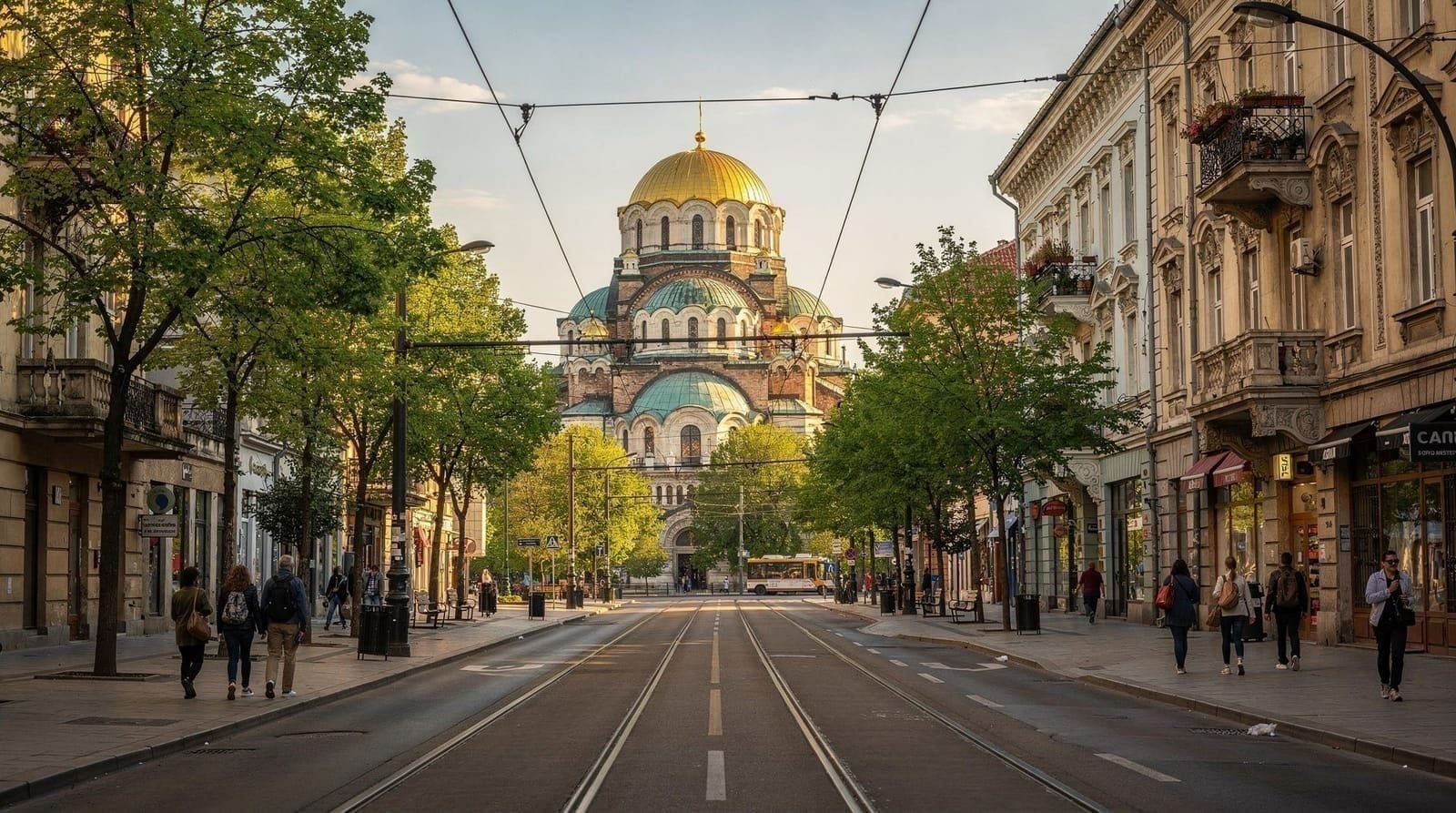
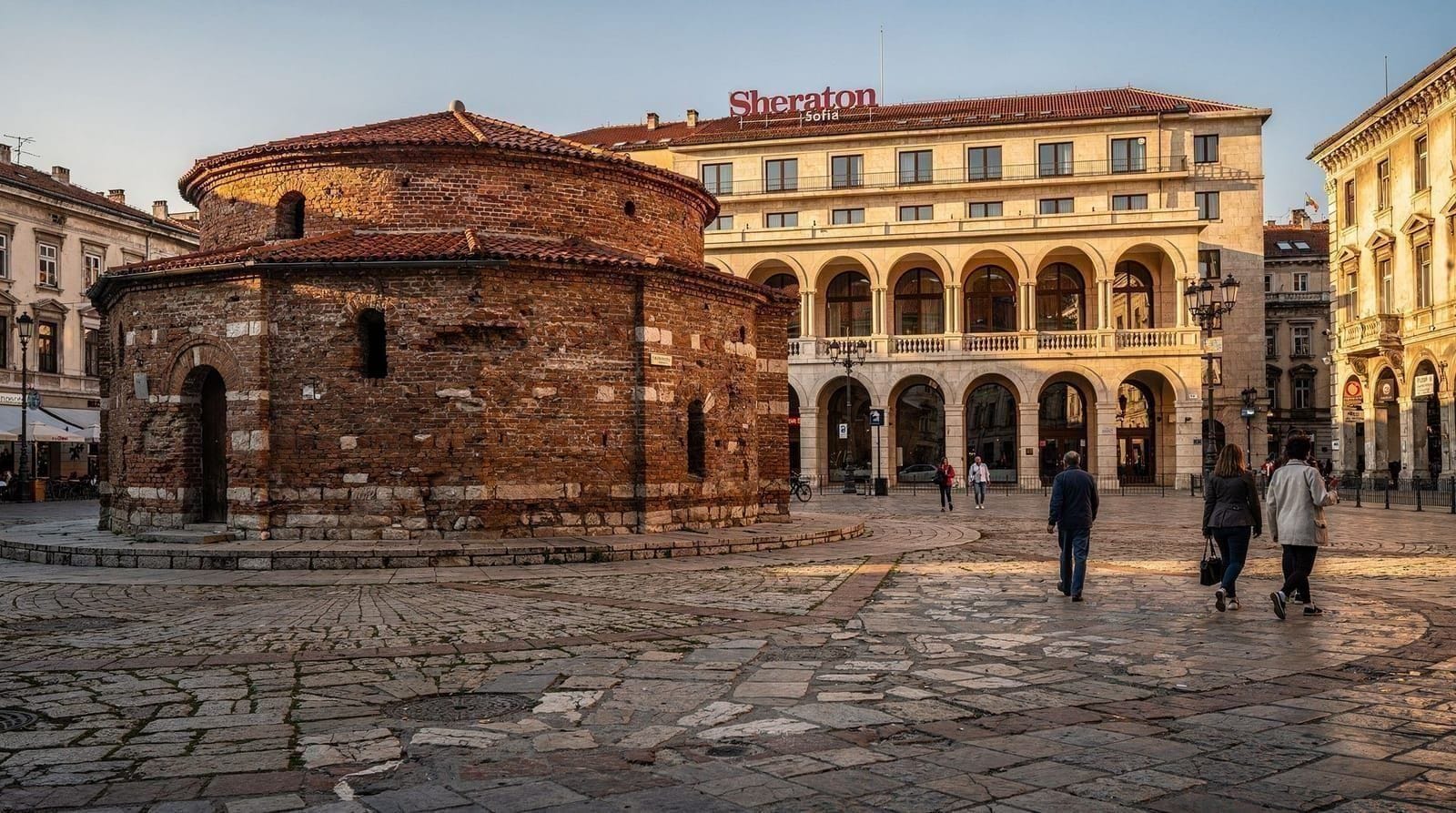
Sofia has limited Revival-period architecture, and it is worth being honest about why. The Ottoman-era town was largely dismantled after Liberation in 1878, when Sofia became the capital of the new Bulgarian state and undertook ambitious Europeanization: broad boulevards, neo-baroque public buildings, and the demolition of much that came before. Later communist-era reconstruction removed further layers.
What survives in Sofia is scattered: a few old houses in the Boyana village area at the foot of Vitosha, some fragments near the old mosque that now houses the National Archaeological Museum, and the occasional preserved building that escaped both waves of demolition. The Sofia old town walk covers these fragments in context, but Sofia is genuinely not the destination for Revival architecture.
If you have only one day for this subject, Koprivshtitsa is the answer. If you have two days, add Plovdiv. Sofia’s architecture is interesting for different reasons — Roman, Soviet, and Orthodox — not Revival.
The craftsmen behind the style
Revival architecture was produced by distinct schools of craftsmen, not anonymous builders. The Tryavna school of woodcarving supplied the decorative elements — carved ceilings, ornate niches, balustrade railings — for houses across northern Bulgaria. The Samokov and Bansko schools of icon painting decorated the churches that anchored Revival-era town life. The Bratsigovo and Koprivshtitsa builders developed the structural and compositional vocabulary that spread from the Sredna Gora region outward.
These craftsmen were mobile: a master carver from Tryavna might spend years working on a commission in Plovdiv or Koprivshtitsa, taking apprentices with him. The style that looks homogenous across a wide geographic area was transmitted by these itinerant craftsmen rather than through any architectural theory or formal instruction.
Understanding this helps explain a feature of Revival architecture that sometimes puzzles visitors: the style is remarkably consistent across very different towns and regions, while the quality varies enormously depending on the wealth of the patron. The same vocabulary of chardak, tavanitsa, and courtyard appears in a wealthy merchant’s house in Plovdiv and in a modestly successful craftsman’s house in a village 100 km away — but the execution differs by orders of magnitude.
Revival churches alongside Revival houses
Revival-period architecture was not confined to domestic buildings. The same period produced a wave of church construction across Bulgaria, as Ottoman restrictions on Christian building were gradually relaxed in the 19th century. The Revival churches share characteristics with the domestic architecture: elaborate carved wooden iconostases (the screen separating nave from sanctuary), painted ceilings, and exteriors in warm plaster colors.
The Preobrazhenski Monastery near Veliko Tarnovo, the Troyan Monastery in the Balkan Mountains, and the churches of Koprivshtitsa itself are among the best examples. In Sofia, the churches guide covers the religious architecture of the capital — which includes some Revival-period work alongside older Byzantine foundations and more recent Orthodox construction.
Planning your visits
The most time-efficient approach for covering both key destinations is to visit Koprivshtitsa on one day and Plovdiv on another, both as day trips from Sofia. Both are manageable in a single day if you leave reasonably early (by 9am for Koprivshtitsa, by 8:30am for Plovdiv to make the most of the day).
If you are combining both in a single longer trip, some tour operators offer itineraries that stop at Koprivshtitsa on the way to or from Plovdiv, which is geographically logical since both lie roughly to the east/southeast of Sofia.
See the day trips from Sofia guide for comparative logistics across all major destinations. The Sofia in 3 days and Bulgaria highlights itineraries suggest how to integrate Revival architecture into a broader visit.
The best time to visit is shoulder season: May–June and September–October. Koprivshtitsa in particular can feel overrun with school groups in late spring (April–May) and with summer tourists in July–August. The town is at its best in golden autumn light.
Budget travelers will find both Koprivshtitsa and Plovdiv excellent value: house-museum tickets are low-cost, good local food is inexpensive, and the pedestrian old town areas require nothing beyond shoe leather. See the Sofia on a budget guide for broader cost context on a Bulgaria trip. If you plan to stay overnight in Plovdiv rather than returning to Sofia the same day, the long-weekend itinerary shows how a four-day trip can integrate the old town, Koprivshtitsa, and a night in Plovdiv into a coherent loop.
What you will take away
Bulgarian National Revival architecture is not a minor curiosity. It is the physical embodiment of one of the most consequential cultural movements in southeastern European history — a movement that produced a literary language, a national educational system, and ultimately a nation-state, within a single century. The houses in Koprivshtitsa and the mansions in Plovdiv’s old town are not merely beautiful old buildings. They are evidence of what a community did with its wealth and ambition at a moment when cultural survival was not guaranteed.
Seeing them in that context — understanding the carved ceilings as declarations rather than decoration — changes the experience completely.
For more on the political dimension of this period, the communist Sofia tour picks up the story from Liberation forward, tracing how the Bulgarian state shaped its capital through successive ideological regimes. The museum of socialist art and socialist monuments cover what came after. But the Revival is the beginning — the moment when Bulgarian visual culture became consciously, defiantly itself.
Frequently asked questions about Bulgarian National Revival architecture
How far is Koprivshtitsa from Sofia?
Approximately 110 km, about 1.5 to 2 hours by car. Direct buses run from Sofia Central Bus Station, taking around 2 hours. There are also slow regional trains, but the bus is easier.Can you visit Revival architecture in Sofia itself?
Sofia has limited examples — the city was heavily rebuilt after Liberation in 1878 and again in the communist period. A few historic houses survive in the Boyana area and near the old town, but Sofia is not the right place for Revival architecture. Go to Koprivshtitsa or Plovdiv.Is Koprivshtitsa a working town or a museum?
Both. Around 2,500 people live there, and the 350+ Revival-era houses are largely inhabited. Six of the most significant houses are open as house-museums. The town functions normally while also receiving tourists — it never feels like a theme park.What is a chardak?
A chardak (чардак) is the projecting covered balcony or upper-floor overhang typical of Revival-period houses. It extends the living space over the street, provides shade, and is the most immediately recognizable external feature of the style.Is the Etara open-air museum worth visiting?
Yes, especially if you have children or are interested in traditional crafts alongside architecture. It is a recreated 19th-century craftsmen's quarter near Gabrovo with working artisan workshops. It adds about 4 hours to a journey from Sofia and is usually combined with Tryavna or Arbanasi.Should I choose Koprivshtitsa or Plovdiv if I only have one day?
Koprivshtitsa if you want the purest, most concentrated Revival-architecture experience in a small, coherent town. Plovdiv if you want Revival houses alongside Roman ruins, a lively old town, and a full modern city to explore afterward. Both are roughly 1.5–2 hours from Sofia, so either works as a single-day trip.Do I need a guide to appreciate Revival architecture, or can I visit independently?
You can absolutely visit independently — both Koprivshtitsa and Plovdiv are walkable and well signposted, and the house-museums have English labelling. A guide adds the most value in Koprivshtitsa, where the political context (the April Uprising) and the family histories behind specific houses are not always obvious from the architecture alone.
Top experiences
Bookable activities with verified prices and instant confirmation on GetYourGuide.