Socialist monuments in Sofia: a complete guide
Sofia: Communist History Walking Tour
What are the main socialist monuments in Sofia?
The key sites are the Monument to the Soviet Army (still standing, repeatedly repainted by activists), the Largo ensemble of Stalinist government buildings, the National Palace of Culture (NDK, 1981), and the empty site where the Georgi Dimitrov Mausoleum stood until 1999. Buzludzha, the most dramatic monument, requires a separate day trip 250 km from Sofia.
Bulgaria’s transition from communism was fast in political terms — the party gave up its monopoly on power in 1989, multiparty elections followed in 1990 — but slow and uneven in cultural terms. Forty-five years of Soviet-aligned rule left behind a landscape of monuments, buildings, and public art that the post-communist state has never quite decided what to do with. Some were destroyed. Some were relocated. Some are still standing in their original positions, arguing silently with the democracy built around them.
Sofia is the place to understand this ambivalence. The monuments here are not in open-air museums or heritage parks. They are on the streets, in the parks, built into the fabric of a functioning city. Walking among them is less like visiting a historical site and more like watching a country think out loud.
| Where | Central Sofia (Soviet Army Monument, Largo, NDK); Buzludzha is 250km away |
| Cost | Free to view outdoors; NDK events and Museum of Socialist Art charge separate entry |
| Time needed | Half a day for the central sites; a full day if adding Buzludzha |
| Getting there | Central sites are walkable; Buzludzha needs a car or organised tour |
| Best time | Any season for central Sofia; Buzludzha’s mountain road can close in winter |
The Monument to the Soviet Army
In the garden south of Tsar Osvoboditel Boulevard, between the National Gallery and the Russian Orthodox church of St Nicholas, stands a monument erected in 1954 to commemorate the Soviet army’s entry into Bulgaria in September 1944. A tall central column, topped with a Soviet soldier in heroic pose, flanked by allegorical figures representing the Bulgarian people — the standard vocabulary of mid-century socialist realism.
For most of its life the monument was simply there: unremarked, uncontested, slowly absorbing pigeons and pollution. Then, in June 2011, everything changed.
Destructive Creation and the repaintings
The Bulgarian activist collective calling itself Destructive Creation climbed the monument one night and repainted the Soviet-era figures into American pop culture icons. The soldier became Superman. His companions became Santa Claus, Ronald McDonald, Captain America, The Joker, Batman, Wonder Woman. On the base, in place of the original Cyrillic inscription, the activists added: “В крак с времето” — “In step with the times.”
The photographs went global within hours. The intervention was understood immediately as a comment on the replacement of one set of cultural colonisations with another, and also as a refusal to treat Soviet memory as sacrosanct. The Sofia Municipality cleaned the monument. Destructive Creation repainted it. This cycle has continued, with variations: a Ukrainian flag colour scheme following the 2014 Maidan uprising, further pop-culture iterations, tributes to various causes.
The municipality’s repeated restoration has cost money and generated controversy of its own. Critics of the cleanups argue that a democratic state spending public funds to restore Soviet war memorials has confused its priorities. Supporters argue that a public monument cannot be treated as a canvas for any political message regardless of content. Neither argument has won.
When you visit, the monument may be in its cleaned state or in one of its repainted incarnations. Either way, the conversation the monument now carries — the accumulated weight of its repainting history — is more interesting than the original sculpture.
For a structured visit combining this monument with the other sites below, the self-guided communist walking tour routes past this garden as part of a 3–4 km circuit through central Sofia.
GetYourGuideSofia: Communist History Walking TourCheck availability → GetYourGuideNis City Tour: Full-Day Trip from SofiaCheck availability →The Georgi Dimitrov Mausoleum: what is no longer there
In the square between the Presidency and the National Theatre, off the main Largo ensemble, there is a stretch of open paving with benches and a small fountain. Visitors who have not read about it walk straight through without pausing.
From 1949 to 1999 this was the site of the Mausoleum of Georgi Dimitrov. Dimitrov was Bulgaria’s first communist leader, a figure of genuine historical significance: as head of the Communist International in Moscow during the 1930s, he famously defended himself against Nazi accusations of involvement in the 1933 Reichstag fire, turning a show trial into a demonstration of fascist legal incompetence that became internationally known. He became leader of Bulgaria after the Soviet-backed takeover in 1944 and held power until his death in Moscow in July 1949.
The circumstances of his death have never been fully explained. He died of liver disease, officially, but historians have long noted that his deteriorating health coincided with a period of tension with Stalin, and Soviet medical care of the era was not reliably benign to those who had fallen from favour.
His body was embalmed — a practice that had become a standard act of communist hagiography since Lenin — and returned to Sofia, where a white marble mausoleum was built in record time, opening in October 1949. For forty years it was among the most significant ritual sites in Bulgaria, the focus of official commemoration and compulsory school visits.
Three demolition attempts
After 1989, what to do with the mausoleum became a sustained political argument. The body was removed and given a civilian burial in 1990. The building remained. Various proposals — convert it to a museum, demolish it, leave it as a reminder — circulated for a decade without resolution.
On 26 August 1999, the decision to demolish was finally acted on. The first explosives brought down part of the structure but not all of it. The rubble was cleared, more explosives were set, and the second attempt also failed to fully bring down the remaining walls. The third attempt finally succeeded. The entire process took longer and cost more than expected, partly because the building had been constructed to last and partly because communist-era builders used exceptionally high-grade materials for prestige projects.
The site was cleared and paved. No memorial, no explanation, no marker has been placed. This blankness is its own political choice — one that continues to generate debate. Some argue that the square’s neutrality is an appropriate democratic statement. Others argue that leaving no explanation condemns future visitors to ignorance about what happened there and why.
The Largo: three buildings, one political vision
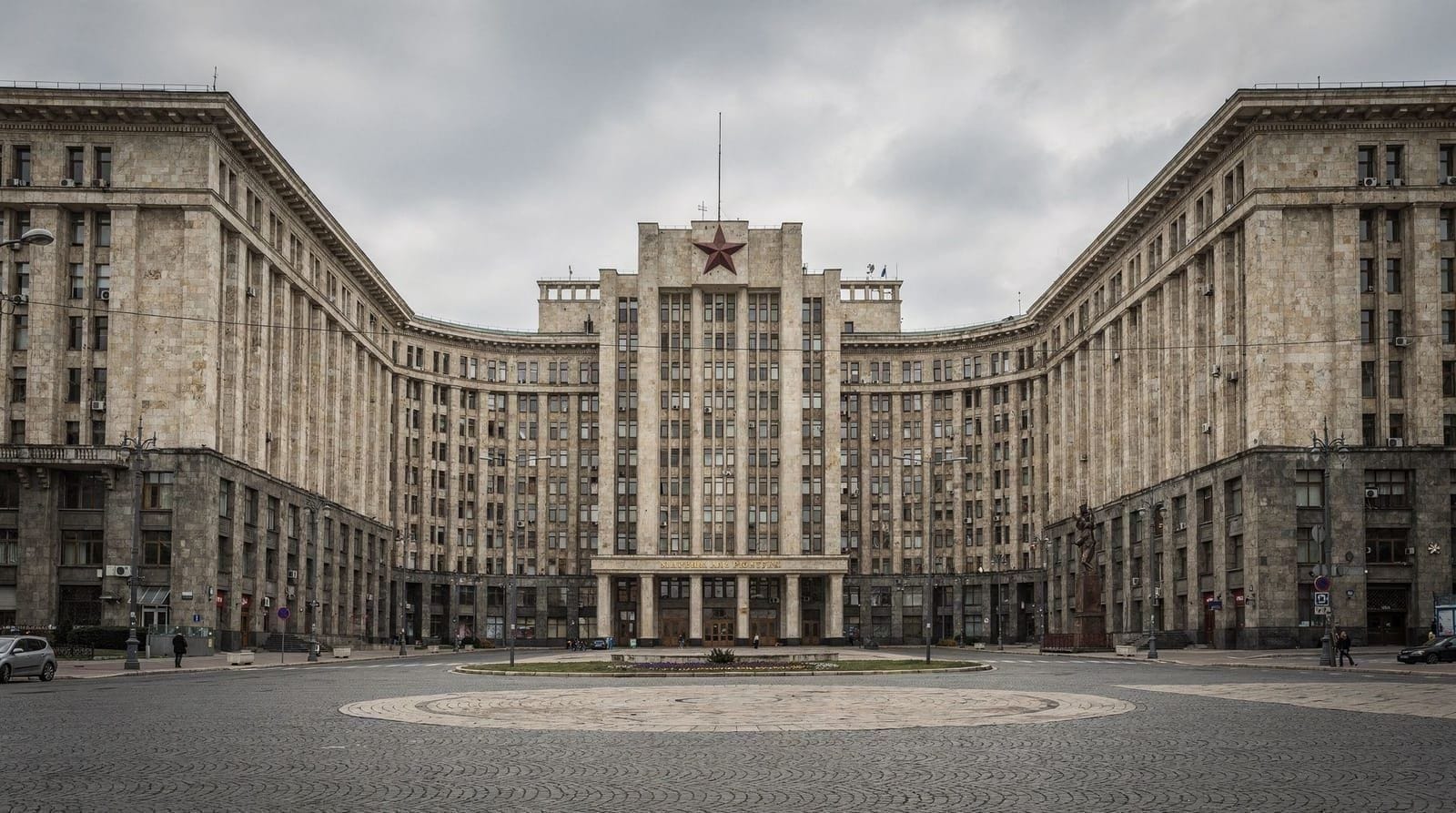
The Largo (Незавизимост / Nezavisimost Square) is the most coherent statement of communist architectural ambition in Sofia and one of the best-preserved Stalinist urban planning ensembles in the Balkans. Three large government buildings arranged around a semi-open square, built between 1951 and 1957, deliberately designed to communicate the scale and permanence of the new order.
The style is Socialist Classicism — neo-classical forms adapted to communist ideological purposes. Colonnades, pediments, symmetrical facades, monumental proportions. The same aesthetic was deployed across the Soviet bloc during the early 1950s: Warsaw’s Palace of Culture and Science, Bucharest’s Casa Scânteii, Minsk’s central boulevard. Sofia’s version is smaller but architecturally coherent in ways that some of those projects are not.
The three buildings remain in active government use. The central east-facing building — formerly the Communist Party Headquarters — now houses the National Assembly and various government ministries. The rooftop red star was removed in 1990. The buildings themselves are unchanged.
Walking through the Largo, pay attention to the urban scale. The buildings are set back from the square’s edges to create a sense of open space that emphasises their height. The proportions are deliberately inhuman — they make individual people feel small, which was the point. Stand in the centre of the square and look at all three buildings at once to understand the intended effect.
Beneath the square, glass panels reveal Roman-era ruins from Serdica — the ancient city that underlies modern Sofia. The communist planners found them during construction. The juxtaposition of imperial Roman ruins beneath Stalinist imperial architecture was not intentional, but it is striking.
If the ruins catch your interest, the Serdica Roman ruins guide explains what else of the ancient city is visible around the centre, and it pairs naturally with a pause in the Largo.
GetYourGuideSofia: Communist Walking TourCheck availability →The National Palace of Culture (NDK)
At the southern end of Vitosha Boulevard, NDK is the largest structure from the communist era in Sofia and the one most likely to genuinely impress. Built in 1981 — specifically dated to mark the 1,300th anniversary of the First Bulgarian Empire — it was the prestige project of Lyudmila Zhivkova, the daughter of Todor Zhivkov and Bulgaria’s minister of culture throughout the 1970s.
Zhivkova was an unusual figure in communist Bulgaria. Where the standard party line emphasised internationalism and Soviet solidarity, Zhivkova consistently foregrounded Bulgarian national cultural heritage — Thracian, medieval, and Orthodox Christian — in her cultural policy. She promoted international cultural exchange, brought foreign artists and exhibitions to Bulgaria, and built NDK as a statement not of Soviet alignment but of Bulgarian cultural confidence.
She died in July 1981 at 38, weeks before NDK officially opened. The official cause was a brain haemorrhage. She had suffered health problems for years. The timing — at the peak of her influence and with her signature project about to be inaugurated — has generated persistent speculation, though no evidence of foul play has ever been established.
NDK today hosts concerts, conferences, international events, and a permanent underground shopping and transit concourse. The interior is freely accessible during events and during the day. The main hall has 3,900 seats. The Bulgarian marble used throughout the interior — floors, walls, decorative panels — was sourced from Bulgarian quarries as a deliberate statement of national resources.
From the outside, walk north from the NDK plaza to see the full extent of Vitosha Boulevard, which was redesigned in the 1980s as a communist-era pedestrian showcase. The boulevard runs directly north to the Largo — a physical axis that links the cultural monument at one end to the political monument at the other.
Buzludzha: the monument that requires a day trip
No account of socialist monuments in Bulgaria can omit Buzludzha, though it demands its own logistics. The monument stands on a mountain ridge in the Balkan Mountains, 250 km from Sofia and 200 km from Plovdiv — in this respect it belongs more to central Bulgaria than to Sofia specifically.
Built between 1974 and 1981, Buzludzha is shaped like a flying saucer on a raised concrete stem — a 70-metre tower topped with a circular hall 70 metres in diameter. Red stars capped the tower and the main hall. Mosaic murals inside covered 35,000 square metres. The building was designed by Georgi Stoilov and built entirely from Bulgarian materials as another statement of national communist achievement.
The site itself has significance: the Buzludzha pass was where Dimitar Blagoev founded the Bulgarian Social Democratic Party in 1891, the precursor organisation to the later communist party. The monument was built to commemorate that founding on its ridgeline.
Since 1990, Buzludzha has been abandoned. The windows were broken in, the mosaics vandalised, the structure left to deteriorate through Bulgarian mountain winters. In the 2010s it became a significant destination for urban explorers and communist heritage tourists, reaching international attention through photography. The Bulgarian state has gradually moved toward a restoration programme, with initial works beginning in the early 2020s, but progress has been contested — some Bulgarians want full restoration as a heritage site, others argue that a crumbling communist monument is a more honest symbol than a restored one.
Access is seasonal and variable. The mountain road is closed in winter. In summer, access has sometimes been permitted to the exterior grounds, sometimes not; the interior has been closed to the public for safety reasons for most of the past decade. If you plan to visit, check the current access status immediately before going — information more than a few weeks old is unreliable.
An organised tour from Sofia that includes Buzludzha as a destination takes a full day and is the most reliable way to get there without a hire car. See the available tours section for options.
GetYourGuideSofia: Museum of Socialist Art and Buzludzha Monument TourCheck availability →If you only have a few hours: what to prioritise
| Site | Time needed | Why it matters |
|---|---|---|
| Monument to the Soviet Army | 15–20 min | The most visually striking and politically live site — likely repainted |
| The Largo | 20–30 min | Best-preserved Stalinist ensemble, Serdica ruins beneath |
| Dimitrov Mausoleum site | 5–10 min | The blankness itself is the point — takes almost no time to see |
| NDK | 30–45 min | Genuinely impressive scale; can combine with a Vitosha Boulevard walk |
| Buzludzha | Full day | Only worth it if you have a spare day and reliable transport |
If your time is limited to a single walk, the Soviet Army Monument, the Largo, and the Dimitrov Mausoleum site sit within about a kilometre of each other and can be covered in under an hour, leaving NDK as an optional add-on a short walk further south.
Scattered monuments: what else to look for
Beyond the headline sites, Sofia’s public spaces contain smaller monuments and inscriptions from the communist era that most visitors walk past without noticing.
University of Sofia area: the space in front of Sofia University has hosted various monuments through different political eras; what is there changes with governments and public debates.
Borisova Garden: Sofia’s main park, just east of the centre, contains several smaller monuments and a stadium built under communism. The park itself was laid out before the communist era, but the stadium complex and several of its formal garden elements date from the 1950s and 1960s.
Residential districts: the panel-block apartment estates in Lyulin, Nadezhda, Mladost, and Studentski Grad are themselves monuments to communist social planning — not monuments in the commemorative sense but in the sense of built ideology made concrete. A bus ride to Lyulin takes fifteen minutes and costs €0.90; what you see there tells you more about how communist Bulgaria organised daily life than any of the prestige sites in the centre.
Practical logistics for a self-guided walk
The three central sites — the Soviet Army Monument, the Largo, and the Dimitrov Mausoleum square — form a rough triangle that can be walked in any order. Starting at the Soviet Army Monument (in the garden south of Tsar Osvoboditel Boulevard) and finishing at NDK, following Vitosha Boulevard south, makes a logical route that also passes through the city’s main pedestrian shopping street, giving the walk a natural change of pace between heavy history and everyday Sofia street life.
Because the sites sit close together, you rarely need transport between them; the getting around Sofia guide is useful mainly for the trip out to the residential districts or back to your hotel at the end of the day. If you would rather mix the monuments with older layers of the city, the Sofia old town walk makes a good contrasting route for another day, and the Alexander Nevsky Cathedral guide covers the church that anchors the same central area.
None of the outdoor sites charge admission or have fixed opening hours, so the walk works at any time of day, though the Largo’s buildings are best appreciated in daylight when the proportions and materials are clearest. Bring a phone with a translated map or a guidebook with historical photos if you want to compare the current state of the Soviet Army Monument with earlier eras — the contrast is often the most memorable part of the visit. If you prefer not to navigate the history solo, a guided walking tour covers the same triangle with narrated context and typically takes 2–2.5 hours including stops.
The debate that is not resolved
What makes Sofia’s socialist monuments interesting is not just what they are but what is happening around them. Bulgaria has not reached a consensus about how to manage this inheritance, and it probably will not anytime soon.
The Tallinn Museum of Occupations and Freedoms in Estonia, the House of Terror in Budapest, and the Topography of Terror in Berlin all represent different national approaches to the same problem: how do you create public memory of a traumatic political system without either glorifying it or pretending it did not happen? Bulgaria has taken none of these approaches coherently. The result is that the monuments remain in something like their original state, with varying degrees of context and controversy, while the argument about what they mean continues.
For visitors, this is genuinely interesting. You are not looking at a curated version of history. You are looking at an active debate. The Monument to the Soviet Army with its protest repainting is more revealing about contemporary Bulgaria than any official explanation would be.
The communist Sofia deep dive on the blog goes further into the people and politics behind these sites, and it works well as reading before you set out. For a wider picture of the city these monuments sit in, the Sofia destination page and the how many days in Sofia guide help you decide how much room to give this theme alongside everything else.
The best guide to the monuments is a knowledgeable local who grew up in the system. The guided communist history tours in Sofia are, at their best, exactly that: an opportunity to hear from someone whose family lived through it, who knows what the buildings meant from the inside, and who can explain the difference between what the monuments said officially and what people understood them to mean in practice.
For the broader context of communist-era architecture and the walking route that connects these sites, see the communist Sofia walking tour guide. For the definitive collection of relocated socialist-era statues and paintings, see the Museum of Socialist Art guide.
If you are planning multiple days in Sofia to cover this material fully, the Sofia in 3 days itinerary includes a dedicated communist heritage day. For a broader view of Bulgarian architecture across eras, the guide to Bulgarian Revival architecture covers the 19th-century national awakening that preceded and in some ways anticipated the communist-era nationalism.
The day trips from Sofia guide covers logistics for reaching Buzludzha and other sites that cannot be reached on foot from the centre. If you are planning a longer Bulgarian itinerary that incorporates Buzludzha with the medieval sites of central Bulgaria, see the medieval Bulgaria loop itinerary.
Frequently asked questions about Socialist monuments in Sofia
Is the Georgi Dimitrov Mausoleum still standing?
No. The mausoleum was demolished in August 1999, after three demolition attempts. The site is now an unmarked open square near the Largo. Nothing marks what stood there.Why is the Monument to the Soviet Army painted with cartoon characters?
Since 2011, the Bulgarian activist collective Destructive Creation has repeatedly repainted the monument with pop-culture figures — Superman, Santa Claus, Ronald McDonald, Captain America — as a commentary on Soviet memory and Bulgarian identity. The municipality has cleaned it each time; it has been repainted each time.Can I visit Buzludzha from Sofia as a day trip?
Technically yes, but it is a long day. Buzludzha is 250 km from Sofia and requires a car (or organised tour). The monument is on a mountain ridge at 1,440 m and may be inaccessible in winter. Check current access status before planning — restoration and access restrictions have changed repeatedly.What happened to the communist statues removed from Sofia after 1989?
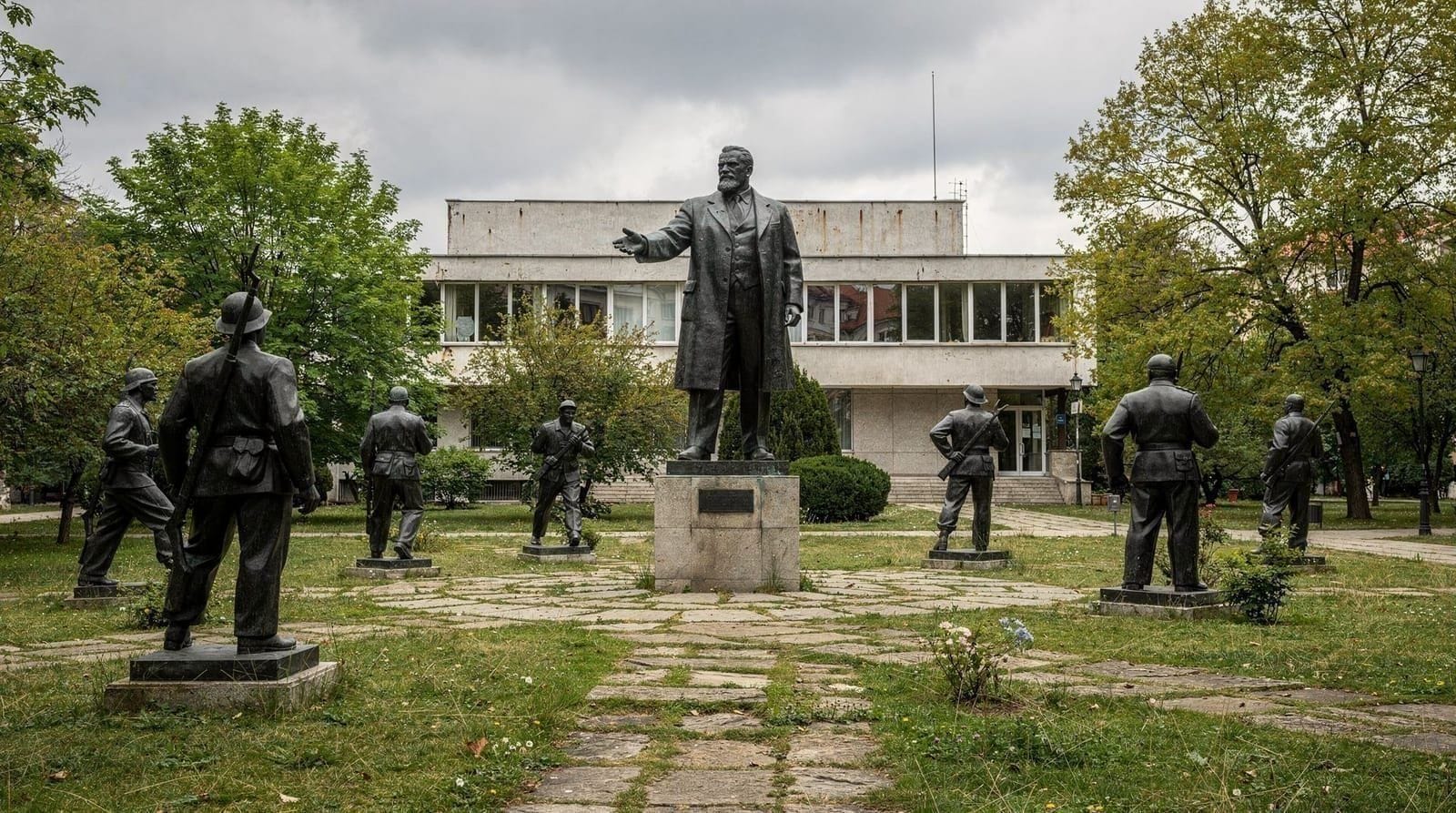
Many were sent to the Museum of Socialist Art in southwest Sofia, opened in 2011. The museum's outdoor sculpture garden contains major pieces including a large Lenin statue. See the separate guide to the museum.What is the Largo in Sofia?
Three Stalinist-era government buildings arranged around a semi-open square in central Sofia, built in the 1950s. They remain in active government use. The centrepiece was the Communist Party Headquarters, now partly the National Assembly.Are the socialist monuments controversial in Bulgaria?
Yes, significantly so. Bulgarian society is divided on whether monuments should be removed, preserved with added context, or recontextualised. The debate has intensified around the Soviet Army Monument and around Buzludzha, where some advocate full restoration and others argue the building should be allowed to decay.How much time should I set aside for Sofia's socialist monuments?
Half a day covers the central sites comfortably: the Soviet Army Monument, the Largo, the Dimitrov Mausoleum site, and NDK are all within easy walking distance of each other. Add a full separate day if you also want to visit Buzludzha, which is 250km away and cannot realistically be combined with the central Sofia sites in one trip.Is it safe or appropriate to photograph these monuments?
Yes, photography is generally welcome and even encouraged, particularly at the Soviet Army Monument given its history of repainting. As with any politically sensitive site, be respectful of any active protests, official ceremonies, or other visitors, and avoid climbing on the structures — the 2011 repainting was a notable exception carried out by activists, not a standing invitation to the public.
Top experiences
Bookable activities with verified prices and instant confirmation on GetYourGuide.