Communist Sofia: a self-guided walking tour
Sofia: Communist Walking Tour
Can I do a self-guided communist walking tour of Sofia?
Yes. The main sites — NDK, the Largo, former Party House, Soviet Army Monument, and Mausoleum site — form a logical 3–4 km loop walkable in 2–3 hours. Start at NDK (metro: NDK), end at the Alexander Nevsky area. A guided tour adds historical depth the buildings alone cannot provide.
Sofia spent 45 years as the capital of the People’s Republic of Bulgaria, and that era left a deeper architectural imprint than most visitors expect. This is not a city that quietly erased its communist past — the monumental buildings are still standing, still in official use, still dominating the skyline in ways that make the era impossible to ignore. This guide walks you through the most significant sites, explains what you are looking at, and gives you an honest picture of which landmarks reward your time and which are overhyped.
The route is 3–4 km, starting at the National Palace of Culture (metro: NDK) and ending near Alexander Nevsky Cathedral. Allow two to three hours at a comfortable pace with stops.
| Where | NDK to Alexander Nevsky, central Sofia |
| Cost | Free self-guided; guided tours €15–25/person |
| Time needed | 2–3 hours self-guided |
| Getting there | Start at NDK metro station (line 2) |
| Best time | Morning, avoiding midday heat in July–August |
Self-guided route at a glance
| Stop | What it is | Time to allow |
|---|---|---|
| NDK | 1981 congress centre, exterior + concourse | 20–30 min |
| The Largo | Stalinist government ensemble + Serdica ruins | 30–40 min |
| Mausoleum site | Where Dimitrov’s mausoleum stood until 1999 | 5–10 min |
| State Security building | Former DS headquarters, exterior only | 5 min |
| Monument to the Soviet Army | 1954 monument, repeatedly repainted | 15–20 min |
| Alexander Nevsky | Route endpoint, not communist-era | 20+ min |
Starting point: the National Palace of Culture (NDK)
Begin at NDK — Национален дворец на културата — on the southern end of Vitosha Boulevard. It is impossible to miss. The building is an eleven-storey slab of exposed concrete and smoked glass, flanked by a fountain plaza that stretches 300 metres toward the city centre. Opened in 1981, it remains the largest conference and congress centre in the Balkans.
NDK was built to mark the 1300th anniversary of the First Bulgarian Empire and was championed by Lyudmila Zhivkova, the daughter of party leader Todor Zhivkov and Bulgaria’s minister of culture. Zhivkova was a singular figure in late communist Bulgaria — she promoted Bulgarian national identity and international cultural exchange in ways that sat uneasily with orthodox Soviet doctrine. She died in 1981, aged 38, weeks before NDK opened. Some historians regard her death as a convenient mystery; the official cause was a brain haemorrhage.
The building itself repays a slow walk around the exterior. The dimensions are genuinely overwhelming: 123,000 square metres of usable space, 14 halls, and a concrete facade that catches the late afternoon light in ways that make it, against all odds, beautiful. The plaza in front hosts outdoor exhibitions, skaters, and buskers today — a public space that the building’s original purpose as a communist showpiece entirely excluded.
Walk inside through the main entrance. The lower concourse is freely accessible and leads to a shopping arcade, café, and ticketing area for whatever is currently showing. The interior stonework — Bulgarian marble, used extensively — is the detail that surprises most visitors. Whatever one thinks of the politics, the builders did not scrimp.
Walk north from NDK along Vitosha Boulevard for ten minutes, and the Largo begins to come into view.
The Largo: Sofia’s Stalinist showcase
The Largo (officially Nezavisimost Square) is the heart of communist Sofia, even now. Three large government buildings flank a semi-open square, all built in the 1950s in a Stalinist neo-classical style that the Soviets were simultaneously deploying across Eastern Europe — think Minsk, Warsaw’s Palace of Culture, the wedding-cake towers of Moscow.
The three buildings are:
The Council of Ministers Building (northwest): the largest of the three, now housing the Bulgarian government. The facade features colonnaded upper floors and an enormous pediment. Until 1990 a red star perched on the rooftop; you can still see the mounting point if you know where to look.
The Presidency (northeast): the building of the Bulgarian head of state. The changing of the guard takes place here hourly — a performance worth watching, if only because it happened identically under communism and now happens in a democracy, using the same choreography.
The Former Party House (centre, east side): this was the headquarters of the Bulgarian Communist Party and the site where decisions were made about who prospered, who was purged, and how the country was governed. It is now partly occupied by the National Assembly (parliament) and partly by government ministries. You cannot go inside, but stand in the square and look at the scale of the building relative to everything around it. The point of the Largo as urban design was exactly this: to make the power of the party visible and physically overwhelming.
The square is also where protests have happened in every era of modern Bulgarian history — anti-communist demonstrations in 1989 and 1990, and more recently protests against corruption. Walking through it is to walk through Bulgarian political history in concentrated form.
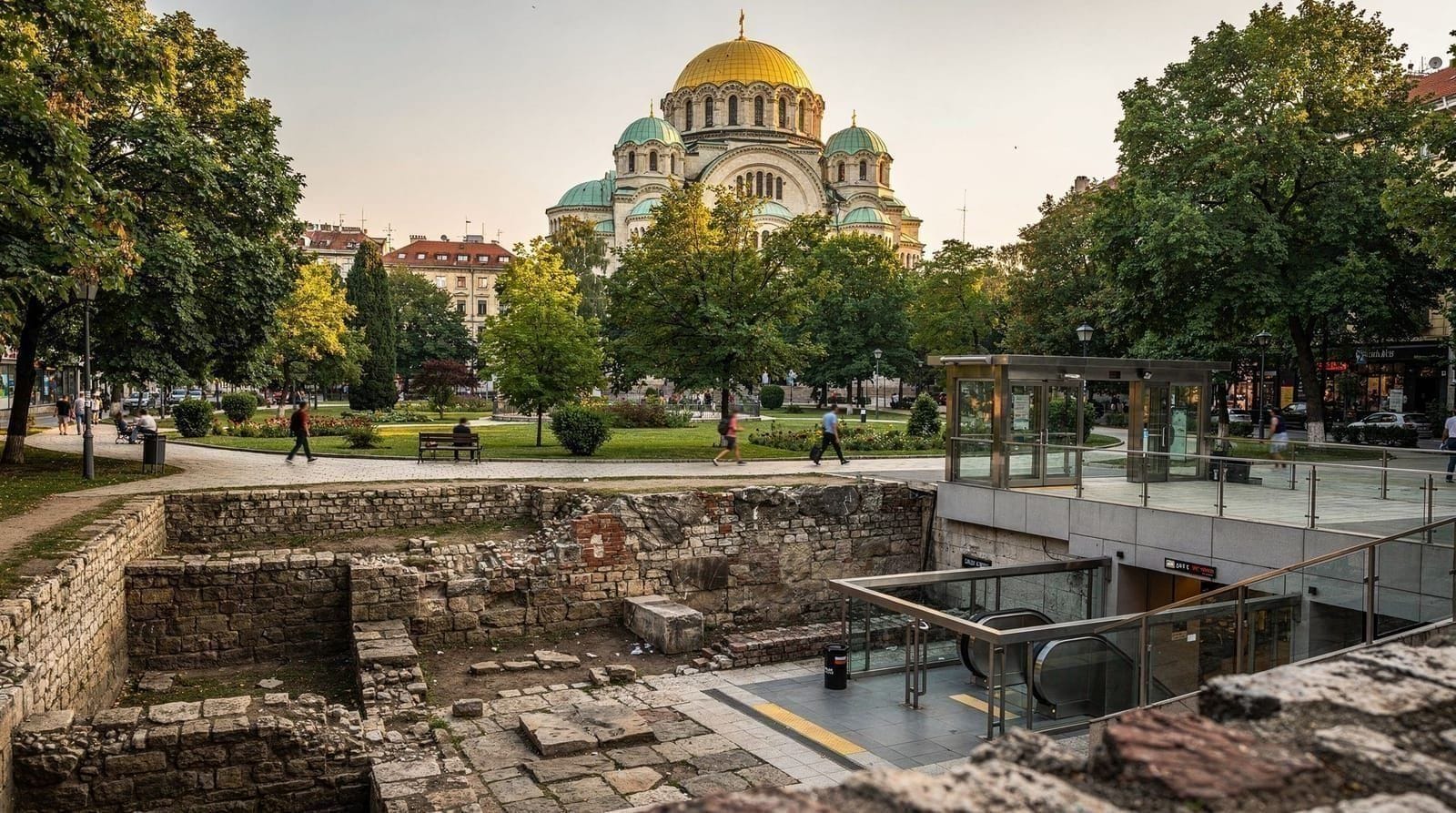
Beneath the square, visible through glass panels set into the pavement, are Roman-era ruins from the ancient city of Serdica. The communist planners found the ruins during construction and built around them — an inadvertent preservation that you can also see in the nearby Serdika metro station, where the excavations are permanently displayed. For more on this layer, see the guide to Roman ruins in Sofia.
GetYourGuideSofia: Communist Walking TourCheck availability →The site of the Georgi Dimitrov Mausoleum
Walk east from the Largo along Tsar Osvoboditel Boulevard. On your right, between the Presidency and the National Theatre, is an open square that looks, frankly, like nothing very much. A few benches, some paving, a fountain.
From 1949 until August 1999, this site held the mausoleum of Georgi Dimitrov — Bulgaria’s first communist leader, who died in Moscow in 1949 under circumstances that have never been entirely explained. His embalmed body was placed in a white marble structure modelled loosely on Lenin’s Mausoleum in Moscow and on Georgi Dimitrov’s own position in communist iconography as a founding martyr.
The demolition was not straightforward. The first attempt, in August 1999, failed: the structure proved more solid than expected and the explosives did not bring it down. The second attempt also failed. The third attempt succeeded. The building that had housed the embalmed body of the man who led Bulgaria for five years was removed in a single day.
There is no marker, no plaque, no acknowledgement of what stood here. This is itself a political statement — and a contested one. Some Bulgarians argue that a democratic state should be capable of acknowledging its own history in public space without endorsing it. Others consider the blank square an appropriate verdict on the man and the regime he represented.
If you want context for this specific site, a guided tour is more useful than the spot itself, which yields almost nothing to a visitor who does not already know the story. The guided communist history tour covers this in detail.
Walking north: the State Security building
From the Largo, walk a few blocks north along General Gurko Street toward the interior ministry district. The building that housed the State Security (DS — Държавна сигурност, Bulgaria’s KGB equivalent) under communism still stands and is still partly in use by the Interior Ministry. It is not marked or signposted as anything historically significant.
The DS maintained files on approximately 10–15% of the Bulgarian population, recruited informers from workplaces, universities, churches, and families, and was responsible for assassinations abroad — most famously the 1978 murder of dissident writer Georgi Markov in London, killed with a poisoned pellet fired from an umbrella on Waterloo Bridge. Bulgaria has opened parts of the DS archive, and Bulgarians can now request their own files, but full transparency has been slow and contested.
The building is not dramatic to look at. That is partly the point. The DS operated through mundane bureaucracy — a grey building, ordinary-looking staff, paper files. Walking past it and knowing what happened inside is a different kind of historical weight than the monumental Largo.
Monument to the Soviet Army
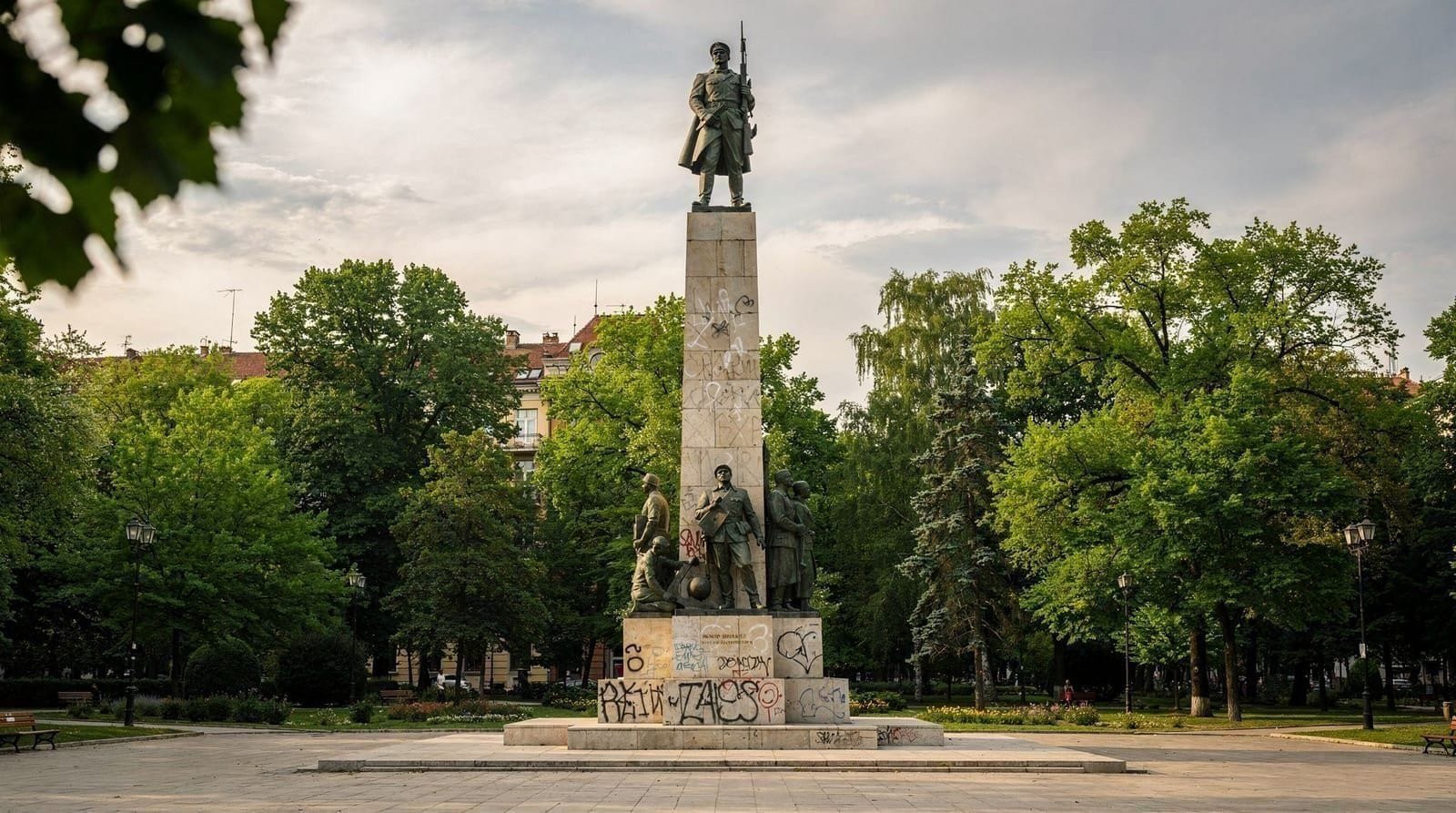
Continue east along Tsar Osvoboditel toward the park between the National Gallery and the Russian church. In the garden here you will find the Monument to the Soviet Army, erected in 1954 to commemorate Soviet forces who entered Bulgaria in September 1944.
The monument is a tall central column topped with a Soviet soldier flanked by female allegorical figures representing Bulgarian workers and peasants. It is imposing, competently executed socialist realism, and it has been repainted repeatedly since 1989 by a Bulgarian activist group called Destructive Creation.
The repainting campaigns are arguably the most interesting thing about the monument now. In 2011, the Soviet soldiers were transformed into American pop-culture characters: Superman, Santa Claus, Ronald McDonald, Captain America, The Joker, Batman. The stunt went viral globally. In subsequent years, figures were painted in support of Ukrainian protesters, then in the colour scheme of the Ukrainian flag, then as a tribute to various causes and anniversaries. The Sofia Municipality has repeatedly cleaned the monument, and it has repeatedly been repainted.
Stand here long enough and you realise that the monument has become a living argument about what Bulgaria owes to Soviet memory, how it should process its history, and who gets to make those decisions. That argument is more interesting than the original sculpture.
Full detail on this monument and others is in the companion guide to Sofia’s socialist monuments.
GetYourGuideSofia: Communist History Walking TourCheck availability → GetYourGuideBulgaria and Serbia Full Day Tour from SofiaCheck availability →Socialist housing: Lyulin and Nadezhda districts
The walking tour does not reach the socialist housing estates, but they are worth understanding as part of the picture. The panel-block apartment buildings (panelki — панелки) visible on the city’s western and northern edges were built between the 1960s and 1980s to house a rapidly urbanising population.
Bulgarian communism deliberately moved rural populations into industrial cities, and panelki were the housing solution: prefabricated concrete panels assembled into apartment blocks of 8–14 storeys, with district heating, communal stairwells, and small balconies that residents personalised as best they could. Today these districts — Lyulin, Nadezhda, Mladost — are home to large parts of Sofia’s working population. They are not tourist sites in any conventional sense, but if you want to understand what communist Bulgaria looked like for most people, a bus ride out to Lyulin takes ten minutes and costs €0.90.
If your interest runs to lived experience rather than monuments, some communist walking tours include a stop in a residential panel block neighbourhood and conversation with local residents about how the transition from 1989 onward changed daily life. Ask about this when booking.
Ending at Alexander Nevsky: what to look for
The route ends at Alexander Nevsky Cathedral, which is not a communist building but functions as the geographical end of this tour. The park around the cathedral contains the entrance to the Sofia History Museum (in the former Central Mineral Baths building, fifteen minutes’ walk south), and the National Gallery fills the palace on the western edge of the square.
Look east from the cathedral and you are looking at the University of Sofia building — 1930s, neoclassical, not communist. But in the square in front of it, various monuments have appeared and disappeared since 1989 as successive governments decided what Bulgaria’s public space should commemorate. The argument is ongoing.
From Alexander Nevsky it is a short walk to the Museum of Socialist Art, though that requires a taxi or bus south — it is not walkable from the centre. If you plan to visit the museum on the same day, do the walking tour in the morning and take transport south afterward.
Guided tours vs self-guiding: an honest assessment
This route is doable without a guide and costs nothing beyond transport. But it works significantly better with one.
The buildings that defined communist Bulgaria are still in official use, and their institutional continuity makes them harder to read than a decommissioned site like a prison or factory. The Party House is now parliament. The Ministry of Finance occupies offices where party members denounced each other. The DS building is still the Interior Ministry. Nothing is labelled. Nothing explains itself.
A good guide does not just identify the buildings — they explain what political meeting happened in which room, what it meant that your neighbour might have been reporting on you, how Bulgarian communism differed from Soviet doctrine (it did, particularly under Zhivkov in his later period), and what Bulgarians in their 50s and 60s actually remember about growing up in that system. That oral history context is not available on any information panel.
The communist walking tours that run in Sofia — typically three hours, €15–25, small groups — are among the better value experiences in the city. Watch out for operators who treat the tour as a nostalgia trip (photographs with Soviet-era props, sampling communist-era food, emphasis on kitsch). The better tours take the politics seriously without being grim.
GetYourGuideSofia: 2-Hour Communist Jeep TourCheck availability →What to photograph
Several sites on this route are particularly rewarding for photography:
NDK: best photographed from the plaza, pointing north toward the boulevard, in morning light when the fountain is active. The brutalist geometry is cleanest from directly in front.
The Largo: shoot from inside the square, low angle, to capture the mass of the three buildings around you. The colonnade of the Council of Ministers building at dusk picks up warm light well.
Monument to the Soviet Army: approach from the park path for a clear view of the central column. If any repainting is currently visible, photograph it from the base.
Panelki: if you make the trip west to Lyulin, the residential blocks are most interesting in the morning when residents are leaving for work, and the contrast between the repetitive block architecture and individual balcony gardens is clearest.
Practical information for the route
Start: NDK metro station (metro line 2). The plaza is directly above the exit.
Distance: approximately 3–4 km point to point, more if you walk around the Largo in detail.
Duration: 2–3 hours self-guided, 3 hours with a guide.
Terrain: flat, mostly pavement and pedestrian zones. Accessible.
Best time: morning light is best for photography. Avoid midday in summer (July–August can reach 34°C in central Sofia). The sites are equally accessible year-round.
Cost: self-guided is free. Guided tours run €15–25 per person for group tours, more for private.
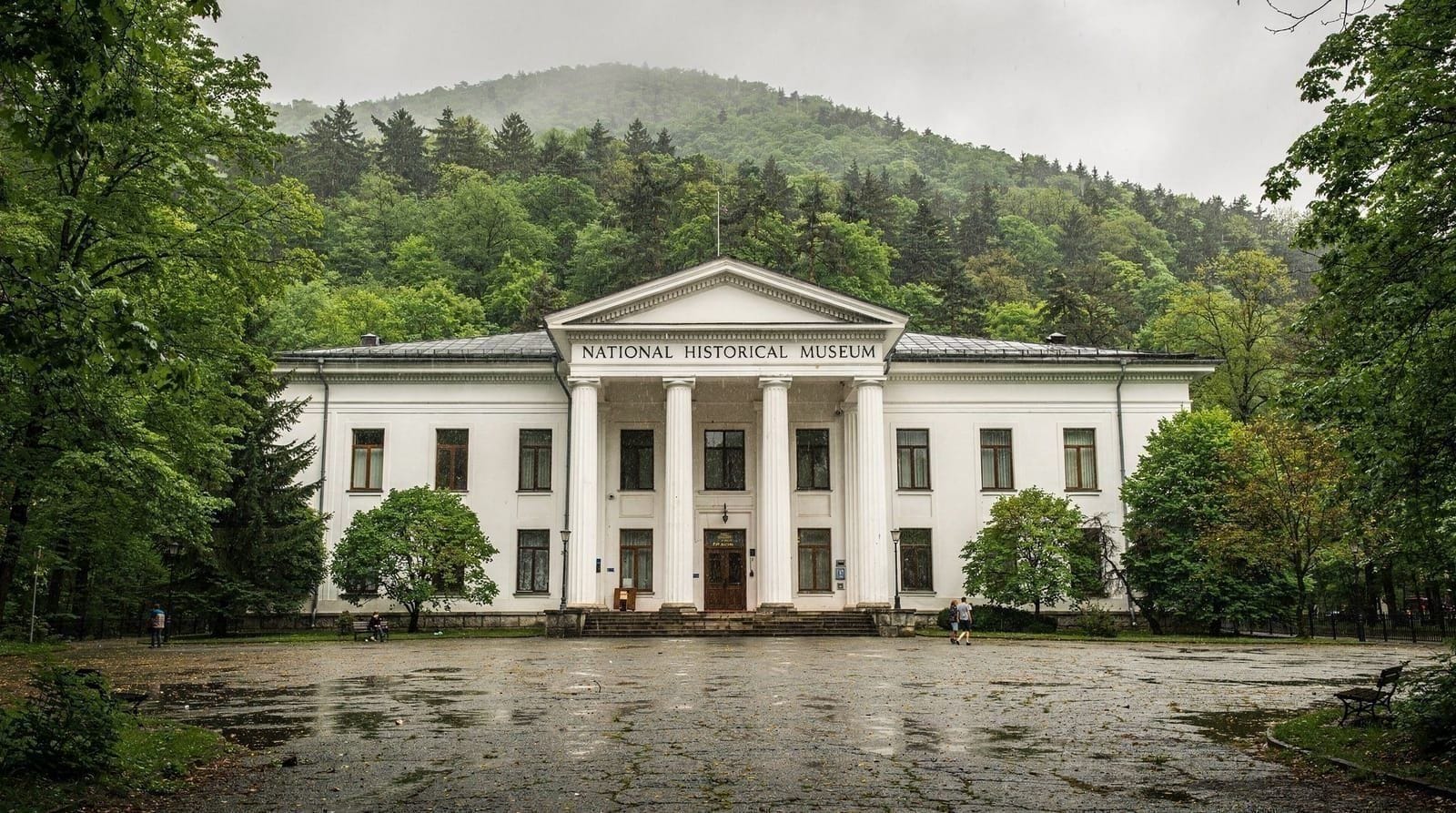
Combine with: the route passes the National History Museum area and is near the Sofia Old Town walking route. Both can be added as extensions. A full day combining this tour with the Museum of Socialist Art makes a coherent theme day on communist heritage.
For a broader multi-day itinerary placing this in context, see Sofia in 2 days or Sofia in 3 days.
Frequently asked questions about Communist Sofia
How long does the communist walking tour of Sofia take?
Self-guided, budget 2–3 hours at a relaxed pace. Guided tours typically run 3 hours and cover more ground because guides get you past locked gates and inner courtyards.Is the communist walking tour suitable for kids?
Yes, with caveats. The Largo and NDK are visually striking. Some of the political context (Show Trials, the DS secret police, forced collectivisation) is heavy for young children but not graphic.Are the communist-era buildings open to go inside?
NDK is open and hosts events — you can walk through the lower concourse freely. The Party House (now Ministry of Finance / government offices) is not publicly accessible. The Monument to the Soviet Army is in an open park. Most sites are exterior-only.What is the Largo in Sofia?
The Largo is a Stalin-era urban planning ensemble in the centre of Sofia, comprising three large government buildings arranged around a semi-open square. Built in the 1950s, it was the showpiece of communist urban renewal and replaced an older mixed neighbourhood.Where was the Georgi Dimitrov Mausoleum?
The mausoleum stood on what is now the square between the Presidency and the National Theatre, near the Largo. It was demolished in August 1999 after three failed attempts. The site is now an open square with no marker.Is it worth taking a guided tour instead of self-guiding?
For most visitors, yes. The buildings themselves are imposing but the stories behind them — the purges, the informers, the cult of personality, daily life under Zhivkov — are what make the visit memorable, and those require a knowledgeable guide.How does this tour connect to Sofia's other historical layers?
The route physically overlaps with Roman Sofia — the Largo sits directly above excavated Serdica ruins, visible through glass panels in the pavement. It's worth mentally separating the two eras as you walk: communist-era buildings from the 1950s–80s standing on and around Roman-era foundations from the 2nd–4th centuries.What should I wear or bring for this walking tour?
Comfortable walking shoes — the route is flat but covers 3–4km of pavement. In summer, bring water and sun protection since much of the route has little shade. No dress code applies since this is an outdoor, exterior-focused route, unlike Sofia's churches.
Top experiences
Bookable activities with verified prices and instant confirmation on GetYourGuide.