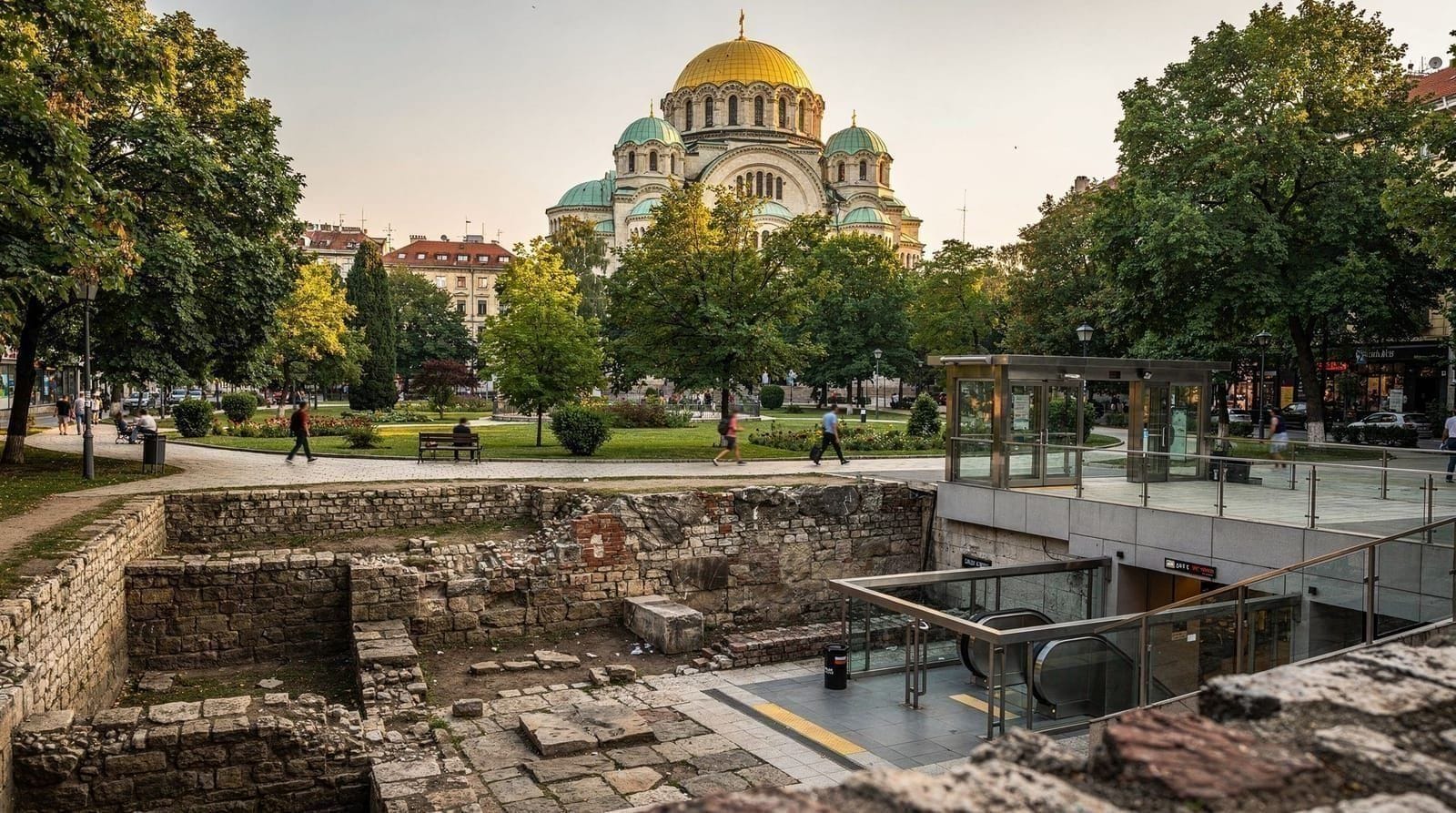
Serdica: Sofia's Roman past hiding in plain sight
Sofia: Archaeology and History Museum Guided Tour
Where can you see Roman ruins in Sofia?
The best visible Roman ruins are at Serdica metro station (free, open 24/7 through glass), the Ancient Serdica complex near the Sheraton Hotel (outdoor, free), the Rotunda of St George (4th century, free entry), and the Archaeological Museum (€7, Tue–Sun 10am–6pm).
Most visitors to Sofia walk across the ancient Roman city without knowing it. The modern Largo — the wide ceremonial square at the heart of the city centre — sits directly above what was once the forum of Serdica, a prosperous Roman provincial capital of 30,000 to 50,000 people. The streets, water systems, and civic buildings of that city are down there. Some of them are visible right now, through glass panels in the metro station and through fences around outdoor excavation sites, at no cost whatsoever.
This guide maps out what’s accessible, what it costs, and how to thread it together into a coherent visit.
| Where | Central Sofia, around the Largo and Serdika metro station |
| Cost | Free except Archaeological Museum (~€7) |
| Time needed | 2.5–3 hours for the full circuit |
| Getting there | Serdika metro station (Lines 1 & 2), central and walkable |
| Best time | Any time; museum closed Mondays |
What was Serdica?
Serdica’s origins predate Rome. The site was settled by the Thracian Serdi tribe — the city’s name derives from theirs. Roman conquest brought it into the empire in the late first century BC, and by the second and third centuries AD Serdica had grown into a significant city: the capital of the Roman province of Dacia Mediterranea (later Inner Dacia), with a full complement of Roman urban infrastructure — forum, amphitheatre, public baths, sewage system, temples, and city walls.
Its strategic position mattered. Serdica sat at the junction of major Roman roads connecting the Danube frontier to Constantinople and the Adriatic to the Black Sea. This made it militarily and commercially important, and it attracted some of the most powerful figures in the Roman world.
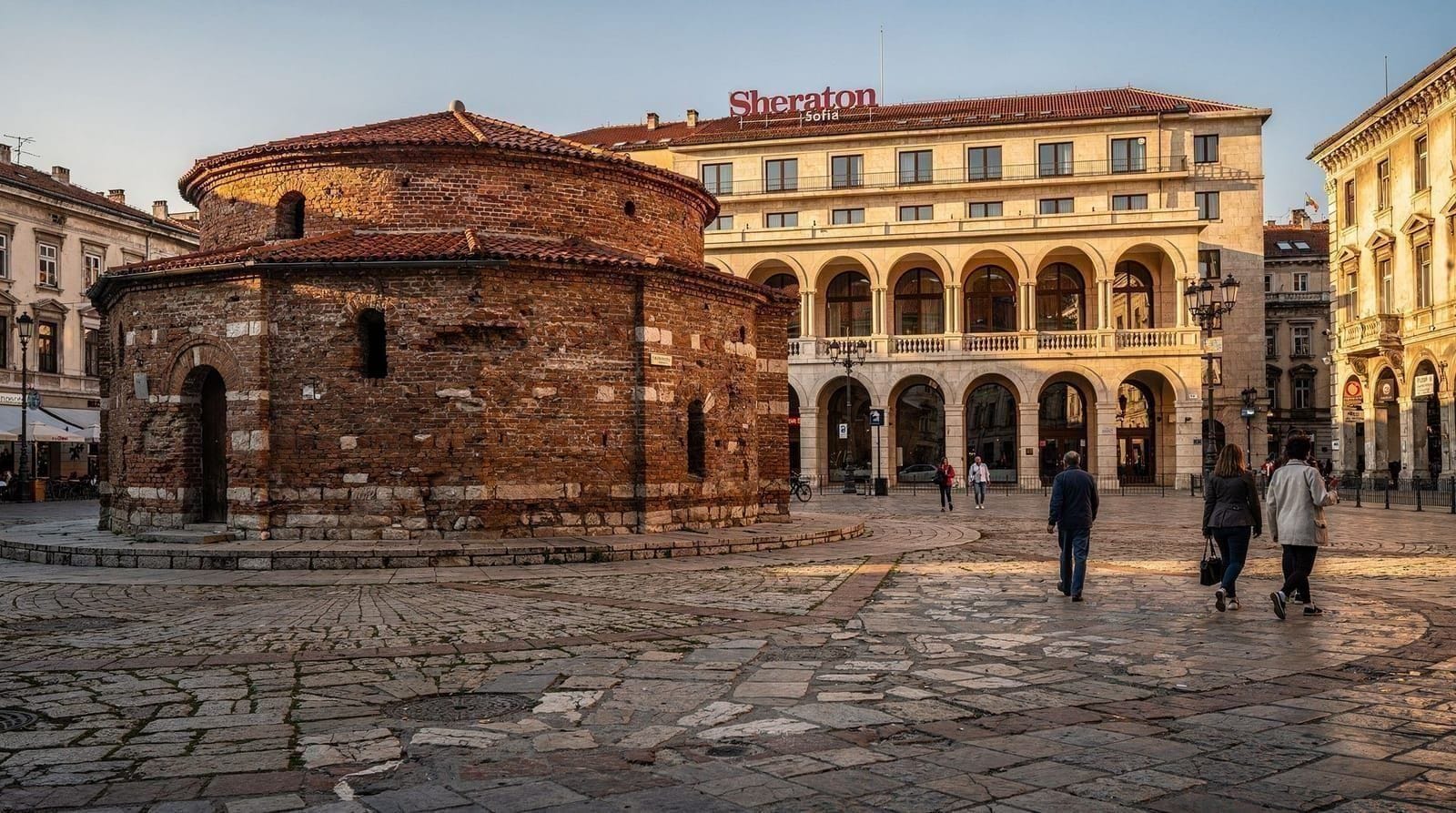
Constantine the Great and Serdica. Constantine spent extended periods in Serdica between his various military campaigns, and the city held a particular place in his affections. The orator Nazarius recorded him declaring “Serdica is my Rome” — a rhetorical flourish, but not an empty one. The Edict of Serdica (311 AD), which preceded the Edict of Milan and was one of the first formal grants of religious toleration to Christians in the empire, was issued here by Emperor Galerius at the Council of Serdica. Constantine himself is believed to have ordered construction of the rotunda that now stands in the courtyard of the Sheraton Hotel — the oldest surviving building in modern Sofia.
By the fourth century Serdica was at or near its peak. The fifth and sixth centuries brought repeated incursions by Huns, Goths, and eventually Slavic tribes that gradually reduced the city’s importance. By the early medieval period it had been reduced to a much smaller settlement called Sredets, which eventually became Sofia.
GetYourGuideSofia: Archaeology and History Museum Guided TourCheck availability →The Serdica metro station ruins
The best introduction to ancient Serdica costs nothing and requires no planning. When the Sofia metro was under construction in the 2000s, excavations beneath the central Largo area uncovered one of the most substantial preserved sections of the Roman city’s street grid: paved streets, drainage channels, building foundations, and a range of smaller finds.
Rather than relocate or rebury the remains, Sofia’s architects incorporated them into the metro station design. The Serdika station (Line 2, but also accessible from Line 1’s interchange here) runs a long glazed corridor through the ruins, allowing you to walk alongside — and in some sections, over — genuine Roman stonework from the second to fourth centuries.
What you see: Roman street paving in large stone slabs, drainage channels running beneath the street level, foundation walls of civic buildings, and several interpretive panels in Bulgarian and English explaining what each section represents. The scale is impressive; these are not isolated fragments but continuous sections of city infrastructure.
The ruins are visible at all hours since the metro station operates around the clock, though the best viewing is in daylight hours when the glass panels are well-lit from outside. Entry is free — you do not need a metro ticket to walk through the connecting corridor.
If you are coming from outside the station: enter from the Largo side, follow signs for the Line 2 connection, and the ruins corridor is the connecting passage between platforms. You can walk the length and back out without buying a ticket.
Because the corridor also functions as a working metro thoroughfare, it can get busy during rush hour (roughly 8–9:30am and 5–7pm on weekdays), when commuters move quickly through the space. Mid-morning and early afternoon give a calmer pace for reading the interpretive panels and taking photographs without feeling like you’re standing in someone’s way.
The Ancient Serdica outdoor complex
Fifty metres northwest of the metro station, in the open-air area between the Sheraton Hotel and the Presidency building, lies the Ancient Serdica complex — a series of excavated outdoor sections of the Roman city, permanently on display behind low glass barriers and low fencing.
This is a mixed experience. On the one hand, you are standing on an actual Roman street corner, looking at walls and pavements that have been in the ground since the second century. On the other hand, the presentation is rudimentary: a few panels, intermittent labelling, and no guided audio option on site. The complex is free to view and is accessible from the pedestrian area around the Largo at all hours.
What to look for: the remains of a Roman street intersection, which shows the orthogonal grid that characterised Roman urban planning; sections of opus mixtum walling (alternating brick and stone courses) that are characteristic of late Roman construction; and in some areas, traces of earlier Thracian habitation beneath the Roman levels.
Combined with the metro station passage, this outdoor section gives a reasonable picture of the Roman street grid at two different points in the city.
The Rotunda of St George
In the courtyard of the Sheraton Sofia Hotel Balkan — enter from the street, the hotel courtyard is publicly accessible — stands the Rotunda of St George: a small red-brick cylinder that is the oldest surviving building in Sofia and one of the most important late Roman monuments in the Balkans.
The rotunda was built in the early fourth century, most likely during the period of Constantine’s engagement with the city. Its original function is debated: a mausoleum, a caldarium (hot room of a bath complex), or a ceremonial structure associated with the imperial palace that was also located in this area. It measures about 12 metres in internal diameter with a central apse.
The building’s subsequent history is readable in its fabric. After Constantine’s Christianisation of the empire, it was converted into a Christian church — frescoes were painted on the interior surfaces, several layers of which survive and are partially visible. Under Ottoman rule (from 1382), it was converted into a mosque — the frescoes were plastered over and a minaret added (the minaret is long gone). After Bulgarian independence, it reverted to Orthodox use, and excavation-and-restoration work revealed multiple fresco layers, some dating to the 10th–13th centuries.
Entry to the Rotunda is free. It is open most mornings; hours vary seasonally and it sometimes closes for private events or restoration work. The interior is small and the visit is brief — ten to fifteen minutes — but the building concentrates more history per square metre than anything else on this walk. For more on the Rotunda’s place in the wider picture of Sofia’s religious architecture, see the sofia churches guide.
The National Archaeological Museum
The most substantial collection of material from ancient Serdica and from Thracian Bulgaria more broadly is held in the National Archaeological Museum, a five-minute walk from the Largo along Maria Luisa Boulevard.
The museum is housed in the Büyük Camii (Great Mosque), a 15th-century Ottoman mosque that is one of the best-preserved Ottoman structures in Sofia. The building itself — a large nine-domed mosque with thick stone walls — is architecturally interesting and worth seeing even before you look at the contents.
What’s inside: The permanent collection runs from prehistoric Bulgaria through the Thracian and Roman periods to the early medieval era. Key sections:
Thracian gold. Bulgaria produced some of the most extraordinary gold and silver metalwork of the ancient world during the Thracian period (roughly 5th–3rd century BC). The museum holds several spectacular pieces: rhytons (drinking horns) in silver, horse fittings in gilded silver, and decorated helmets. These are not replicas.
Roman Serdica. Sculptures, inscriptions, architectural elements, and everyday objects from the city excavated beneath the modern streets. The inscription collection includes milestones, funerary monuments, and religious dedications that document the social life of the provincial capital. A marble portrait head believed to depict Constantine is one of the highlights.
Thracian heritage. Finds from burial mounds (tumuli) across Bulgaria, including painted pottery, jewellery, and ritual objects. For deeper context, see the thracian heritage guide.
Medieval section. Ceramic tiles, architectural ornaments, and devotional objects from the medieval Bulgarian kingdoms, complementing what you can see at Boyana Church and Veliko Tarnovo.
Practical information:
Entry: €7
Hours: Tuesday–Sunday, 10am–6pm (closed Monday)
Audio guides: Available in several languages
Photography: Permitted in most sections without flash
Bags: Cloakroom available at the entrance
Accessibility: The museum’s ground floor is step-free from the main entrance; some upper galleries in the former mosque building require stairs, so visitors with mobility needs should ask staff about the accessible route on arrival.
The museum is chronically underestimated by visitors who assume it will be provincial. It is not: the Thracian gold alone would justify entry at twice the price, and the Roman collection is among the most substantial in the region. Budget at least 90 minutes.
GetYourGuideSofia: Must-See Attractions Walking TourCheck availability →Practical tips for a comfortable visit
The metro corridor and outdoor Ancient Serdica complex are both accessible year-round and unaffected by weather, since the metro section is indoors and the outdoor section is compact enough to see quickly even in rain. The Rotunda’s opening hours vary more, since it functions as an active place of worship as well as a monument, so mornings tend to be the more reliable time to find it open. If you specifically want to see the Rotunda’s fresco layers well-lit, aim for a clear morning — the interior has limited artificial lighting and relies substantially on daylight through its windows.
The Archaeological Museum benefits from a slower pace than most visitors give it. Because the Thracian gold gallery in particular draws crowds around midday when tour groups arrive, an early visit shortly after the 10am opening tends to be noticeably quieter than an afternoon visit, giving you more time in front of the display cases without competing for space.
The Largo archaeological panels
Around the perimeter of the Largo itself — the large open square framed by the government buildings and the former Party headquarters — there are additional sections of Roman ruins visible behind glass panels set into the pavement. These are smaller and less dramatic than the metro corridor, but they are points of continuity: you are standing in a modern plaza and looking down through your feet at a second-century street.
The Largo as a whole is a study in layers. The Roman forum was here. The medieval city of Sredets was centred roughly here. The Ottoman city that followed occupied the same ground. The current arrangement dates from the 1950s when the Communist government redesigned the square to project Soviet-style monumentality. Each redesign eliminated and buried parts of the previous one; the 21st-century excavations are slowly revealing what was underneath all of it.
For the full picture of what the Largo means as a Communist-era intervention, see the communist Sofia tour guide.
Combining the sites into a single visit
The practical routing for a half-day of Roman Sofia:
- Start at Serdica metro station (Lines 1 & 2) — walk the ruins corridor (free, 15 minutes)
- Exit to the Largo and inspect the pavement panels (free, 10 minutes)
- Ancient Serdica outdoor complex between the Sheraton and Presidency (free, 15 minutes)
- Rotunda of St George in the Sheraton courtyard (free, 15 minutes)
- National Archaeological Museum (€7, 90 minutes minimum)
Total time: 2.5–3 hours. Total cost if you enter the museum: €7.
This route can be extended into a full day by adding Alexander Nevsky Cathedral (800m east, 1 hour), the icon crypt (€3), and the sofia old town walk loop. For a structured two-day Sofia plan that builds in this morning, see sofia in 2 days.
Serdica in the broader Roman context
Understanding how significant Serdica was requires a brief comparison. In the second and third centuries AD, the Roman Empire administered its Balkan territories from a series of provincial capitals: Thessaloniki (Thessalonica), Naissus (modern Niš in Serbia), Philippopolis (modern Plovdiv in Bulgaria), and Serdica. Of these, Serdica was not the largest but it occupied one of the most strategically valuable positions — at the crossroads of the road system linking the Danube frontier, Constantinople, and the Adriatic.
This mattered increasingly from the late third century onward, when the empire faced simultaneous pressure on multiple frontiers. Emperor Diocletian’s reorganisation of the empire created a new administrative unit (the Diocese of Dacia) with Serdica at its heart. The city grew in importance as the traditional western capitals — Rome, Milan — became less central to actual governance.
Constantine’s relationship with Serdica reflects this shift. He fought several campaigns from the city, used it as a base, and appears to have considered making it one of his capitals before eventually choosing Byzantium (Constantinople) instead. The Council of Serdica in 343 AD — a major church council convened to resolve disputes within the Christian church following the First Council of Nicaea — drew bishops from across the empire. That a meeting of such importance was held in Serdica is a measure of the city’s standing in the fourth-century Roman world.
After Constantine, the city continued to function but began a long decline as the empire’s western territories fragmented and invasion pressures increased. The Visigoth passage through the region in 378 AD (after the Battle of Adrianople), followed by repeated Hunnic raids in the fifth century, degraded the city’s infrastructure and population. By the sixth century, Serdica was substantially reduced; by the early medieval period it had become a modest fortified town called Sredets.
The extraordinary fact about walking across the Largo today is that you are traversing the ground of a city that was, for a century or so, one of the most important places in the Roman world — and almost nothing is visible above ground.
Bulgaria’s Roman heritage in wider perspective
Serdica is not the only major Roman site in Bulgaria — it is simply the one that happens to be under the capital city. Bulgaria’s Roman heritage is richer than most visitors expect, and contextualising Serdica within it adds depth to any visit.
Plovdiv (ancient Philippopolis) has one of the best-preserved Roman amphitheatres in the Balkans, fully visible and partly in use as a concert venue. Plovdiv’s Roman stadium (of which one end is visible under the central pedestrian zone) was one of the largest in the ancient world. A day trip to Plovdiv from Sofia makes the comparison vivid: where Serdica is mostly hidden, Philippopolis is mostly visible.
The Thracian heritage that preceded Rome is equally significant. The Kazanlak Rose Valley area contains major Thracian burial mounds, including the painted Kazanlak Tomb (UNESCO). The thracian heritage guide covers this layer of Bulgarian prehistory in detail, and the Archaeological Museum in Sofia has the best Thracian gold collection outside Plovdiv.
For a longer trip that takes in all of these layers, the bulgaria highlights 7 days itinerary threads Roman, Thracian, medieval, and Ottoman sites into a coherent route.
Serdica sites at a glance
| Site | Cost | Time | Highlight |
|---|---|---|---|
| Serdica metro station ruins | Free | 15 min | Continuous Roman street grid, 24/7 access |
| Ancient Serdica outdoor complex | Free | 15 min | Roman street intersection, opus mixtum walls |
| Rotunda of St George | Free | 10–15 min | Oldest surviving building in Sofia, layered frescoes |
| Largo pavement panels | Free | 10 min | Roman street visible beneath the Communist-era square |
| National Archaeological Museum | ~€7 | 90 min min. | Thracian gold, marble portrait head believed to be Constantine |
What remains hidden
The honest answer is that most of ancient Serdica has not been excavated — not because there’s nothing there, but because it’s under a working modern city. Large sections of the Roman amphitheatre are believed to lie beneath several buildings near the Presidency. The Roman forum extends well beyond the visible sections. The palace complex associated with Constantine almost certainly underlies significant parts of the Largo.
What has been found has often been found during construction works, and Sofia has developed an infrastructure for rapid archaeological response — teams are dispatched when any foundation work hits Roman levels. Some of these finds end up in the Archaeological Museum; others are documented and reburied; a few, like the metro corridor, become public spaces.
The current excavation sites in the Largo area are living projects. If you see fencing around open ground near the Sheraton or the Presidency building, there is a reasonable chance active archaeological work is ongoing.
GetYourGuideSofia: Bulgarian Yogurt Tasting in Ancient RuinsCheck availability →Getting there and nearby
Serdica metro station is the natural starting point: Lines 1 and 2 both stop here, and it is the geographical centre of the central Sofia walking area.
From sofia airport: Take Line 1 directly to Serdika (about 25 minutes from Terminal 2).
Nearby sights after the Roman circuit: Banya Bashi Mosque (5 minutes west), Sofia Synagogue (7 minutes west), Vitosha Boulevard (10 minutes south). For day trips that extend the historical picture beyond the city, Plovdiv has significant Roman ruins of its own — the amphitheatre there is above ground and partly in use — and Koprivshtitsa offers a completely different historical layer (Bulgarian National Revival).
The sofia travel guide covers logistics, neighbourhoods, and planning for a broader Sofia visit.
Why the ruins are worth prioritising on a short visit
For travellers with only one or two days in Sofia, it’s worth understanding why the Serdica sites deserve a slot even on a tight schedule. Unlike most archaeological sites, which require a dedicated excursion, the Serdica circuit is entirely embedded in the walking route between the main hotels, the metro, and the rest of the historic centre — you are not choosing between Serdica and the rest of the city, because Serdica sits directly on the path between them. A visitor walking from the Serdica metro area to Alexander Nevsky Cathedral passes the ruins corridor, the outdoor complex, and the Rotunda without any detour at all, and the Archaeological Museum is a five-minute walk off that route. This makes the free portion of the Serdica circuit close to a zero-cost addition to any Sofia itinerary, regardless of how little time you have.
Frequently asked questions about Serdica
Is Serdica the same as Sofia?
Yes. Serdica was the Roman provincial capital that eventually became medieval Sredets and then modern Sofia. The name Serdica survives in Sofia's metro system — Line 2 has a Serdika station — and in the name of the Ancient Serdica archaeological complex near the city centre.Was Constantine the Great really connected to Sofia?
Yes. Constantine spent significant time in Serdica, which was a major city in the Diocese of Dacia. A contemporary source (the orator Nazarius) records him saying 'Serdica is my Rome.' The Edict of Serdica (311 AD), one of the early edicts granting toleration to Christians, was issued here.How much does it cost to see the Serdica ruins?
The metro station ruins are free (visible through glass at any hour). The outdoor Ancient Serdica complex near the Sheraton is also free. The Rotunda of St George is free to enter. The Archaeological Museum charges €7 and is open Tuesday–Sunday 10am–6pm.What is the Archaeological Museum housed in?
The National Archaeological Museum of Bulgaria is housed in the Büyük Camii — the Great Mosque — a 15th-century Ottoman mosque in the centre of Sofia. The building itself is one of the best-preserved Ottoman structures in the city.Can I combine Serdica with other sights in one morning?
Easily. The Serdica metro ruins, Rotunda, Ancient Serdica outdoor complex, and Archaeological Museum are all within about 400 metres of each other near the Largo. Add Alexander Nevsky Cathedral (800m east) and you have a full morning without taking any transport.Are there guided tours specifically about Roman Serdica?
Yes. Several Sofia walking tours include the Serdica ruins as part of a broader historic centre route. A dedicated archaeology-focused tour runs through the Archaeological Museum as well. See tour options at the end of this guide.How much time should I set aside for the Serdica sites on a short Sofia visit?
The free sections (metro ruins, outdoor complex, Rotunda, Largo panels) take about 45–55 minutes combined and sit directly on the walking route between the metro and Alexander Nevsky Cathedral, so they add almost no detour. Add the Archaeological Museum only if you have at least 90 extra minutes to spare.
Top experiences
Bookable activities with verified prices and instant confirmation on GetYourGuide.