Sofia old town walking route: 3.5 km through 2,000 years of history
Sofia: Night Walking Tour with Guide
How long does a walk through Sofia old town take?
The core circuit — Serdica ruins, Rotunda, Presidency, Alexander Nevsky, Banya Bashi, Sofia Synagogue, Vitosha Boulevard — covers about 3.5 km and takes 3–4 hours at a relaxed sightseeing pace, not counting museum entries.
Sofia rewards walkers. The city’s historic centre is compact enough to cover in a single morning, yet dense enough with Roman arches, Byzantine rotundas, Ottoman minarets, and Socialist-era granite that it takes real attention to unpick. This route does the unpicking for you: a 3.5 km loop that moves chronologically from the second century to the twentieth, with practical notes on what to see, what to skip, and how long everything actually takes.
| Distance | around 3.5 km |
| Time needed | 3–4 hours, 5+ with museum/crypt stops |
| Start point | Serdica metro station |
| Cost | mostly free; around €10–15 with paid stops |
| Best time | weekday mornings, 9am–1pm |
Route at a glance
| Stop | Sight | Time to allow |
|---|---|---|
| 1 | Serdica Roman ruins | 5–10 min |
| 2 | The Largo & Socialist skyline | 10 min |
| 3 | Rotunda of St George | 10 min |
| 4 | Presidency & changing of the guard | 5–10 min |
| 5 | Church of St Nedelya | 10 min |
| 6 | Alexander Nevsky Cathedral | 30–60 min with crypt |
| 7 | Sofia University & National Gallery | 10–15 min pass-by |
| 8 | Banya Bashi Mosque | 10 min |
| 9 | Sofia Synagogue | 20–30 min |
| 10 | Vitosha Boulevard | open-ended, cafés & shops |
Before you start
The best time to do this walk is between 9am and 1pm on a weekday. Churches are quieter, the light is good for photography, and the Soviet-era government buildings that frame the Largo are at their most atmospheric before the lunch crowds arrive. In July and August, an early start also means finishing before the midday heat. In October or May — the sweet spots of the best time to visit Sofia — time of day matters less.
Wear comfortable shoes. Most of the route is flat pavement, but the Cathedral Square has cobblestones and the Rotunda courtyard has uneven stone. Dress modestly if you plan to enter any of the Orthodox churches (see Sofia’s churches guide).
Start point: Serdica metro station, Lines 1 and 2. It is directly below the Largo — the open square that forms the ceremonial heart of the city.
GetYourGuideSofia: Night Walking Tour with GuideCheck availability →Stop 1: Serdica Roman ruins at the metro station
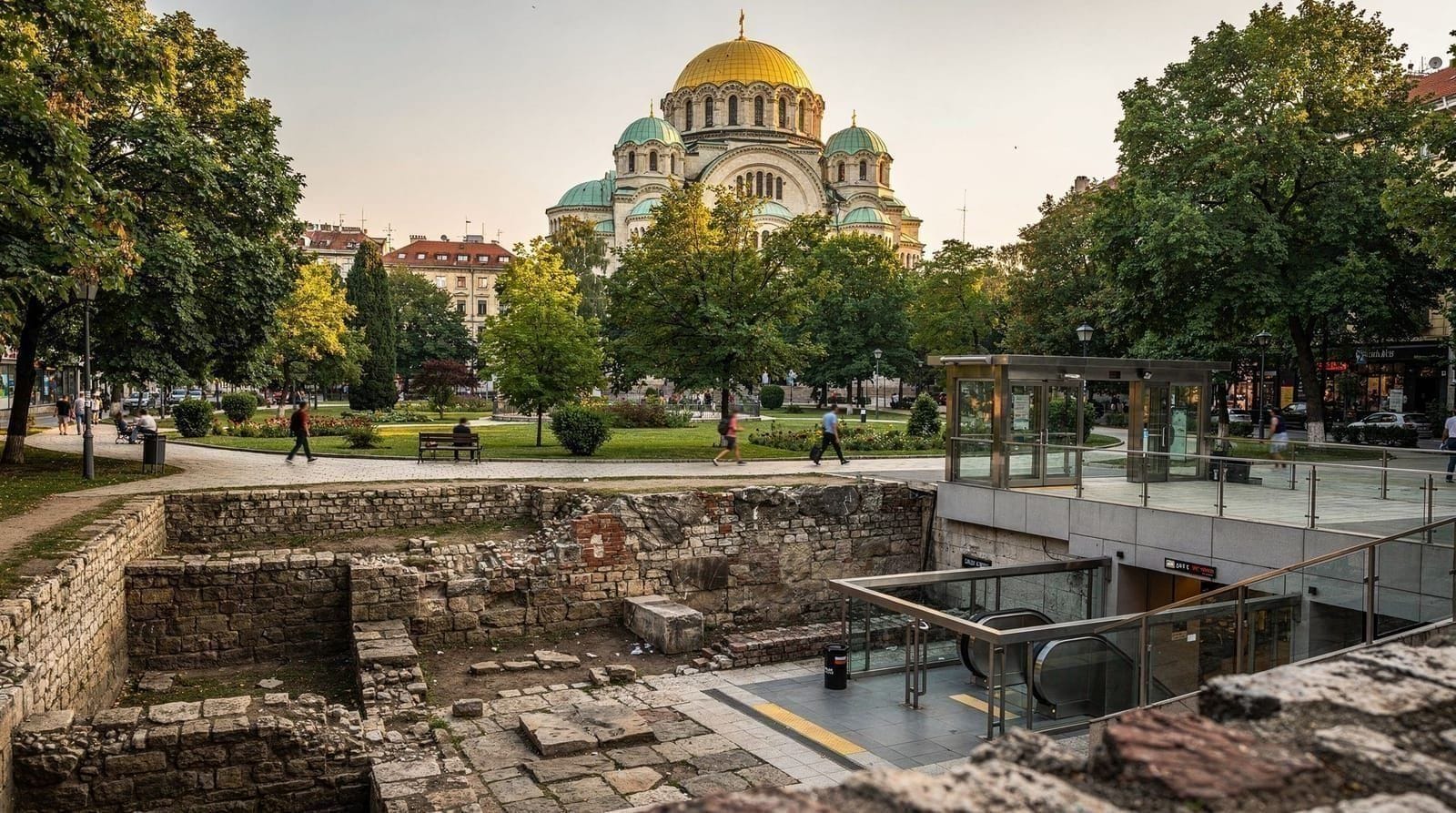
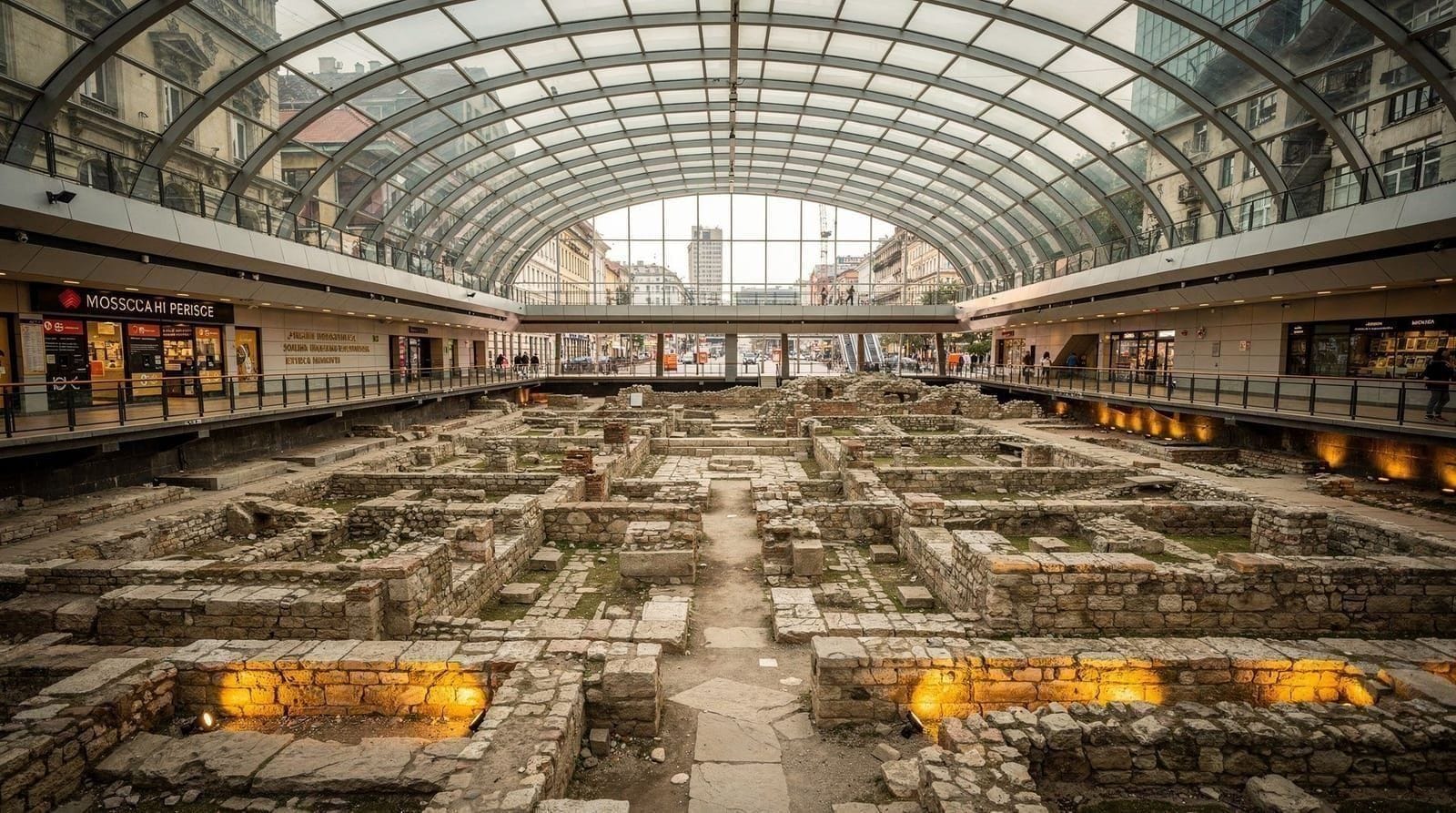
When Serdica metro was built in the 2000s, excavations uncovered one of the best-preserved sections of the ancient Roman city’s street grid. Rather than bury the finds, Sofia incorporated them into the station design. You can walk through a glass-walled passage between the two metro lines and see Roman streets, foundations, and water channels dating from the second to fourth century AD — all free, all without leaving the metro environment.
This is not a reconstruction. The stones you see are the actual Roman stones, at the actual level they were when the city was a provincial capital of 30,000 people. Take five minutes here even if you’ve been to Rome. The juxtaposition — commuters with phones rushing past a first-century drainage canal — is very specifically Sofia.
Full context on what you’re seeing is in the Serdica Roman ruins guide.
Stop 2: The Largo and the Socialist skyline
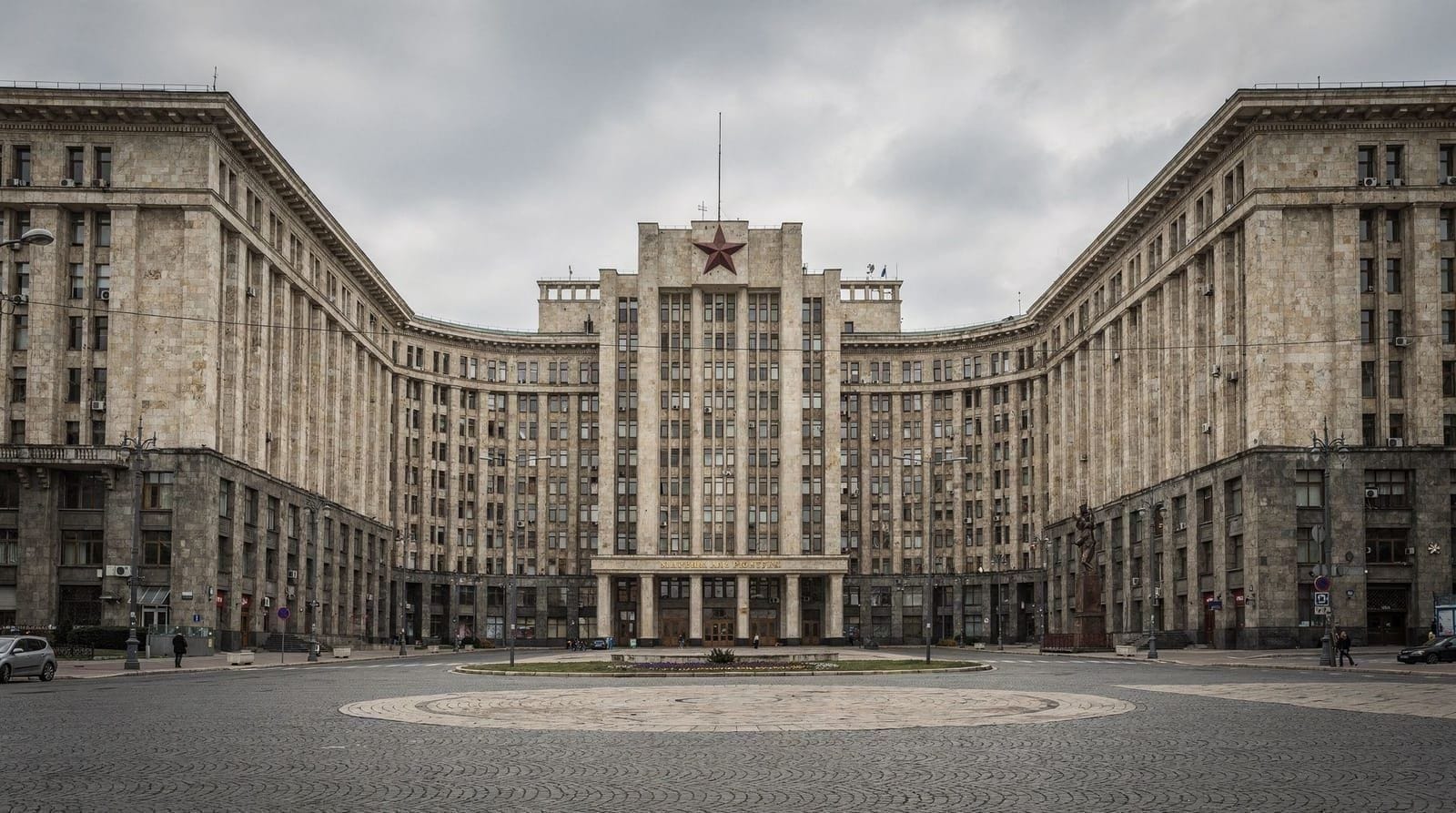
Exit onto the Largo. This open plaza was redesigned in the 1950s to reflect Soviet urban planning ideals: wide, formal, and slightly intimidating. Three monumental buildings frame it — the Council of Ministers, the former Communist Party Headquarters (now the Presidency), and the Central Department Store (TSUM). The red star that once sat atop the Party building was removed in 1990.
Look at your feet. Embedded in the square are more sections of Roman ruins from ancient Serdica — low walls and column bases visible behind glass barriers. The Largo itself sits on top of what was once the heart of the Roman city.
If you’re interested in how Sofia’s communist past shaped its streets, buildings, and public art, the communist Sofia walking tour or a dedicated socialist monuments guide covers this in much more depth.
Stop 3: Rotunda of St George
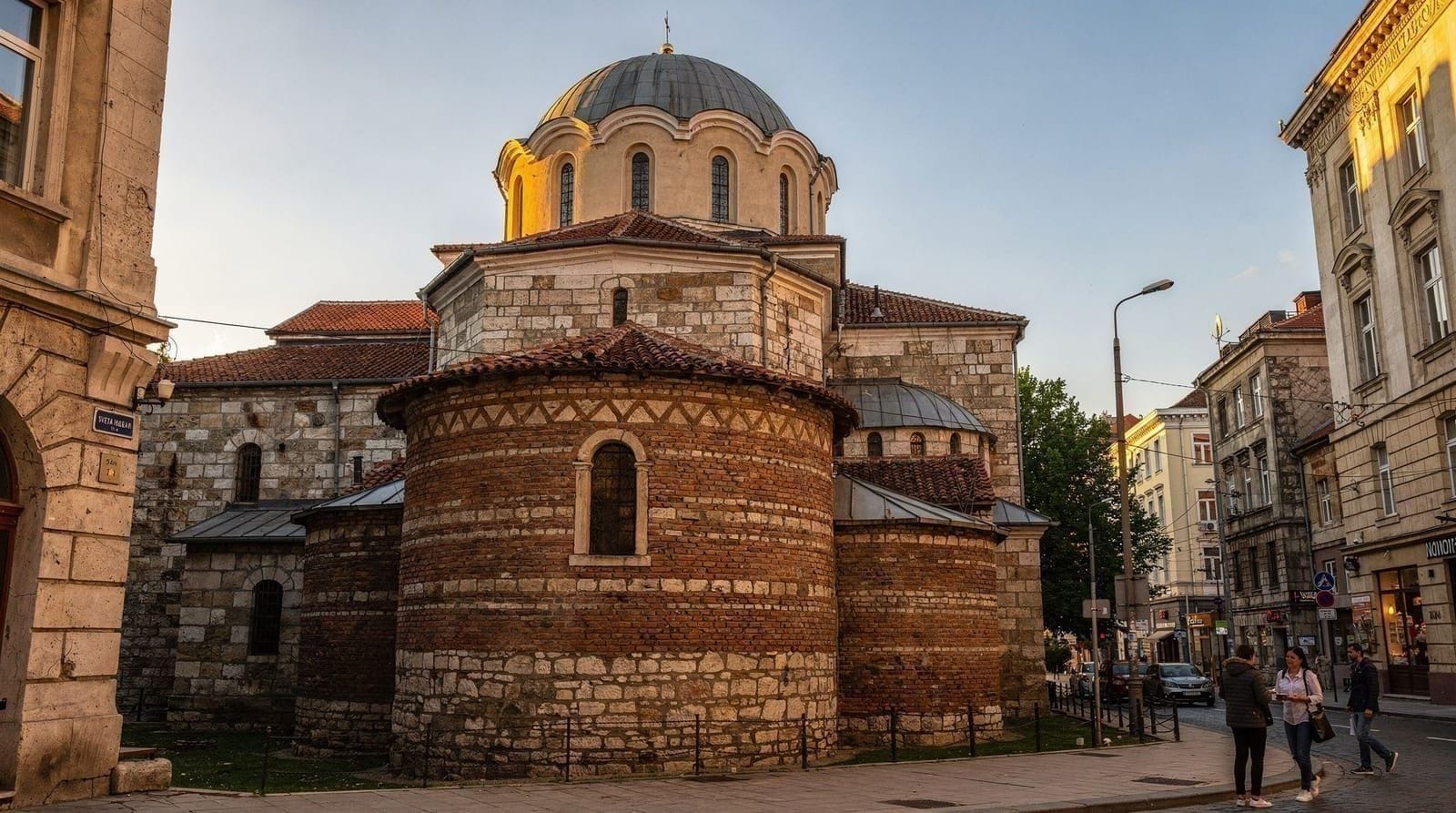
Walk south from the Largo about 50 metres into the courtyard of the Sheraton Hotel. In the centre of this unlikely setting — surrounded by a Soviet-era hotel on one side and Roman foundations on the other — stands the Rotunda of St George: a small red-brick cylinder that is the oldest surviving building in Sofia.
It was built in the fourth century, most likely during the reign of Constantine the Great, as a mausoleum or ceremonial bath. Constantine reportedly had a particular affection for Serdica — a contemporary source quotes him saying “Serdica is my Rome.” The building was later converted into a Christian church, and then, under Ottoman rule, into a mosque. The layers of that history are literally visible inside: if you look up at the dome, you can see where frescoes were plastered over during the mosque period and later uncovered.
Entry is free and the Rotunda is open most mornings. It’s small — you can see the interior properly in ten minutes — but it is the single most historically layered building on this entire walk.
Stop 4: Presidency building and the changing of the guard
Back on the Largo, the building with the white-uniformed guards is the Presidency — the office of the Bulgarian head of state. The ceremony here is low-key compared to London or Copenhagen, but it happens every hour on the hour and lasts about five minutes. The uniforms are elaborate 19th-century cavalry dress. If you time the walk right, it costs nothing to watch.
The building itself was the Communist Party headquarters until 1990 and has a complicated history. The president’s role in Bulgaria’s parliamentary system is largely ceremonial.
Stop 5: Church of St Nedelya
Walk east along Tsar Osvoboditel Boulevard for five minutes to reach the Church of St Nedelya, a large domed Orthodox church sitting in its own square. The current building dates from 1925 — it was rebuilt after a catastrophic assassination attempt in April of that year, when anarchists detonated a bomb in the roof during a state funeral, killing 213 people in what remains one of the deadliest terrorist attacks in European history before the Second World War.
The tsar and his cabinet survived only because they were delayed. The current church is sober and dignified, the interior well worth stepping into for a moment. Entry is free.
Stop 6: Alexander Nevsky Cathedral
Continue east on Tsar Osvoboditel to the Alexander Nevsky Cathedral, Sofia’s defining landmark and one of the largest Orthodox cathedrals in the Balkans. The copper-green and gold domes are visible from most of the city centre.
The cathedral was built between 1882 and 1912 to commemorate the Russian soldiers — roughly 200,000 of them — who died in the 1877–78 Russo-Turkish War that ended Ottoman rule of Bulgaria. It is a Russian church in Bulgaria, which tells you something important about Bulgarian-Russian history and the complicated gratitude that runs through it.
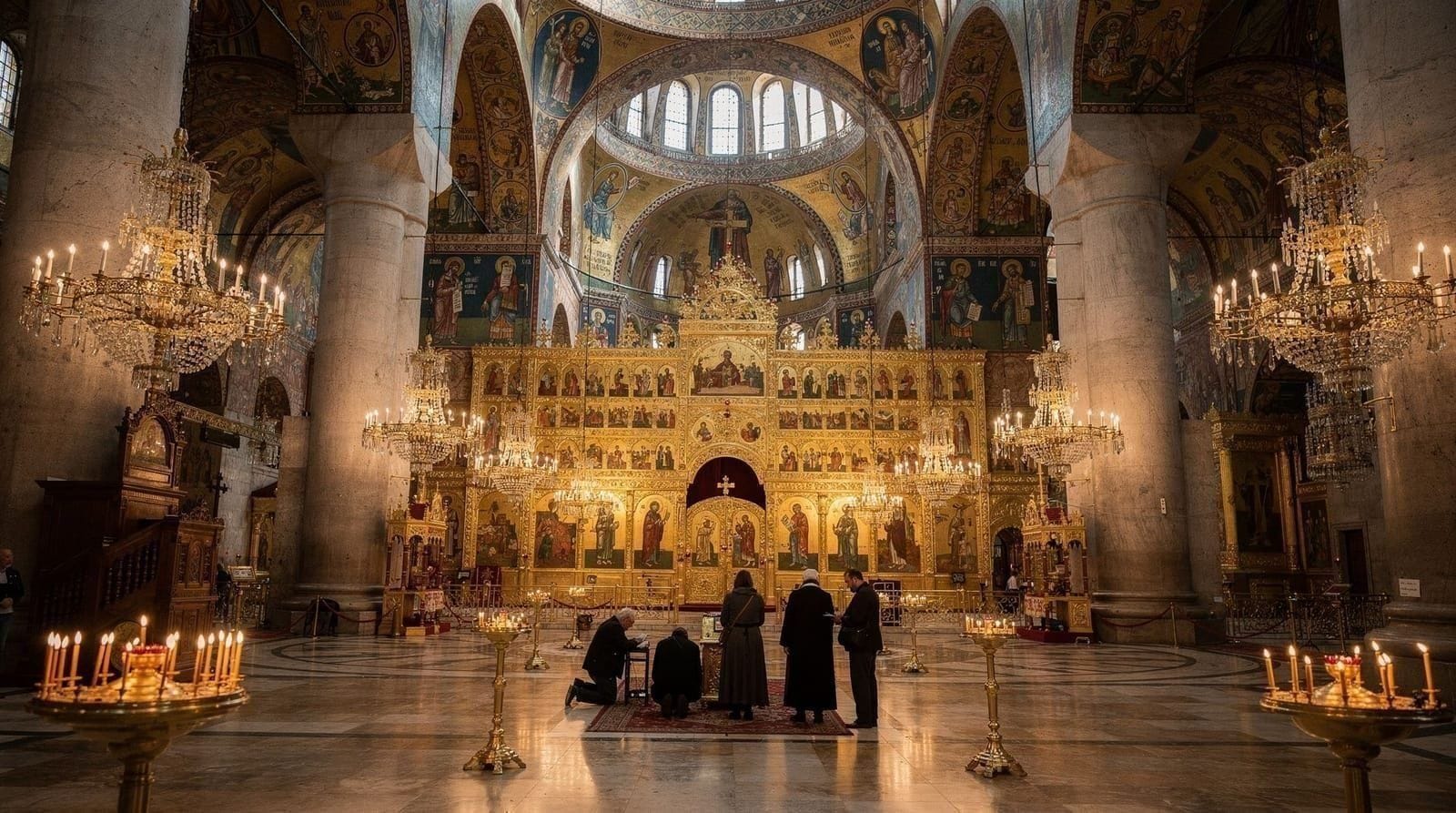
The nave is free to enter. Inside: mosaics, massive chandeliers, carved iconostasis, and a general sense of purposeful grandeur. The icon gallery in the crypt (separate entrance on the south side, €3) holds Bulgaria’s finest collection of medieval and National Revival icons — genuinely outstanding and consistently under-visited. Budget an extra 30–40 minutes if you enter.
Full details, history, and visiting tips are in the dedicated Alexander Nevsky Cathedral guide.
GetYourGuideSofia Walking TourCheck availability →Stop 7: Sofia University and National Gallery
Directly across the square from Alexander Nevsky is the National Gallery (formerly the Royal Palace), housing Bulgarian art from the 19th century to the present. Entry is €5. The building itself — a neoclassical palace built for the Bulgarian princes after independence — is handsome.
Next to it, the Sofia University St Kliment Ohridski occupies a grand 1930s building along Tsar Osvoboditel. The university is not a tourist sight per se, but the wide boulevard in front of it, lined with linden trees, is one of the most pleasant sections of the walk. The pedestrian underpass near the university sometimes hosts small exhibitions or musicians.
For a deeper look at Sofia’s museums, see the Sofia museums guide.
Stop 8: Banya Bashi Mosque
Head west along Maria Luisa Boulevard, back toward the city centre, to the Banya Bashi Mosque — a 16th-century Ottoman mosque that is the only still-functioning mosque in Sofia. It was built in 1576, probably by the Ottoman court architect Mimar Sinan or his school.
Non-Muslim visitors may enter outside prayer times, with shoes removed and appropriate dress. The interior is modest — a single dome, tiled walls, no figurative imagery — and the visit takes about ten minutes. What makes it significant is not the interior but the survival: Bulgaria has a substantial Muslim minority (around 10% of the population), and the mosque is genuinely in use, not a museum.
Notice the steam rising from the ground nearby. The mosque was built next to the mineral springs that have been flowing through Sofia since Roman times. The Banya Bashi mineral baths — the large yellow Art Nouveau building next door — used to be public baths; they now house a museum about the springs. For more on Sofia’s thermal water heritage, see the Sofia mineral baths guide.
Stop 9: Sofia Synagogue
A two-minute walk south of the mosque is the Sofia Synagogue — and yes, the juxtaposition of these two buildings is very deliberate as a walking itinerary, because it reflects the actual geography of Sofia’s religious communities. The synagogue, built in 1909, is one of the largest in Europe and follows a Moorish Revival style unusual for the Balkans. Its yellow-and-red striped exterior is striking.
Entry is €4. The interior features a 2,000 kg chandelier, Viennese-style ironwork, and a small museum documenting the history of Bulgaria’s Jewish community — including the remarkable story of how Bulgaria, under German pressure during World War II, deported Jews from occupied Thrace and Macedonia but ultimately protected its own 50,000 Bulgarian Jewish citizens from deportation through a combination of public protest and political resistance.
Stop 10: Vitosha Boulevard and the walk south
From the Synagogue, walk south to Vitosha Boulevard — Sofia’s main pedestrian shopping street, running from Sveta Nedelya Square toward the NDK (National Palace of Culture). This is the urban wind-down section of the walk: good cafés, some decent shops, and the distant backdrop of Vitosha Mountain at the far end of the street on clear days.
Vitosha Boulevard is largely modern and commercial. The draw is the atmosphere of a working city on its main street, not heritage architecture. It is also where Sofia’s coffee culture is most visible — small flat whites, fresh pastries, and a very strong local tradition of sitting outside regardless of the weather.
For a proper sit-down, the section around pl. Slaveykov (a small square partway down, with a famous open-air second-hand book market) is the best choice. The sofia coffee culture guide has the full picture on where locals actually drink.
The layers beneath the surface
One thing this walk tries to make clear is that Sofia is a city built on top of itself, repeatedly. The Serdica metro ruins give you the clearest visual proof: here is a modern underground railway running through a Roman street that is eighteen centuries old. But the layering continues above ground too.
The Banya Bashi Mosque and the Sofia Synagogue stand within 200 metres of each other, and within 400 metres of a fourth-century Christian rotunda that was itself converted to a mosque during the Ottoman period before being re-converted. These are not coincidences of geography — they reflect the actual movement of communities and faiths through the same urban space over a long time. Sofia was Serdica, then Sredets, then Triaditsa, then Sredets again, then Sofia. Each name change reflects a shift in who controlled and shaped the city.
The Communist era added another layer, more recent and still contested. The Largo’s monumental granite was a 1950s intervention that physically demolished earlier neighbourhoods to create a ceremonial plaza appropriate to the new socialist state. The Party headquarters building (now the Presidency) had a red star on its roof until 1990. The scale of the wide boulevards around it — oversized for the actual pedestrian traffic they carry — is a legacy of Soviet urban planning ideology.
Walking this route attentively means seeing all of these layers simultaneously, which is harder than it sounds when there are also trams, coffee shops, and pigeons to navigate. If you find you want a guide to help read the city, the tour options listed below are genuinely useful for exactly this purpose.
Food and coffee on the route
The walk passes through one of Sofia’s best areas for eating and drinking, and timing a break well is worth planning.
Coffee: The most atmospheric coffee stops near the route are on Vitosha Boulevard and the streets immediately west of it — a dense cluster of independent cafés where the flat white culture is taken seriously. Avoid the chain cafés on the Largo itself; they’re overpriced and impersonal.
Lunch: The pedestrianised streets around pl. Slaveykov have several good options for Bulgarian food at reasonable prices. A banitsa (cheese or spinach pastry, €1–1.50 from a street bakery) is the right call for a mid-walk snack. For a proper meal, the banitsa and street food guide covers the options, and the sofia food guide covers everything from restaurants to market halls.
Water: Drink from the taps. Sofia’s water is excellent — a combination of mountain spring sources — and the city has multiple free drinking fountains near the mineral baths on Maria Luisa Boulevard. The thermal water there is warm and slightly sulphurous; some people drink it for health reasons, many others find the smell enough of a deterrent.
What to skip
The Lion Bridge area is often listed in walking guides but is a 15-minute detour that adds little unless you’re specifically interested in Art Nouveau ironwork. The National History Museum is legitimately excellent but is a 30-minute bus ride from the centre and needs a half-day of its own — do not try to fold it into this walk. The Archaeological Museum, housed in the old Ottoman mosque near the Largo, is worth entering if you want to go deeper on Roman Serdica; see the serdica roman ruins guide for what’s inside.
When to do this walk in the year
Sofia’s historic centre is walkable year-round but the experience varies significantly by season.
Spring (April–June): The best time. The lime trees on Tsar Osvoboditel are in leaf and then in flower (late May, when the scent is extraordinary). Temperatures are mild (15–22°C), crowds are manageable, and the longer daylight hours give you flexibility. The best time to visit Sofia guide discusses this in more detail.
Summer (July–August): Hot (often above 30°C) and crowded, but operational. Start by 9am and you’ll be done before the worst heat. Alexander Nevsky and the Rotunda offer shade and cool stone. Keep Vitosha Boulevard for late afternoon when the shade from the buildings reaches the street.
Autumn (September–October): Almost as good as spring. The air is cleaner after summer, the light is softer, and tour groups have reduced. October is arguably the best single month to walk Sofia.
Winter (November–March): Cold (occasionally below freezing, sometimes snow), short days, but many fewer tourists. The Christmas market around the Largo is one of the better versions in the region. The museums are quieter. Alexander Nevsky in December light, surrounded by light snow on the domes, is genuinely beautiful.
Practical details
Distance: approximately 3.5 km
Duration: 3–4 hours at a sightseeing pace; 5+ hours if you enter the Cathedral crypt, Synagogue, and at least one museum
Public transport: Start at Serdica metro (Lines 1 and 2). The route ends on Vitosha Boulevard, from which multiple tram and metro connections are available at NDK station.
Best season: May–June and September–October. Manageable in winter; beautiful in spring when the lime trees on Tsar Osvoboditel are in bloom.
Cost of walk: Mostly free. Budget €10–15 if you pay for the Cathedral crypt (€3) and Synagogue (€4) plus a coffee.
For transport logistics from the airport or within the city, see getting around Sofia and Sofia airport to city.
GetYourGuideSofia: Private Walking TourCheck availability →Going deeper: day trips and wider context
This walk covers sofia city centre. Once you’ve seen the centre, the most logical next steps are Boyana Church (4 km south, UNESCO frescoes), Vitosha Mountain (skiing, hiking, views directly above the city), and the classic day trips from Sofia — particularly Rila Monastery and Plovdiv.
If two or three days is all you have, see sofia in 2 days or sofia in 3 days for structured itineraries that build on this walk.
GetYourGuideSofia: Alternative Walking TourCheck availability → GetYourGuideThe Real Sofia Insider Tour – Exclusive Inside AccessCheck availability →Facilities along the route
There is no shortage of places to rest. Cafés cluster around pl. Slaveykov and along Vitosha Boulevard, with outdoor seating even in cooler months — Bulgarians sit outside year-round, and joining them is part of the experience. Public toilets are scarce; the practical approach is to use facilities at a café when you stop for coffee, or at the National Gallery or Archaeological Museum if you’re entering either. Benches are plentiful in the small squares around St Nedelya and Slaveykov, useful for a short break without committing to a full café stop. Free drinking-water fountains near the mineral baths on Maria Luisa Boulevard are a good top-up point roughly two-thirds of the way through the route.
Photography notes along the route
The best light for the Alexander Nevsky domes is mid-morning, when the sun catches the gold from the east without harsh shadows across the square. The Rotunda’s interior is dim — a small tripod-free camera with decent low-light performance helps more than a wide lens. Sunset from Vitosha Boulevard, with Vitosha Mountain silhouetted at the far end on a clear day, is the single best closing shot of the walk, and it lines up naturally if you finish the route in late afternoon rather than rushing it in one go.
Doing the walk in reverse or in two halves
Nothing about the route requires starting at Serdica. Doing it in reverse — starting on Vitosha Boulevard with coffee, then working north through the Synagogue and mosque toward the Largo — works just as well and can be a good option if your accommodation sits closer to NDK than to Serdica metro. Splitting the walk into two half-day outings is also sensible if you are combining it with museum visits: morning for stops 1–6 (Serdica to Alexander Nevsky, including the crypt), and a separate afternoon or the next day for stops 7–10, which flow naturally into an evening on Vitosha Boulevard.
Travelers based near NDK or staying multiple nights often prefer this two-half-day version anyway, since it avoids the fatigue of a single long walk and leaves energy for a proper sit-down dinner rather than a rushed final stretch. This split pairs well with the Sofia museums guide if you want to add the Archaeological Museum or National Gallery without turning the day into a marathon.
Frequently asked questions about Sofia old town walking route
Is Sofia old town walkable in one morning?
Yes. Start at 9am at Serdica metro station and you'll reach Vitosha Boulevard by early afternoon. Avoid midday in July–August when heat is intense; morning and late afternoon are the most comfortable slots.Are there entrance fees on this route?
The Roman ruins at Serdica station are visible for free through glass panels. The Rotunda of St George is free. Alexander Nevsky Cathedral nave is free; the icon crypt costs €3. The Sofia Synagogue charges €4. Everything else on the route is free to walk past.Is this walk accessible with a pushchair or wheelchair?
Mostly yes. The main pavements on Vitosha Boulevard and around Largo are flat and wide. The Rotunda courtyard has some uneven stone. The Synagogue entrance involves steps. Church of St Petka Samardzhiiyska is underground with stairs.What should I wear for the churches?
Shoulders and knees should be covered when entering any Orthodox church. Light scarves work perfectly in summer. The Synagogue requires men to wear a kippah, available at the entrance.Can I combine this walk with a guided tour?
Yes, and it is a good idea for your first visit. Guides explain the layers of history that are easy to miss — particularly around the Roman Largo and the Socialist-era buildings that frame it. See the tour options at the end of this guide.Where should I stop for lunch on this walk?
The pedestrianised streets around pl. Slaveykov, roughly halfway through the route, have the best concentration of reasonably priced Bulgarian food. A banitsa from a street bakery works as a quick mid-walk snack for around €1–1.50; for a sit-down meal, budget around €8–15 per person.Does this walk work well with young children?
Yes, in shorter form. The route is flat and stroller-friendly apart from the Rotunda's uneven courtyard and the Synagogue's entrance steps. Consider splitting it into two shorter outings rather than the full 3–4 hours, and see the Sofia with kids guide for pacing tips.
Top experiences
Bookable activities with verified prices and instant confirmation on GetYourGuide.