Bulgarian dishes to try in Sofia: the essential food list
Sofia: 16 Pirotska Street Bulgarian Food and Drinks Tasting
What are the must-try dishes in Bulgaria?
Shopska salad, banitsa, tarator, kavarma, and kebapche are the essential five. For the adventurous: shkembe chorba (tripe soup). For drinks: rakia before a meal, ayran alongside spicy food, and Bulgarian mavrud wine with anything grilled.
Bulgarian food is one of the most underrated cuisines in southeastern Europe. Not because it is refined or technically ambitious — traditional Bulgarian cooking is fundamentally peasant food: honest, ingredient-led, and built around dairy, grains, and seasonal produce from the mountains and plains. It is underrated because the country’s isolation during the communist period kept it off the international food circuit, and the wave of generic Mediterranean restaurants that arrived after 1989 pushed the traditional cooking into homes and mehanas rather than into the places tourists see.
What follows is an honest account of what you should try, what to expect, and where the good versions are.
| Where | Neighbourhood mehanas in Oborishte, Lozenets; Women’s Market; halite |
| Cost | €3–13 per dish; a full mehana meal €10–15 |
| Time needed | One mehana lunch (1 hr) or a guided tasting walk (3 hrs) |
| Getting there | Most mehanas are a short walk or tram ride from the centre |
| Best time | Lunch on a weekday for fresh, made-to-order dishes |
Shopska salad — the national dish
If Bulgaria has a single defining dish, it is shopska salad. The ingredients are simple to the point of obviousness: diced tomatoes, cucumber, raw onion, green pepper, and a generous snowfall of grated sirene — white brined cheese. A drizzle of sunflower oil, sometimes a few olives or pickled pepper. That is it.
The quality depends entirely on the ingredients. The tomatoes need to be ripe — and in Bulgarian summer, the tomatoes from village gardens and the Women’s Market are extraordinary: intensely flavoured in a way that mass-produced supermarket tomatoes in Western Europe never are. The sirene matters enormously. Good Bulgarian sirene is creamy, tangy, and not aggressively salty. Bad sirene is industrial feta-equivalent and ruins everything.
Ordering tip: ask for extra cheese (povechye sirene, molya). Every traditional mehana will give it to you without complaint. Some charge a small extra; most do not. The ratio should be roughly equal parts cheese to everything else.
Where to try it well: any proper mehana in Oborishte or Lozenets. The sofia food guide has specific restaurant picks. Avoid the shopska salad at tourist-facing restaurants around Alexander Nevsky — the tomatoes are often refrigerated and the cheese is from the cheapest wholesale supplier.
Cost: €3-5 as a first course in a neighbourhood restaurant.
Banitsa — the essential pastry
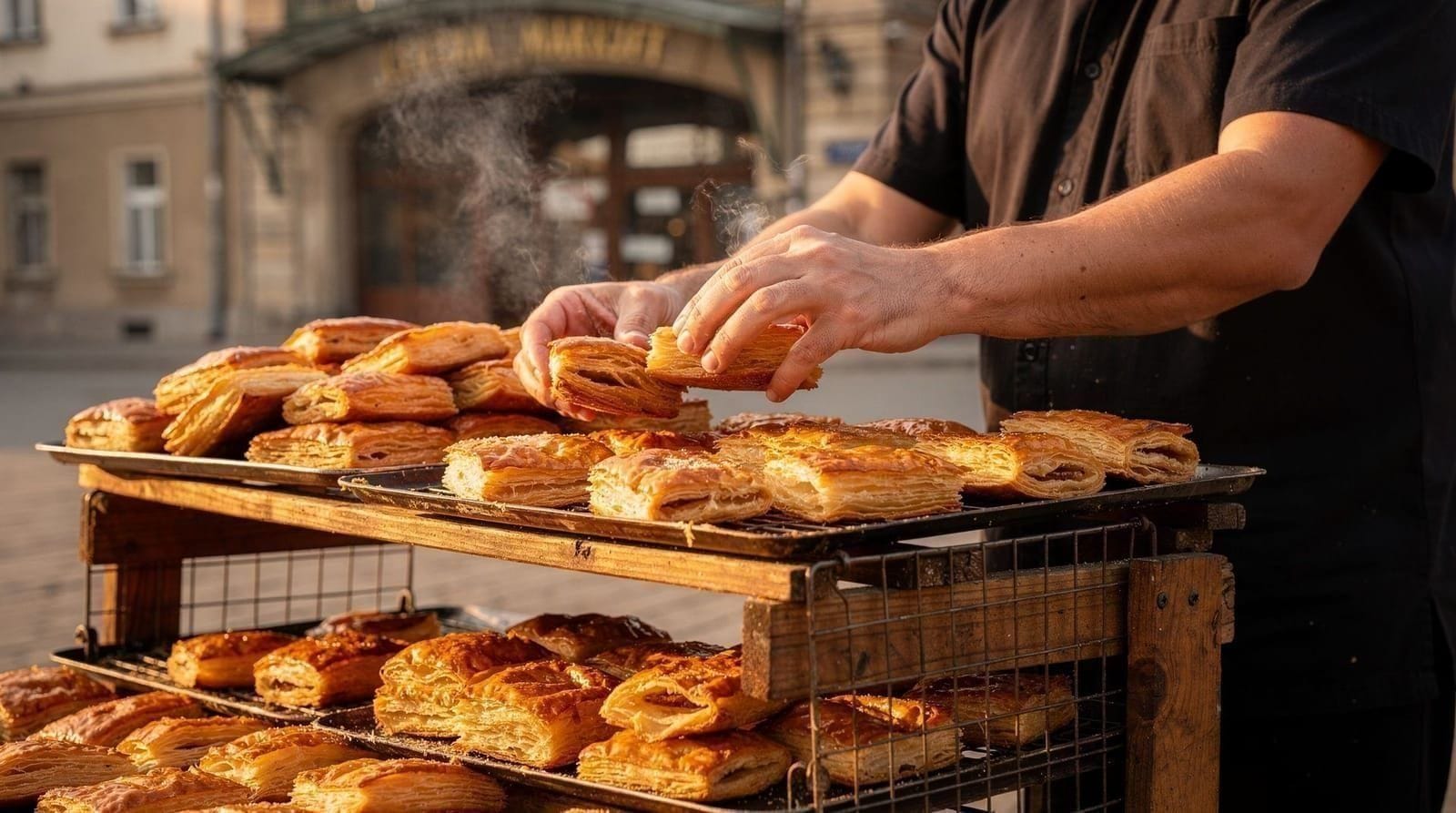
Banitsa is the most democratic food in Bulgaria: eaten for breakfast by construction workers, pensioners, and bank managers alike, found in every bakery in the country, costing €1-2, and consumed standing up or on the move as often as sitting down.
The pastry is filo layered with a filling of crumbled sirene, eggs, and a little yogurt, then baked until the top is golden and the inside is hot and molten. The best banitsa comes out of the oven between 7am and 10am. By noon it has cooled and lost its essential quality; by 4pm it is a different, inferior thing.
The standard filling is cheese (sirene). Variations include spinach and cheese (spanak i sirene), meat (mesna), and sweet pumpkin (tikva) — the sweet version is a winter special, typically made at Christmas. None of them are the same as the cheese version; try that first.
Where to get it: the bakeries inside the Central Market Hall (halite), the Women’s Market stalls, and any neighbourhood bakery with a queue before 9am. See the full banitsa and street food guide for specific addresses and the New Year’s fortune banitsa tradition.
Cost: €1-2 fresh from the oven. The ayran (yogurt drink, see below) that Bulgarians drink alongside it costs another €1.
GetYourGuideSofia: Banitsa Pastry Class with a Local with Bulgarian WineCheck availability →Tarator — cold yogurt soup
In a hot Sofia August, tarator is not just pleasant but necessary. This cold soup is everything that the Bulgarian relationship with yogurt represents: simple, practical, and significantly better than it sounds to people who have not tried it.
The base is Bulgarian kiselo mlyako — the thick, tangy fermented yogurt that Bulgaria has been producing for centuries, using the Lactobacillus bulgaricus bacteria that Bulgarian microbiologists identified and named. Into the yogurt go grated cucumber, fresh dill, crushed walnuts, a small amount of garlic, water to thin it to a soup consistency, and sunflower oil. The result is a cold, creamy, faintly nutty, deeply refreshing bowl.
Bulgaria’s relationship with yogurt runs deep. The country claims — with some scientific legitimacy — to have given the world yogurt culture. Lactobacillus bulgaricus was first identified in Bulgarian fermented milk in 1905, and Bulgarian yogurt has its own PDO (Protected Designation of Origin) status in the EU. You will understand why after tasting the real thing.
When to eat it: May through September, as a first course before anything heavier. Most mehanas list it but may not have it in cooler months — it is a seasonal dish in practice.
Cost: €3-5 as a starter.
Shkembe chorba — tripe soup
This is the dish that divides visitors more than any other. Shkembe chorba is tripe soup: slow-cooked stomach lining in a hot, fatty, paprika-spiced broth, served with vinegar, garlic, and red pepper on the side for self-seasoning. It is intensely savoury. The smell is distinctive and not subtle.
It is also, to many Bulgarians, the most important breakfast of their lives: consumed at 6am after a night of rakia, credited with preventing hangovers or softening their aftermath. Several restaurants in Sofia stay open late specifically to serve shkembe chorba to the post-midnight crowd. This is not marketing; it is a genuine cultural practice.
You should try it, even if you do not expect to enjoy it, because it is one of the clearest windows into a strand of Bulgarian food culture that the tourist-menu version never shows you. Order it, season it heavily with the vinegar and garlic, and drink at least three spoonfuls before deciding.
Cost: €3-5. Available at traditional mehanas and at some specialist early-morning spots.
A strong suggestion: do not try it as your first Bulgarian food experience. Try shopska, kavarma, and kebapche first. Come to shkembe chorba when you have context.
Kavarma — clay pot stew
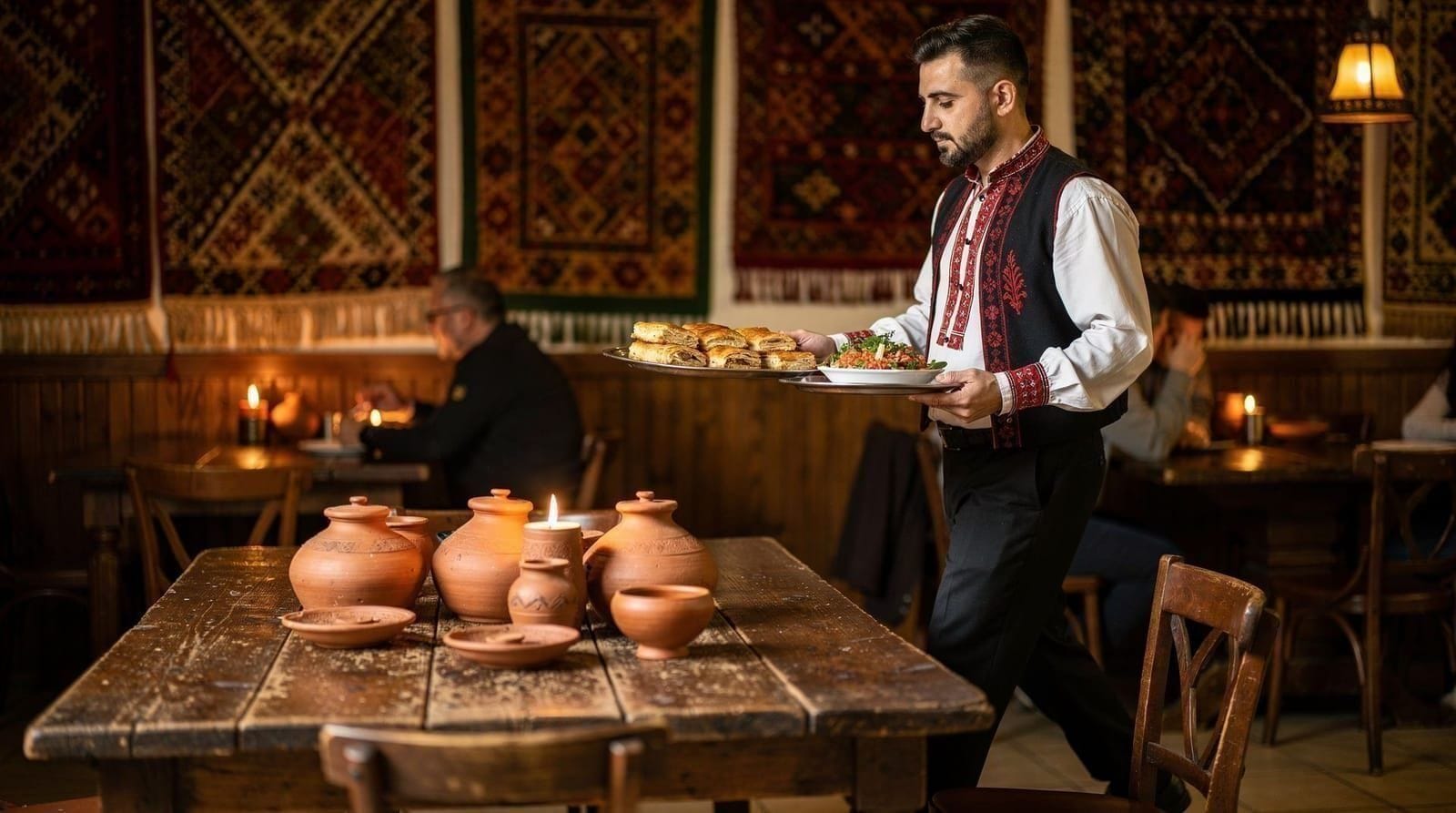
Kavarma is perhaps the best argument for eating at a traditional mehana rather than a modern restaurant. The dish is meat — pork or chicken, sometimes lamb — cut into pieces and slow-cooked with onions, peppers, mushrooms, and wine in an individual clay pot that goes into a traditional oven and stays there for several hours.
The result does not translate to any other cooking method. The clay pot creates a steam environment that keeps the meat from drying, the long cooking breaks down connective tissue into gelatin, and the confined space concentrates flavours in a way that a regular oven casserole never achieves. A well-made kavarma arrives at the table still bubbling, the top barely set, the meat falling apart, the sauce thick enough to demand bread.
Quality varies dramatically. At a good mehana where the chef makes it fresh in the morning and keeps it in the oven until ordered, it is extraordinary. At a place that makes it in batches and reheats portions, it is acceptable but missing the essential quality.
How to identify the good version: order it at lunch on a weekday at a neighbourhood mehana. Ask if it is made today (dnes li e napravena). Any cook worth their salt will say yes, and will mean it.
Cost: €8-13 depending on the meat and the restaurant.
Kebapche and kyufte — grilled meat staples
These two are the workhorses of the Bulgarian grill and appear on every mehana menu without exception. Kebapche are elongated rolls of seasoned minced pork (sometimes pork-beef), grilled over charcoal. Kyufte are flattened patties of the same basic mixture. The difference is mostly shape; the seasoning is similar — cumin, black pepper, salt, and sometimes a trace of savory (chubritsa), the herb that appears in Bulgarian cooking the way oregano appears in Italian.
The key variable is freshness. Good kebapche is minced that morning, mixed with spices by hand, shaped and grilled to order — the inside stays juicy, the outside chars properly. Mediocre kebapche has been sitting pre-formed since morning and arrives pale, dense, and dry.
Ordering tip: if you see the grill working actively and the restaurant is busy, the kebapche is probably good. If the grill is empty and you are the only customer, order something else.
Accompaniment: served with white bread, shopska or tomato salad, and sometimes lyutenitsa (roasted pepper spread). The bread is for soaking up the fat; do not skip it.
Cost: €6-10 for a portion of two or three, with salad.
Gyuvech — ceramic pot vegetables
Gyuvech (pronounced roughly “gyu-vech”) is a baked dish of vegetables and sometimes meat in a ceramic pot — the name applies to both the pot and the dish. The vegetable version (zelenchukovo gyuvech) is a mixed bake of courgettes, peppers, onions, tomatoes, and green beans, topped with egg and feta towards the end of cooking. It is Bulgarian comfort food in its most approachable form.
The meat version adds pork or lamb to the same vegetable base. Both versions take at least an hour in the oven; restaurants that do it properly will tell you to wait twenty minutes after ordering.
Cost: €7-12 depending on version.
Mish-mash — the Bulgarian scrambled eggs
The name sounds dismissive; the dish is not. Mish-mash is scrambled eggs cooked with roasted peppers, tomatoes, and crumbled sirene, done in a frying pan over high heat until set but not rubbery. It is the definitive Bulgarian breakfast and one of the best arguments for going to a mehana at 9am rather than a hotel buffet.
The key is the peppers — they need to have been roasted (charred skin removed), not raw or sautéed. Good mish-mash has a slight smokiness from the peppers that ties everything together.
Cost: €4-7 at a breakfast mehana or café.
Rakia — the national spirit
Rakia is fruit brandy, produced across the Balkans but most fiercely claimed by Bulgaria. The most common varieties are slivova (plum), grozdoba (grape), and kaysieva (apricot). A house-distilled rakia from a mehana in Koprivshtitsa or a village near Melnik is a different product from the bottled versions — stronger, more aromatic, and occasionally extraordinary.
The protocol around rakia is not complicated but it is real. You drink it slowly, in small sips, alongside cold starters — shopska salad, lutenitsa, white cheese, olives. You do not drink it fast. You do not drink it without food nearby. You do not mix it with other spirits in the same sitting without expecting consequences. Bulgarians take the pace of rakia drinking seriously; matching that pace is a sign of respect.
Varieties to try:
- Slivova (plum): the most common, ranges from medicinal to excellent
- Grozdoba (grape): lighter, more refined, closer to a young grappa
- Kaysieva (apricot): aromatic, slightly sweet, the most approachable for newcomers
Cost: €2-4 for a 50ml pour at a mehana. House rakia is usually priced the same as or slightly more than bottled.
GetYourGuideSofia: Bulgarian Yogurt Tasting in Ancient RuinsCheck availability →Ayran — the yogurt drink
Ayran is yogurt thinned with cold water, salted, and sometimes frothed — a cold drink that appears wherever Bulgarian food is served. It is the natural pair for anything spicy or rich, cutting through fat and heat in a way that beer or wine does not.
The Bulgarian version is made from kiselo mlyako, which gives it a tanginess and depth that the Turkish or Middle Eastern versions often lack. Buy it from a dairy stall at the Central Market Hall to understand what it should taste like before comparing it to the refrigerated commercial versions in restaurants.
Cost: €1-2. Available in bottles at any supermarket, fresh from dairy stalls at the markets.
Bob chorba — the soul of Bulgarian winter
Bean soup does not require a long explanation but it deserves one, because bob chorba is not merely a warm starter: it is the dish that kept much of rural Bulgaria fed through hard winters for centuries and remains one of the most satisfying things you can eat in the city on a cold day.
The base is white beans — small, creamy varieties specific to Bulgarian highland growing — cooked until just tender with onion, dried chilli, dried mint, and a finishing touch of oil. That is it. The result is thick, earthy, slightly smoky from the pepper, and deeply restorative. With bread and a shopska salad, it is a complete lunch for €6-8.
Good bob chorba requires patience in the cooking that cannot be shortcut. Places that do it properly will have it from Monday through the week, not just on slow Sundays when they have time. If a mehana has bob chorba on Tuesday, it probably knows what it is doing.
Mish-mash — the Bulgarian scrambled eggs
Before mish-mash became an international slang term for a mess or mixture, it was a Bulgarian breakfast dish, and the Bulgarian version is considerably more coherent than the word suggests.
The dish is scrambled eggs cooked with roasted peppers, fresh tomatoes or tomato paste, and crumbled sirene cheese. The peppers need to have been roasted — properly charred over flame or under a grill, peeled — not sautéed or added raw. The smoke from the peppers is structural to the flavour. Good mish-mash has a depth and complexity that makes the scrambled eggs you have been eating your whole life seem underachieving.
It is a dish that requires a certain temperature of pan and speed of cooking to work: too slow and the eggs become rubbery, the tomatoes release too much water, and the whole thing goes watery and flat. At the best mehana breakfasts and at well-run café kitchens, it arrives just set, slightly loose, with the pepper smokiness woven through rather than sitting on top.
When to eat it: breakfast or brunch, 9am to noon. Most mehanas that serve mish-mash list it under breakfast, not all-day menus.
Cost: €4-7.
Desserts and sweet things
Bulgarian sweet food is not the strength of the cuisine in the same way the savoury dishes are, but several things are worth knowing about.
Baklava — the layered nut-and-honey pastry appears on most mehana menus as a dessert option. Bulgarian baklava is similar to Greek and Turkish versions: flaky filo, crushed walnuts, sugar syrup. It is not usually remarkable, but at good pastry shops it is competent and satisfying.
Sutlyash — rice pudding, served cold, with a burnt-sugar crust. Bulgarian sutlyash is creamier and less sweet than most Western European rice puddings. Find it at traditional mehanas.
Halva — sesame or sunflower seed paste pressed into blocks, sweet and dense. Sold in markets, eaten as a snack rather than a dessert course. The sunflower version is specifically Bulgarian and worth trying.
Kozunak — a brioche-style sweet bread eaten at Easter. If you visit in March or April, bakeries will have it in various sizes. Sweet, enriched, sometimes with raisins or nuts woven through the dough.
For the most specifically Bulgarian sweet experience, the Sofia banitsa pastry class covers the sweet as well as savoury versions of the pastry in a hands-on context.
Dishes at a glance: what to order and when
| Dish | Type | Typical cost | Best for |
|---|---|---|---|
| Shopska salad | Starter | €3–5 | Every meal, any season |
| Banitsa | Pastry | €1–2 | Breakfast, 7–10am |
| Tarator | Cold soup | €3–5 | Hot weather, May–September |
| Kavarma | Main | €8–13 | A slow lunch or dinner |
| Kebapche/kyufte | Grilled meat | €6–10 | Quick lunch between sights |
| Shkembe chorba | Soup | €3–5 | Adventurous eaters, after dishes above |
What tourist restaurants get wrong
The dishes above exist in two versions in Sofia: the honest version at neighbourhood mehanas and markets, and the tourist version at restaurants around Alexander Nevsky Cathedral, Vitosha Boulevard, and the immediately central hotel strips.
The tourist version is distinguished by three things: refrigerated tomatoes in the shopska salad, pre-made kavarma reheated from morning batches, and prices that are two to three times higher for identical or inferior food. This is not a conspiracy; it is simply the economics of high-footfall tourist zones in any European city.
The solution is ten minutes’ walk in any direction away from the main tourist sites, or a food tour at the start of your visit to get your bearings. The Sofia food tasting cultural walking tour covers several neighbourhood spots that most visitors never find independently.
For the full restaurant picture, including specific names and price brackets, see the Sofia food guide. For street food and market eating specifically, the banitsa and street food guide goes into much more detail on the Women’s Market, the Central Market Hall, and what to eat standing up.
Planning around food
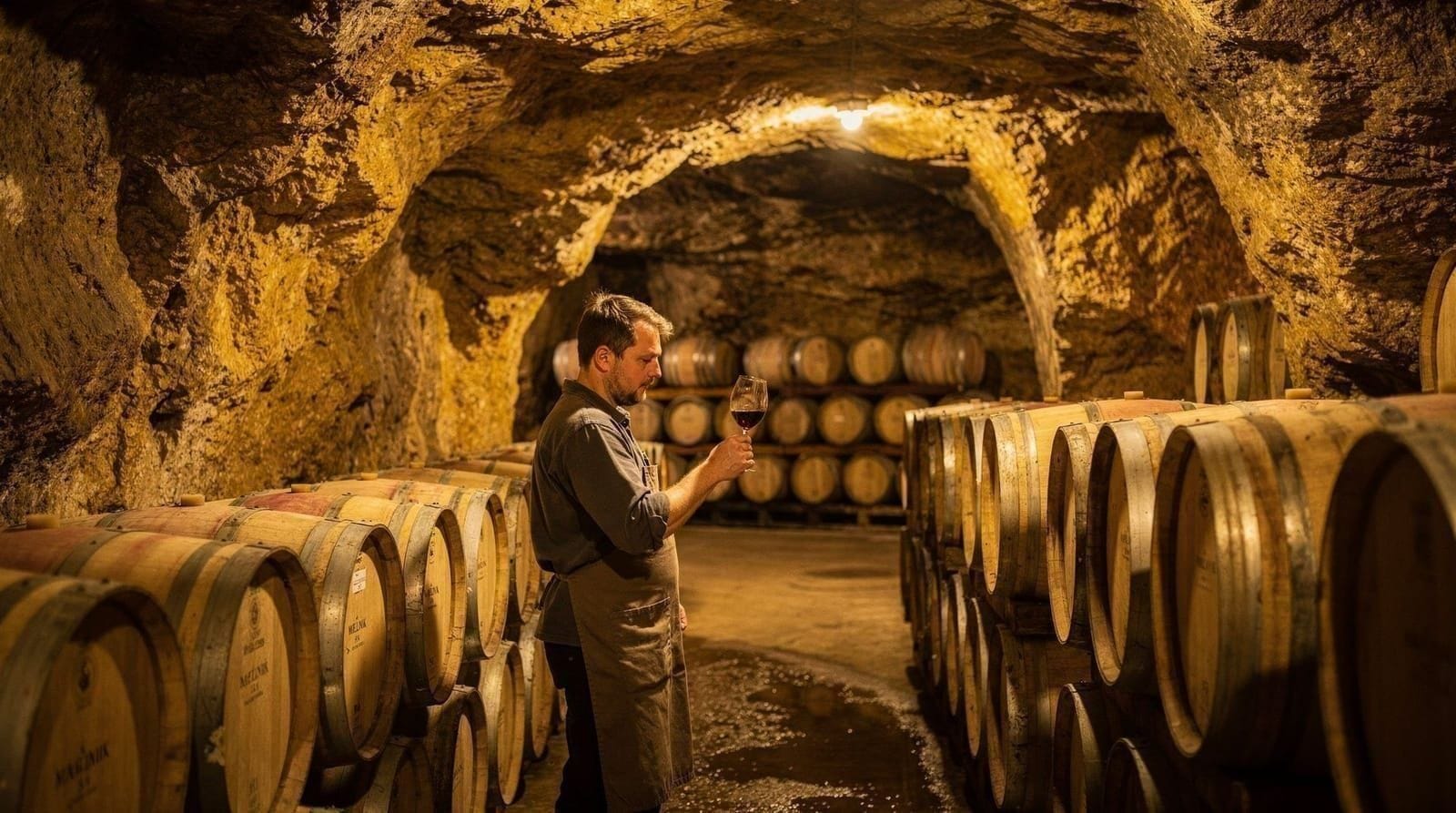
If you are planning a longer trip, the best approach is to use Sofia as a base and let the food change as you travel. Koprivshtitsa has village mehanas where kavarma and kebapche taste noticeably different from the city versions — slower, more rustic, made by people who have been cooking these dishes for decades. Melnik pairs Bulgarian wine with local lamb dishes in a setting that the Sofia restaurants cannot replicate.
The Bulgaria highlights 7 days itinerary structures a food-aware trip around these differences — Sofia for the city cooking, the villages for the traditional roots, the wine regions for the most interesting drinking.
GetYourGuideSofia: 2-Hour Guided City Tour with Gourmet LunchCheck availability →Frequently asked questions about Bulgarian dishes to try in Sofia
Is Bulgarian food vegetarian friendly?
Partly. Shopska salad, tarator, mish-mash, banitsa (cheese version), and bob chorba (bean soup) are all vegetarian. Most mehanas also offer grilled vegetables and cheese platters. Traditional Bulgarian cooking is meat-heavy overall, but there are enough vegetarian dishes to eat well without meat.What does sirene cheese taste like?
Sirene is a white brined cheese similar to feta but usually softer and creamier, with a higher fat content. Bulgarian sirene tends to be less salty and tangier than Greek feta. It is the defining ingredient in shopska salad and banitsa.Where can I try rakia in Sofia?
Any traditional mehana will have rakia, either bottled or house-made. House rakia is worth asking for — it is usually better. The Rakia Museum near the city centre also runs tasting sessions. Hadjidraganovite Izbi has an extensive rakia list.What is tarator and when is it served?
Tarator is a cold soup made from yogurt, cucumber, dill, crushed walnuts, garlic, water, and a little sunflower oil. It is served as a first course from May through September and is one of the best things to eat in Sofia on a hot day.Is shkembe chorba really a hangover cure?
Bulgarians believe it firmly. Tripe soup, heavily spiced and fatty, is consumed in the early hours and credited with preventing the worst effects of a night drinking rakia. There is some science to the idea — fat and liquid absorption — but the psychological element is at least as important.What is the cheapest way to try a wide range of Bulgarian dishes?
A neighbourhood mehana lunch is the best value: a shopska salad, one main (kavarma or kebapche), and bread typically costs €10–15 total. A guided food tasting walk costs more upfront but covers more dishes in one sitting with context, which suits a short visit. Markets like the Women's Market are cheapest of all for banitsa and produce-based tasting.Do Bulgarian restaurants take reservations?
Traditional mehanas rarely require reservations except on weekend evenings in the city centre, when booking a table a day ahead is sensible. Casual lunches and market eating never need booking. If you have a specific mehana in mind for a Friday or Saturday dinner, call or book online a day or two in advance.
Top experiences
Bookable activities with verified prices and instant confirmation on GetYourGuide.