Sofia coffee culture: the best cafés and what to order
Sofia: 3-Hour Breakfast and Sightseeing Tour
Duration: 3 hours
Where is the best coffee in Sofia?
Square Lab Coffee and One More Cup are the top specialty options. Vivendo on Vitosha does reliable third-wave espresso in a central location. Fabrika Daga in Lozenets is the best full-space experience with specialty coffee and co-working. Avoid generic chains on Vitosha Boulevard.
| Where | City centre (Vivendo, Barista Coffee) and Lozenets (Fabrika Daga, Before & After) |
| Cost | Around €2.50–3 for espresso, €3.50–4.50 for milk drinks |
| Time needed | An hour minimum — lingering is the norm, not the exception |
| Getting there | Central cafés are walkable; Lozenets is a short tram ride from Vitosha Boulevard |
| Best time | Weekday mornings for a table; avoid Vitosha Boulevard’s tourist-facing terraces |
Sofia took its time getting to coffee. Under communism, the standard was Nescafé — instant, often weak, consumed more as a ritual than for pleasure. Real espresso machines arrived in the 1990s with the Italian cafés that opened across central and eastern Europe after the Wall fell, and Sofia adopted the espresso format quickly: strong, small, drunk fast, standing at a counter or in brief pauses between other things.
That first wave of espresso culture lasted until the early 2010s, when a different kind of café started appearing. Not the chrome-fronted espresso bar, not the chain café with syrup-laden frappés, but a smaller, more serious kind of place: wooden surfaces, single-origin coffee listed on a chalkboard, baristas who knew the difference between a washed and a natural process and were willing to explain it. Third-wave specialty coffee had reached Sofia.
It has now firmly established itself. The city has a handful of cafés that could hold their own in London or Amsterdam, a dozen more that are genuinely good by any standard, and a broader café culture that is one of the most pleasant things about spending time in the city.
GetYourGuideSofia: 3-Hour Breakfast and Sightseeing TourCheck availability →The café as institution
Before the specific cafés: an important note about how Sofia uses them.
In most Western European cities, a café is somewhere you pass through. You queue, you collect, you leave. This is alien to Sofia. The café here functions closer to the Viennese Kaffeehaus tradition: a place where you arrive, settle, and stay. Meetings happen in cafés. Business is discussed in cafés. Arguments are resolved over long afternoons of coffee. Students write dissertations in cafés. Friendships are maintained through weekly café appointments that have been running for twenty years.
This means two things for the visitor. First: do not feel rushed. No café in Sofia will pressure you to vacate your table after one coffee. Ordering a single espresso and sitting for ninety minutes while you read or work is entirely normal behaviour and no one will give you a look. Second: cafés are good for understanding the social temperature of the city in a way that bars and restaurants are not. The conversations you overhear (or would overhear if you spoke Bulgarian) are about real life, not tourism.
WiFi is excellent and expected. Any café without it is making a deliberate aesthetic choice that will be communicated clearly.
How Sofia’s coffee landscape breaks down
The specialty strip and city centre
The city centre has the highest density of coffee options and the widest quality range — from genuinely excellent to tourist-facing mediocre. The key is avoiding anything on Vitosha Boulevard that prioritises visible terrace space over what goes in the cup.
Vivendo sits on the Vitosha Boulevard side of the city centre and is one of the better arguments for occasionally ignoring the “avoid Vitosha for food and drink” rule. The espresso here is properly calibrated, the milk work is technically good, and the space is large enough that you can usually find a table without waiting. It is not the most adventurous coffee in Sofia — the menu is espresso-based and relatively conventional — but it is reliably excellent in a central location. Good for a morning coffee before hitting the Sofia old town walk.
Barista Coffee is smaller, more focused, and popular with Sofia’s coffee-aware crowd. Multiple central locations, consistent quality across them, and a menu that explains where the beans come from without becoming insufferably earnest about it.
Off-centre specialty
Square Lab Coffee is the recommendation you will hear most from Sofians who take coffee seriously. The café is not in an obvious tourist location — that is part of the point. The focus is entirely on the coffee: rotating single-origin beans, multiple brew methods, and bar staff who can walk you through the difference between a light-roasted Ethiopian filter and an espresso blend without making you feel like you asked a dumb question. The space is minimal and usually full. Go in the morning on a weekday.
One More Cup occupies a different emotional register: it is cozy in the way that serious coffee places sometimes forget to be. There is vinyl, there are comfortable chairs, there is the kind of light that makes two hours disappear without noticing. The coffee is genuinely good — specialty sourcing, proper extraction — but the atmosphere is the equal draw. Work-from-café culture is strongest here; arrive before 10am on weekdays if you want a table with an outlet.
Lozenets and the south
Fabrika Daga is the most architecturally interesting café in Sofia, housed in a converted factory space in Lozenets — the same district as Pod Lipite and the upscale restaurant scene. The café occupies part of a larger creative complex: there are studios, event spaces, and a co-working element that makes the WiFi situation excellent and the seating arrangements more varied than most cafés.
The coffee here is specialty, the food menu extends to lunch, and the outdoor courtyard in summer is one of the better places in the city to spend a morning. It is not as purely focused on coffee as Square Lab — Fabrika Daga is trying to do several things at once — but it does all of them competently, and the space is unlike anything else in Sofia.
Before & After sits in a jazz-café aesthetic — low lighting, mismatched furniture, cocktail menu alongside coffee, the kind of place where the line between café and bar blurs pleasantly in the evening. Specialty coffee during the day, cocktails from around 6pm. The flat white is good. The atmosphere after 8pm is better. In Lozenets, easy to combine with dinner at a neighbourhood restaurant.
Brunch cafés
Made in Home is not a specialty coffee destination in the way Square Lab is, but it produces consistently good flat whites and lattes alongside one of the better brunch menus in Sofia. The aesthetic is deliberately domestic — mismatched vintage furniture, bookshelves, the feeling of eating in someone’s thoughtfully designed home. Two locations (one near Vitosha, one in Lozenets). Weekend queues are real but move faster than they look.
Made in Home is the best answer to “I want good coffee and food in the same place” — the banitsa at Square Lab is adequate; the food at Made in Home is the reason to go. See the Sofia food guide for the full restaurant context.
GetYourGuideSofia: 16 Pirotska Street Bulgarian Food and Drinks TastingCheck availability →What to order
Espresso — the default and the format everything else is judged by. At a specialty café ask for a single or double; both will be properly extracted. If you get an espresso that is thin and sour, you are at a café that needs to be calibrated. Move on.
Flat white — now universally understood in Sofia specialty cafés. The Bulgarian term is not standardised (you may see “flat white” in English on the menu or a Bulgarian approximation). At a good café the texture will be properly microfoamed, not steamed to the point of losing structure.
Filter coffee — available at specialty cafés under various names: filter, pourover, V60, Chemex. Ask what origins they are running. If the café can tell you the region and processing method, they are running a serious program.
Freddo espresso — during the summer months, cafés serve cold espresso over ice. This is the Greek influence via Bulgarian proximity; in July and August it is more practical than a hot espresso and equally good at the right café.
What to avoid: anything described as “cappuccino” at a tourist-facing café on Vitosha Boulevard with picture menus. The coffee at those places is commercial blend espresso machines run at the wrong temperature, producing espresso that is bitter rather than complex. The cost is similar to a specialty café (€2-3); the quality is not.
Coffee prices: the reality
Sofia’s specialty coffee prices converged with Western European norms between 2022 and 2025. An espresso at Square Lab costs €2.50-3. A flat white or latte costs €3.50-4.50. A filter coffee costs €3-4. These are not cheap by Bulgarian standards — a banitsa costs €1.50, a bowl of soup €4 — but they are roughly what the same coffee costs in a comparable city in Austria or the Netherlands.
The lower end of the market still exists. You can get an espresso at a corner bar for €1.50. It will not be from a specialty roaster. For most visitors the quality gap justifies the marginal price difference.
Working from cafés in Sofia
If you are planning to work while traveling, Sofia is unusually good for it. WiFi is fast and reliable across the city’s cafés, not as a selling point but as a basic expectation. The café-as-social-institution culture means that working on a laptop is normal behaviour at any time of day. No one will look at you twice.
The best working cafés by function:
Long sessions (4+ hours): Fabrika Daga (space, outlets, varying environments, proper lunch) and One More Cup (quieter, better for concentration, comfortable seating).
Short bursts between sightseeing: Vivendo or Barista Coffee in the centre — quick, reliable, close to everything.
Evening work: Before & After if you do not mind the ambient noise increasing after 7pm. The switch from café to bar mode happens gradually, not abruptly.
Weekend: Square Lab on Saturday mornings attracts Sofia’s tech and creative community in a way that can make the café feel like a very informal co-working space. Either lean into it or go to One More Cup for something quieter.
The café-to-wine transition: an evening structure
One of the more pleasurable things about Sofia’s food and drink culture is the way it moves across the day without hard breaks. The same people drinking single-origin filter coffee at Square Lab at 10am are at a wine bar in Lozenets by 8pm, and the physical distance is twenty minutes by tram. Understanding this rhythm helps you structure an evening that feels like a local one rather than a tourist itinerary.
The transition starts at the café level. Before & After begins its pivot from café to bar around 6pm, when the cocktail menu becomes the primary draw and the coffee orders thin out. This is a good place to spend the hour between afternoon exploration and the start of proper dinner service. One glass of something while the city shifts gears, then onward.
From Before & After or Fabrika Daga, Lozenets restaurant dinner starts at 7pm. Pod Lipite fills from 7:30pm. The wine bars in Lozenets — not named specifically here because turnover is high and the specific good ones change faster than a guide can track — are open from 6pm and serve Bulgarian natural wines by the glass.
The connection between Sofia’s coffee culture and its wine culture is not coincidental. The generation that brought specialty coffee to Sofia is the same generation that created the demand for small-production Bulgarian wines, craft beer, and ambitious food. They are now in their thirties, running businesses in the city, and their consumption patterns set the cultural tone. Following that pattern — specialty coffee by morning, mehana lunch, wine by evening — gives you the best orientation to where Sofia’s urban food culture has arrived.
What to eat with your coffee
Most specialty cafés in Sofia do not run serious food programs — the focus is the coffee, and the food is supplementary. But some offer things worth eating alongside.
Pastries: several specialty cafés source from artisan bakers and stock croissants, banana bread, or seasonal pastries. One More Cup usually has something worth eating in the morning. Square Lab is more minimal.
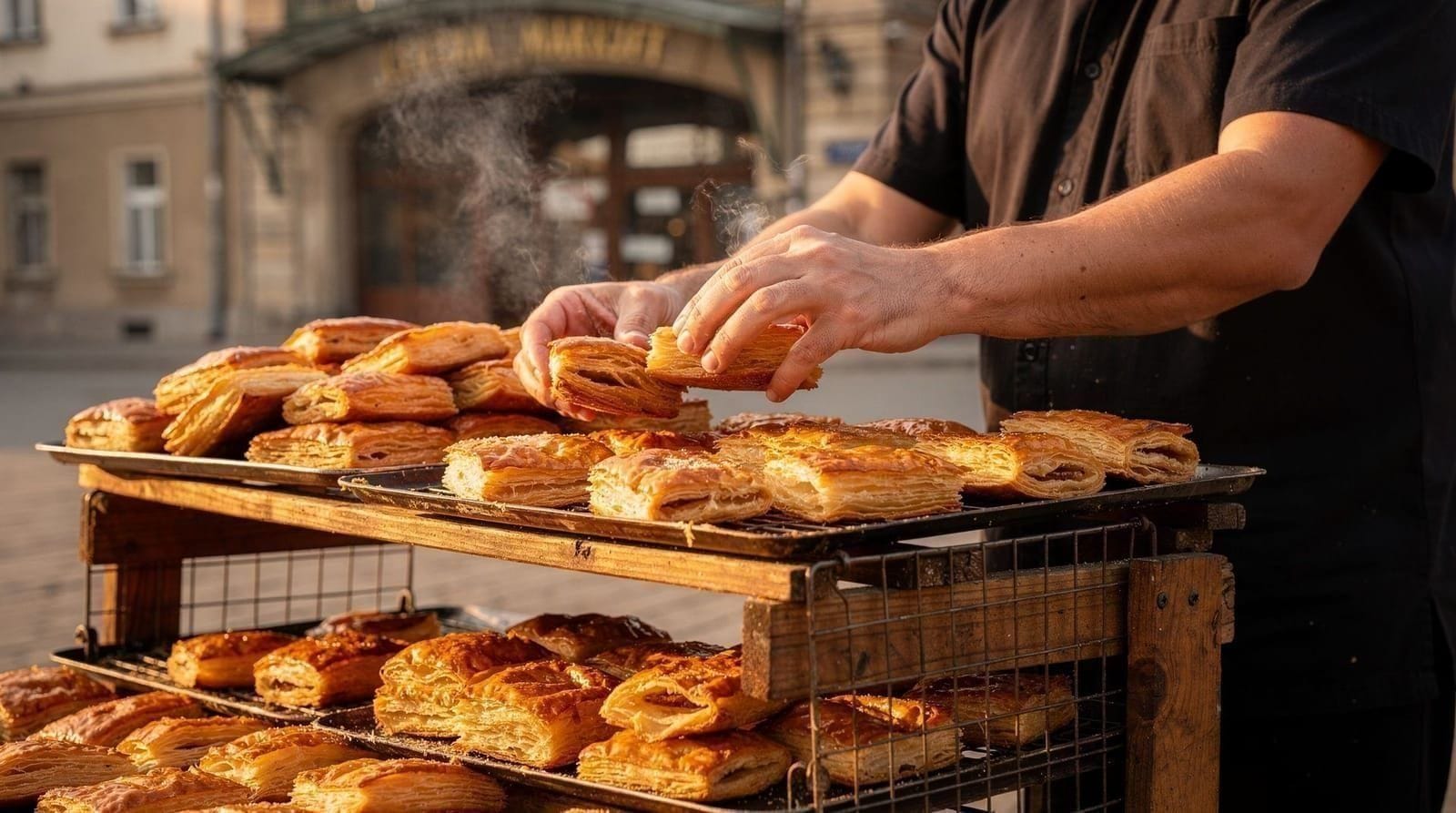
Banitsa nearby: the smarter move is to get coffee at a specialty café and banitsa from the nearest neighbourhood bakery. These two are complementary rather than competitive, and the combination — fresh filo pastry, good espresso — is as close to a perfect Sofia breakfast as you will find. See the banitsa and street food guide for bakery specifics.
Made in Home food: the brunch menu at Made in Home is genuinely worth ordering rather than just looking at. Avocado preparations, eggs several ways, Bulgarian-inflected brunch dishes (mish-mash with good bread, yogurt with honey and nuts). This is the café where the food quality matches the coffee quality most closely.
The tourist café trap on Vitosha Boulevard
It is worth spending a paragraph on what to avoid as well as what to seek, because Vitosha Boulevard presents the visitor with a particular version of the tourist trap: not the obvious bad version, but a reasonable-looking facsimile of a good café.
The cafés on Vitosha Boulevard and around the Alexander Nevsky Cathedral zone look like cafés. They have good furniture, attractive outdoor seating, and menu descriptions that use the same language as specialty cafés — “espresso,” “flat white,” “specialty blend.” The prices are €2.50-3.50, similar to Square Lab or Vivendo.
The difference is in the cup. The coffee at these cafés is almost universally commercial blend espresso extracted at the wrong temperature on machines that are not calibrated for specialty-grade beans. The result is bitter, flat, and characterless. You have paid the same as at a genuinely good café and received something worth half the money.
The tell is the machine and the barista interaction. At a good café, the barista is adjusting the grind, checking extraction time, and handling the portafilter with attention. At a tourist-strip café, coffee is made the same way every time with no adjustment — a button is pressed, a cup is filled, the next customer is served. This takes thirty seconds of observation to identify. If you are unsure, walk one street back from Vitosha and the quality gap will present itself clearly.
Ordering coffee if you don’t speak Bulgarian
Language is rarely a barrier at Sofia’s specialty cafés — English is standard among baristas, and menus are usually printed in English or bilingual. At traditional neighbourhood cafés and kiosks, a little Bulgarian goes a long way: “edno kafe, molya” (one coffee, please) covers the basics, and pointing at the machine or menu board works everywhere else. If you want your espresso a specific way, “silno” means strong and “slabo” means weak, though at a genuinely good café you’re better off just asking what they’d recommend rather than second-guessing their calibration. Decaf is available at most specialty cafés but rarely at traditional ones — if it matters, ask before you sit down rather than after ordering, since not every espresso machine has a decaf hopper loaded.
Coffee culture seasonal notes
Sofia cafés adapt to the seasons in ways that are worth knowing.
Winter: hot drinks volumes double. Café seating moves indoors. Many cafés introduce seasonal drink specials in November — spiced versions of espresso drinks, hot chocolate with Bulgarian honey, the occasional mulled wine parallel. The cosiness of a well-lit Sofia café in January is not insignificant.
Spring: terraces open from around March, tentatively, then confidently by April. The outdoor seating explosion on warm spring days is one of the more cheerful things about the city. Every café with a pavement-facing space puts tables outside; the street becomes the salon.
Summer: iced coffee becomes the primary format at most cafés — not the sweet, cold-brew-over-ice trend that arrived from the US, but the Greek freddo espresso style, which is just espresso chilled over ice and served cold. It is better with good espresso than with mediocre espresso, which is another reason to find the specialty cafés before committing.
Autumn: café culture intensifies. Sofians return from summer holidays, the city re-densifies, and the cafés fill with the social activity that makes them so pleasant to inhabit. October is one of the better times to be in Sofia’s café scene.
Across all four seasons, the underlying rhythm holds steady: mornings are for coffee, whatever the weather is doing outside the window. A rainy November afternoon in a Sofia café, watching the trams pass on Vitosha Boulevard through a fogged-up window, is arguably a more honest introduction to the city than a sunny terrace in July — you see the place as its residents actually live in it most of the year, not just during the brief peak-season window.
Roasters behind the scenes
Several of Sofia’s better cafés roast their own beans or source from a small number of Bulgarian micro-roasters rather than importing pre-roasted stock, and this is part of what separates the specialty tier from the commercial-blend cafés on Vitosha Boulevard. Ask at Square Lab or Fabrika Daga whether the beans on the current menu are roasted in-house or by a partner roaster — staff are generally happy to talk about it, and the answer often changes month to month as new lots come in.
This is a relatively recent development: as late as the early 2010s, almost all specialty-grade beans in Bulgaria were imported from established Western European roasters, and homegrown roasting only became a viable small business in the years since. It’s a useful marker of how quickly the scene has matured, and it means the coffee you’re drinking in Sofia today is increasingly a Bulgarian product from bean to cup, not just an imported format applied to a new city.
Coffee and the rest of the food scene
Coffee culture in Sofia does not exist in isolation from the rest of the city’s food scene. The same generation of young urban professionals who drove the third-wave coffee revival also drove the natural wine bar scene, the revival of traditional Bulgarian cooking at a higher level, and the demand for better breakfast food. The cafés that opened from 2015 onwards were often followed closely by brunch spots, wine bars, and the restaurants that have made Oborishte and Lozenets worth visiting.
If you want to understand the city’s current food culture in sequence: start at Square Lab or One More Cup in the morning (coffee), cross to the Central Market Hall (the old city at breakfast), have lunch at a neighbourhood mehana in Oborishte (traditional revival), and end the evening at a wine bar in Lozenets. That arc gives you the range.
The Sofia in 2 days itinerary threads through this geography in a practical sequence. The Sofia food guide covers the lunch and dinner half of the equation.
Getting to the cafés
Square Lab Coffee and One More Cup are both within walking distance of the city centre — fifteen minutes on foot from Alexander Nevsky or ten from the Serdika metro. Fabrika Daga and Before & After in Lozenets are best reached by tram (stop at NDK / Yuzhen Park). Made in Home’s Lozenets location is similarly accessible.
For the Sofia old town walk route, Vivendo or Barista Coffee work as a pre-walk morning stop. If you are doing the Communist Sofia tour or Sofia museums guide loop, Square Lab is a natural midpoint break.
GetYourGuideSofia: Afternoon Walking Tour with Wine and Food TastingCheck availability →The tram network along Vitosha Boulevard connects the centre to Lozenets efficiently; the getting around Sofia guide has route details. For orientation on how much time to allocate across the city, the how many days in Sofia guide covers the coffee district alongside the main sights.
Café comparison at a glance
| Café | Best for | Neighbourhood | Price level |
|---|---|---|---|
| Square Lab Coffee | Coffee purists, weekday mornings | Off-centre | €€ |
| One More Cup | Long work sessions, atmosphere | City centre | €€ |
| Vivendo | Reliable central espresso | Vitosha Boulevard | €€ |
| Fabrika Daga | Space, co-working, lunch | Lozenets | €€ |
| Made in Home | Coffee plus a real brunch menu | Vitosha / Lozenets | €€€ |
| Before & After | Café-to-bar evening transition | Lozenets | €€ |
Frequently asked questions about Sofia coffee culture
How much does coffee cost in Sofia?
Espresso costs €2-3 at specialty cafés. A flat white or latte runs €3-4. These prices are now broadly similar to Western European capitals. Budget cafés and chains are slightly cheaper but the quality gap is significant.Do cafés in Sofia have good WiFi?
Yes. WiFi quality in Sofia cafés is generally excellent — faster than what most people have at home. Work-from-café culture is strong in the city, and cafés actively cater to it. Fabrika Daga and One More Cup are particularly well set up for working.What is the café culture like in Sofia?
Cafés function as social institutions. Sofians spend hours in cafés — meeting friends, working, reading, running small businesses. Lingering over one coffee for two hours is completely normal and expected. No one will rush you.Is there oat milk in Sofia cafés?
At specialty cafés, yes. Oat milk, almond milk, and soy milk are available at most third-wave spots. At traditional cafés and chains, options are more limited. Ask for 'oveseno mlyako' (oat milk) or just say 'oat milk' — baristas at specialty cafés will understand.What was coffee like in Bulgaria under communism?
Instant coffee (Nescafé) was the standard. Real coffee was expensive and imported in small quantities. The Italian espresso machine arrived in Bulgaria in the 1990s after the fall of communism, and espresso culture took hold quickly. Instant coffee still has nostalgic connotations for older Bulgarians.Which Sofia café is best for a first-time visitor with limited time?
Square Lab Coffee or One More Cup, both an easy walk from the city centre, give the truest sense of Sofia's specialty coffee scene without a special trip. If you're already near Vitosha Boulevard, Vivendo is the reliable central option that avoids the tourist-strip pitfalls nearby.Are Sofia cafés good for meeting locals or working alongside them?
Yes. Cafés function as genuine social institutions in Sofia rather than quick-turnover stops, so it's normal to see the same regulars working, meeting friends, or reading for hours. Fabrika Daga and One More Cup in particular attract Sofia's creative and remote-working crowd, making them good places to absorb the city's everyday rhythm rather than a tourist bubble.
Top experiences
Bookable activities with verified prices and instant confirmation on GetYourGuide.