Sofia food guide: where and what to eat in the Bulgarian capital
Sofia: 16 Pirotska Street Bulgarian Food and Drinks Tasting
What is the best area to eat in Sofia?
Oborishte district and Lozenets have the best local restaurants. Avoid Vitosha Boulevard for anything except coffee — prices are triple and quality is mediocre. Central Market Hall (halite) is the best place for breakfast and fresh produce.
| Where | Oborishte and Lozenets for locals’ restaurants; avoid Vitosha Boulevard for meals |
| Cost | Around €6–12 at a mehana, €15–25 mid-range, €35+ upscale |
| Time needed | A dedicated evening for a proper mehana meal; markets are best in the morning |
| Getting there | Central Market Hall and Women’s Market are both walkable from Serdika |
| Best time | Lunch specials 12–2pm; markets 8–11am for the best produce and freshest banitsa |
Sofia’s food scene has changed more in the last decade than in the previous forty years. Under communism the city’s restaurants were state-run, menus were standardised, and the best food was made at home. That legacy is still visible — many older Sofians will tell you the only good food is their mother’s — but alongside it has grown a genuinely exciting restaurant culture: traditional Bulgarian cuisine revived with care, good imported ingredients, an emerging wine bar scene, and a handful of international kitchens good enough to compete in any European capital.
This guide is for the visitor who wants to eat well without getting scalped, and who is curious about what Bulgarian food actually tastes like rather than what the tourist-menu version approximates.
GetYourGuideSofia: 16 Pirotska Street Bulgarian Food and Drinks TastingCheck availability →The state of the food scene
The culinary revival started slowly in the early 2010s and accelerated after 2015. The trigger was partly economic — a new urban professional class with money to spend — and partly cultural, a pushback against the wave of generic pizza-and-pasta restaurants that dominated the post-communist decade. Young Bulgarian chefs who had trained in Germany and France came home and opened places that took shopska salad and kavarma seriously, using heritage recipes and local ingredients rather than industrial shortcuts.
The result is a city with genuine range. You can eat poorly in Sofia — there are plenty of mediocre tourist-trap restaurants, especially around the Alexander Nevsky Cathedral and along Vitosha Boulevard — but you can also eat exceptionally well for surprisingly little money. A three-course dinner with Bulgarian wine at a neighbourhood restaurant costs €20-28 per person. Equivalent food in Prague or Warsaw would cost more.
The international food scene has also filled in. Georgian food became wildly popular after 2018 — Egur Egur near the National Palace of Culture has a permanent queue. Vietnamese kitchens, Japanese ramen, and Lebanese spots have all appeared in the last five years. Sofia now has the range of a small Western European capital, with the prices of central-eastern Europe.
Neighbourhoods for food
Oborishte
The most rewarding neighbourhood for eating if you have only a few evenings. Oborishte sits northeast of the city centre, walkable from the cathedral and the national gallery. The streets here are residential — blocks of communist-era apartments alternating with pre-war buildings — and the restaurants serve locals first, tourists occasionally. Prices reflect that. A full dinner at one of the mehanas here costs the same as lunch at a tourist spot on Vitosha. Walk Oborishte Street and Shipka Street to get oriented.
Lozenets
The upscale district south of the city centre. Lozenets is where Sofia’s professional class lives and eats: wine bars, brunch spots, and the best mid-range and upscale restaurants in the city. Pod Lipite is here. Hadjidraganovite Izbi is here. It feels like a different city from the centre — quieter, greener, with outdoor seating under trees. A tram connects Lozenets to the NDK (National Palace of Culture).
Serdika area and the centre
The city centre has everything from terrible to very good within three blocks of each other. The Serdika metro area, the streets behind the Presidency, and the zone around Banya Bashi mosque all have neighbourhood spots used by office workers at lunch. Quality is variable; checking Google Maps reviews from the last three months is worth the thirty seconds.
Vitosha Boulevard
Avoid for food. Vitosha is Sofia’s pedestrian shopping boulevard, crowded from noon till midnight, lined with cafés and restaurants charging two to three times neighbourhood prices for food that is reliably worse. The coffee is fine — there are some decent cafés on Vitosha — but for meals, treat it as a transit zone between your hotel and somewhere worth eating.
Markets worth visiting
Central Market Hall (halite)
The Central Market Hall, known as halite (from the Greek word for market buildings), is a covered Victorian-era building from 1909 sitting on Maria Luiza Boulevard. Inside: fresh produce, cheese vendors, meat counters, a small bakery section, and several hot food stalls serving breakfast and lunch. The building itself is worth seeing — ornate ironwork, high glass ceiling, a scale model of what early twentieth-century Sofia looked like.
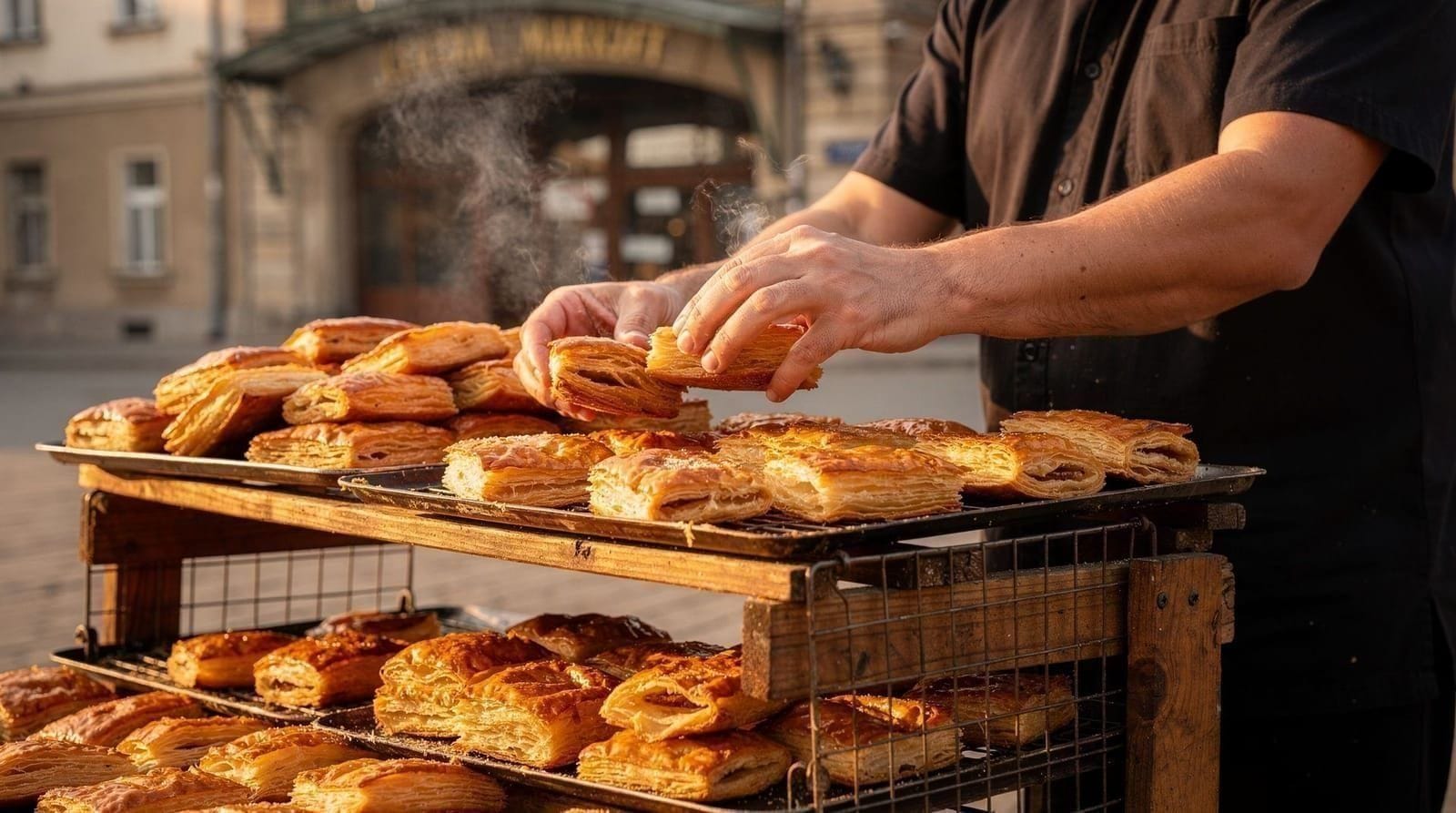
Go between 8am and 11am for the best experience. Buy yogurt from the dairy vendors and compare it to what you get from supermarkets — the difference is startling. The bakery at the back sells fresh banitsa through the morning. Avoid the tourist-facing stalls near the main entrance, which sell the same packaged Bulgarian products you can find cheaper at any supermarket.
Halite sits at the corner of Maria Luiza Boulevard and Ekzarh Yosif Street, a five-minute walk from Serdika metro.
Women’s Market (Zhenski Pazar)
The largest open-air market in Sofia runs daily along Stamboliyski Boulevard and the surrounding streets. It is not photogenic in the way tourists might expect — no Instagram-ready stalls under romantic awnings — but it is exactly where Sofia actually buys its food. Produce, spices, dried herbs, pickles in barrels, seasonal vegetables in volume, eggs from farm stalls, cheap imported goods.
The food stalls on the western side of the market serve breakfast and lunch to market workers and neighbourhood residents. You can eat banitsa, mish-mash (scrambled eggs with peppers), or bean soup standing at a counter for €2-3. It is the most honest introduction to everyday Bulgarian food in the city. Combine with a visit to the nearby Bitaka flea market on Saturdays for the full market experience.
The market runs daily from roughly 6am to 6pm; Sunday is smaller. Stamboliyski Boulevard, tram stop Zhenski Pazar.
Restaurant recommendations
Budget (€5-10 per person)
Supa Star — exactly what the name says: a soup restaurant. Four to six soups daily, rotating by season, served with bread, for €3-4 a bowl. The mish-mash here is excellent. Cash only, communal tables, no fuss. City centre, Gurko Street area.
Women’s Market stalls — no reservation possible, no menu in English, but for €4-5 you eat what Sofia actually eats. Point at what the person ahead of you is having.
Banitsa from any neighbourhood bakery — see the full banitsa and street food guide for specifics, but any bakery with a queue before 10am is doing something right. The pastry costs €1-2 and is breakfast sorted.
Mid-range (€15-25 per person)
Made in Home — Brunch and all-day food in a warm domestic aesthetic. Good flat whites, excellent eggs, a weekend queue that moves fast. Somewhere between a café and a restaurant. Popular with the young Lozenets crowd. Two locations: Vitosha area and Lozenets. Budget €12-18 for a full brunch.
Egur Egur — Georgian restaurant near NDK, consistently one of the most popular restaurants in Sofia. Khinkali (Georgian dumplings), khachapuri (cheese bread), and a menu that translates well for visitors unfamiliar with Georgian food. Queues form at weekends; go on a weekday evening. Budget €18-24 per person with wine.
Divaka — Vegetarian restaurant in the centre. Bulgarian and international dishes without the meat that dominates most menus here. A good option if you are vegetarian and tired of ordering around dishes designed for carnivores. Budget €14-20.
Mehana Gurko — In the old town, tourist-facing but not a tourist trap. The traditional Bulgarian food here is competently made, the menu is in English, and the covered courtyard is pleasant on warm evenings. Prices are slightly above neighbourhood level. It is not the most authentic experience in the city but it is not dishonest either. Budget €18-25 per person.
Upscale (€35+)
Pod Lipite — The benchmark for traditional Bulgarian fine dining. In Lozenets, in a house with a courtyard under lime trees (pod lipite = under the linden trees). The menu goes beyond the standard mehana dishes — expect heritage recipes with good sourcing, an excellent Bulgarian wine list, and service that takes the food seriously. Booking essential for weekends. Budget €40-55 per person.
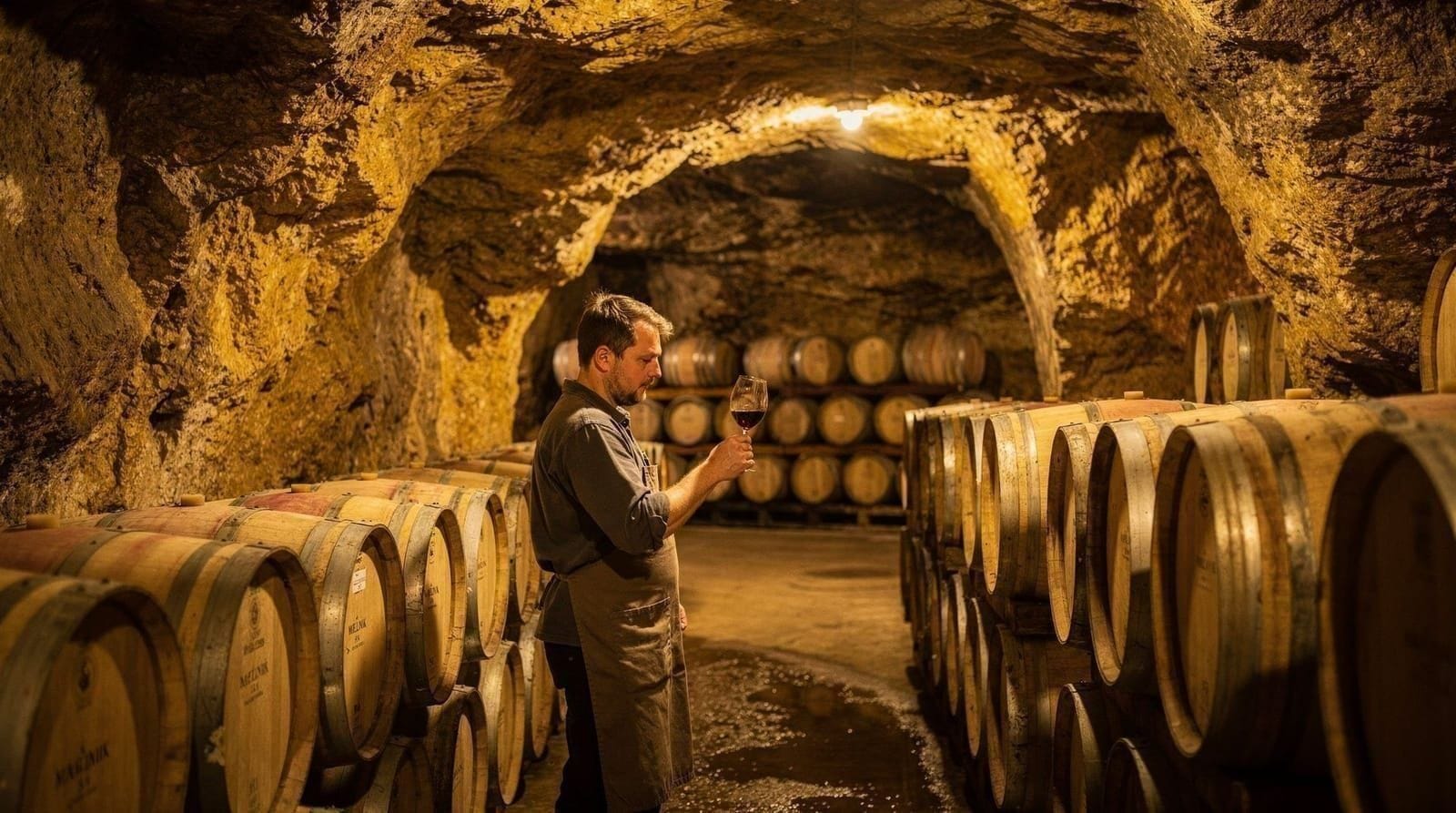
Hadjidraganovite Izbi — Wine cellar restaurant under a historic building near Dondukov Boulevard. The setting does most of the work, but the Bulgarian food holds up: grilled meats, cold starters, and rakia pairings. Good for a long, convivial evening. Budget €35-50 per person.
Cosmos — High-end modern Bulgarian cuisine in the city centre. The most technically ambitious cooking in Sofia, with a tasting menu that reinterprets traditional dishes through a contemporary lens. Not every experiment lands, but the good dishes here are genuinely excellent. Budget €55-80 per person with wine pairing.
GetYourGuideSofia: 2-Hour Guided City Tour with Gourmet LunchCheck availability →What to order
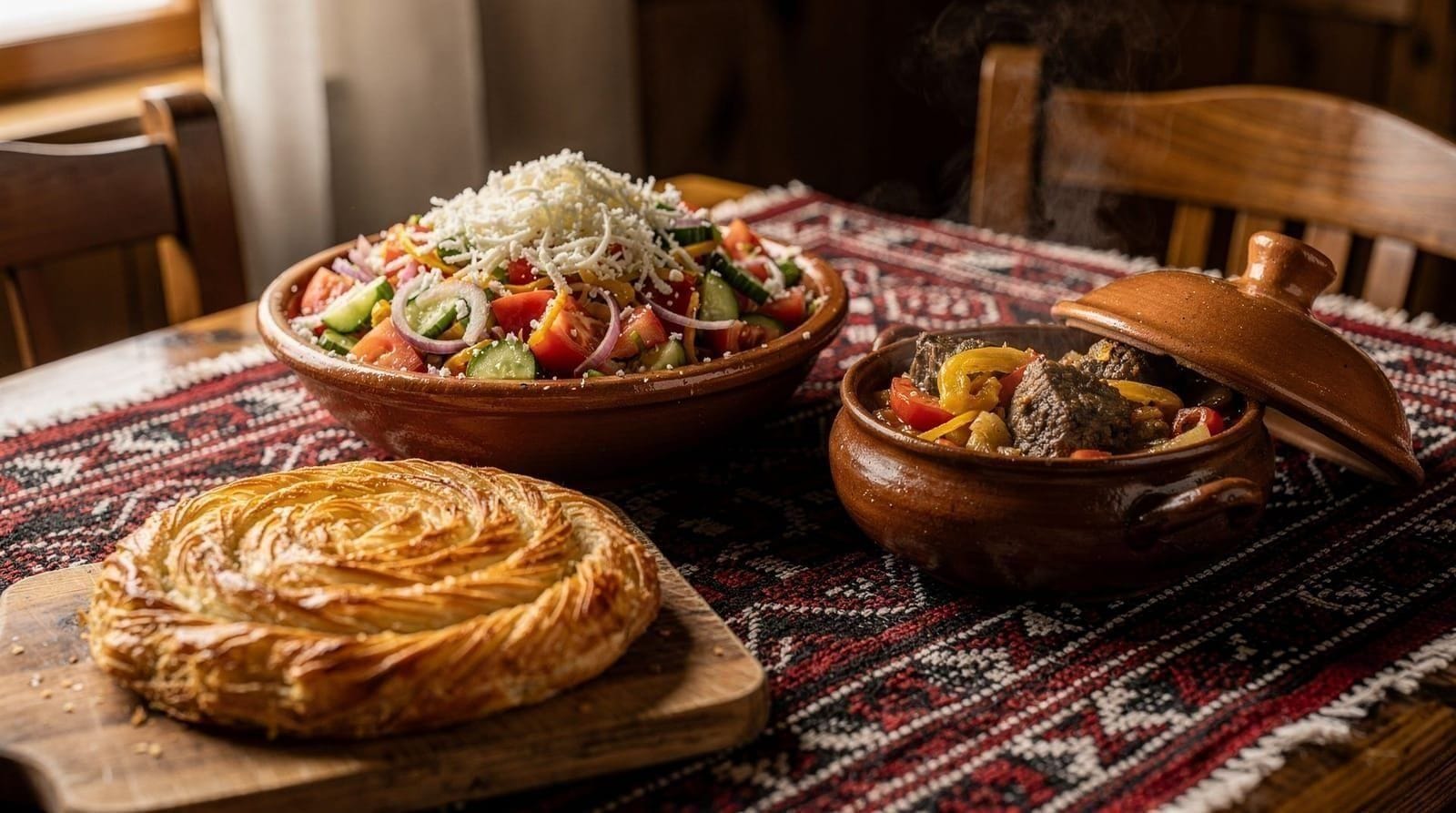
Always order: shopska salad to start (the national salad — tomatoes, cucumber, onion, and a pile of grated sirene white cheese), tarator in summer (cold cucumber and yogurt soup), kavarma when you see it on a mehana menu (clay-pot stew, slow-cooked, genuinely different from any stew you have had elsewhere), and ayran with spicy food (yogurt drink, cuts heat perfectly).
Order with curiosity: shkembe chorba if you want to understand Bulgarian working-class food culture. It is tripe soup, traditional hangover cure, aggressively savoury. Not everyone will enjoy it. You should try it anyway.
Be selective about: kebapche and kyufte. Every restaurant has them; quality varies enormously. At a good mehana they are freshly mixed and grilled to order. At a mediocre place they have been sitting in a bain-marie since 11am. The smell and colour of the grill is your best guide.
Avoid on Vitosha: anything a menu describes as “traditional Bulgarian” near Alexander Nevsky or along Vitosha Boulevard. You are likely paying €18-22 for something worth €8 three streets away.
For a full breakdown of individual dishes, see the Bulgarian dishes to try guide.
Drinks
Rakia is the national spirit — fruit brandy, most commonly plum (slivova) or grape (grozdoba). It arrives in a small glass and is meant to be sipped slowly with cold starters. Never drink it on an empty stomach. Never rush it. A good mehana has its own house rakia; ask what is homemade rather than ordering from the bottle list.
Bulgarian wine has been genuinely good since the 1990s, though it took international attention until the 2010s to get properly noticed. Mavrud (red, tannic, complex), Rubin (a cross between Nebbiolo and Syrah), and Misket (white, aromatic) are the varieties most worth exploring. See the Bulgarian wine guide for specifics.
Beer — Zagorka and Kamenitza are the main domestic lagers. Fine cold, nothing remarkable. Craft beer has arrived in Sofia via several taprooms; if you want something more interesting ask about local craft options.
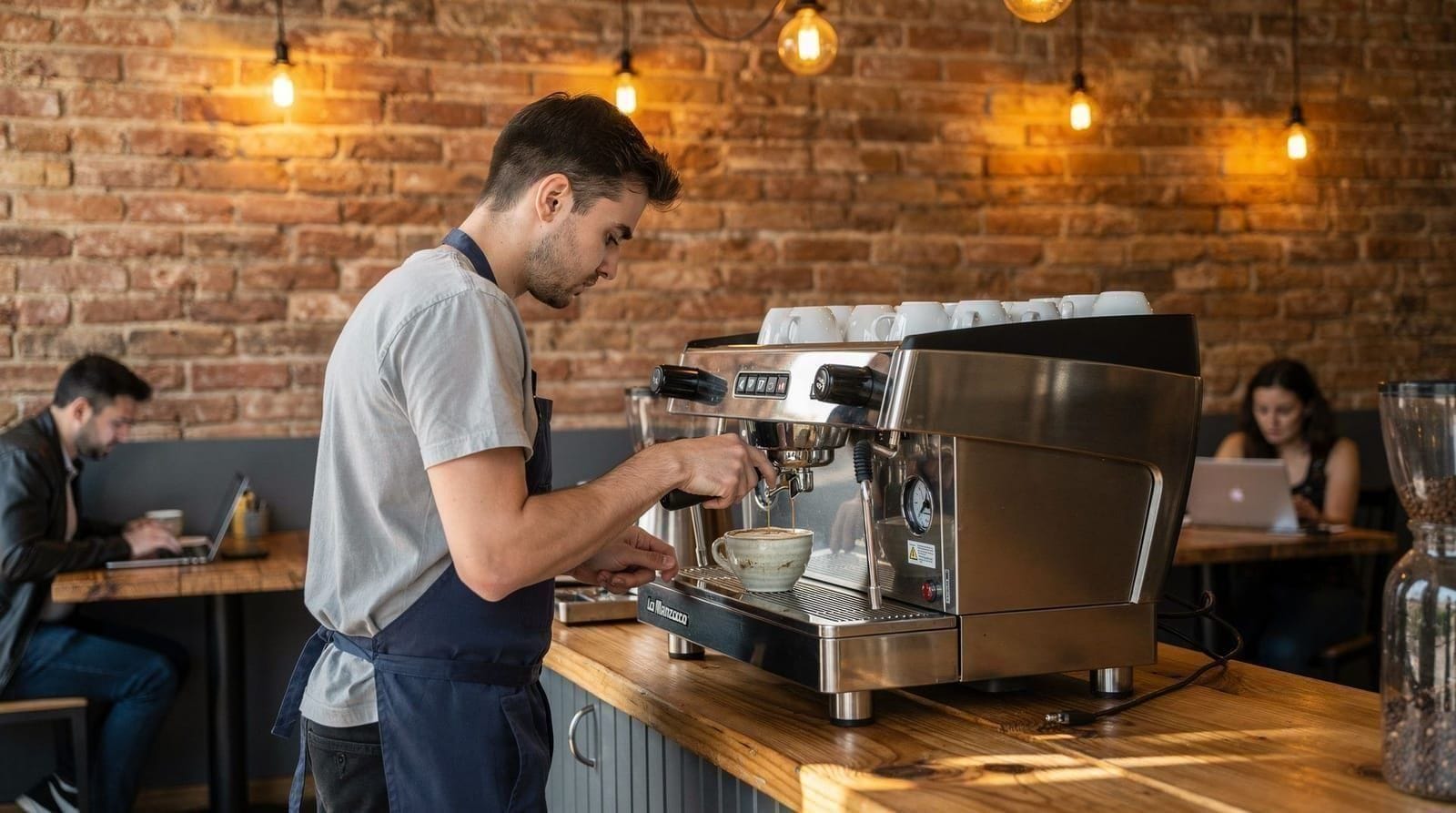
Coffee — see the full Sofia coffee culture guide for café recommendations, but the short version: third-wave specialty coffee arrived in Sofia in the 2010s and there are now excellent options for filter and espresso across the city.
Seasonal eating in Sofia
Sofia’s food changes with the seasons in a way that a single visit cannot fully capture, but knowing the rough pattern helps you order better.
Spring (April–May): The city wakes up slowly from winter stodginess. Fresh herbs arrive at the Women’s Market — dill, parsley, spring onions, the first radishes. Tarator returns to mehana menus. Lamb dishes appear around Easter. The outdoor terrace culture starts properly in May.
Summer (June–August): Peak season for produce and the most important time to eat Bulgarian food. The tomatoes for shopska salad are at their irreplaceable best — purple-black heirloom varieties from village gardens that have no equivalent the rest of the year. Tarator is essential. Street food stalls are at full capacity. Restaurant terraces are full; book ahead for anything better than neighbourhood level, or arrive before 7pm and before 8:30pm (the two turnover slots).
Autumn (September–October): The harvest season brings pumpkins, mushrooms, and the sweet tikva (pumpkin) banitsa to bakeries. Wine regions are mid-harvest, which means wine bars in Sofia start getting new-release Bulgarian wines in October and November. Gyuvech at its best uses autumn vegetables. Temperature drops enough to make kavarma and heavier stews feel right again.
Winter (November–March): The festival period from Christmas through New Year includes fortune banitsa at every bakery. Bob chorba (white bean soup) and shkembe chorba become the dominant street foods. Chestnut vendors appear on Vitosha Boulevard. Rakia becomes socially acceptable at any hour after 3pm.
The Bulgarian yogurt question
Every restaurant and food context in Sofia will involve yogurt in some form — as a condiment, in tarator, in banitsa filling, as ayran alongside food. This is not a coincidence and it is worth understanding before you arrive.
Bulgaria has a specific historical and scientific claim on yogurt culture. In 1905, the microbiologist Stamen Grigorov, working in Geneva, identified the bacteria responsible for fermenting Bulgarian milk and named it Lactobacillus bulgaricus. This is still the strain used in authentic Bulgarian kiselo mlyako (literally “sour milk”), and it produces a tangier, more complex flavour than the commercial yogurt cultures used in mass-market production elsewhere in Europe.
The practical result is that Bulgarian yogurt tastes different from Western supermarket yogurt — more acidic, thicker when made traditionally, with a complexity that makes it more than a vehicle for flavour. When you eat shopska salad, banitsa, or tarator in Sofia and something in the flavour registers as particularly interesting, it is often the quality of the dairy underneath it.
The best place to understand this is a dairy stall at the Central Market Hall or Women’s Market, where you can taste kiselo mlyako in a small cup alongside commercial-grade ayran. The difference is significant.
Eating with children
Sofia’s restaurant culture is generally relaxed about children, and traditional mehanas in particular tend to welcome families without much fuss — expect no dedicated kids’ menu at most places, but simple, mild dishes like grilled chicken, plain kashkaval pane (fried cheese), and bread are easy to find on any menu. Portions at mehanas are typically generous enough to split between an adult and a child if needed.
Highchairs are inconsistent outside of more upscale or international restaurants, so it’s worth asking when you arrive rather than assuming one will be available. The Central Market Hall and Women’s Market are good options for a food-focused outing with children, since the open, browsing format suits shorter attention spans better than a sit-down meal, and trying banitsa or fresh fruit while walking is an easy way to introduce Bulgarian food without committing to a full restaurant sitting.
How to read a Bulgarian menu
Bulgarian menus at traditional restaurants follow a consistent structure that is useful to understand:
Salati (салати) — Salads: these are the cold starter section. Order one shopska per table as a rule. Also look for lyutenitsa (roasted pepper spread) and kashkaval pane (fried yellow cheese) as additional starters.
Chorbi (чорби) — Soups: always a tarator in summer; bob chorba (bean soup) year-round; shkembe chorba at specialist places. Soups here are first courses, not meals.
Skara (скара) — Grill: the section for kebapche, kyufte, and pork chops. The quality of this section tells you how seriously the kitchen takes the basics.
Yastiya (ястия) — Main dishes: this is where kavarma, gyuvech, and the slow-cooked dishes live. In a good mehana, this section is the most important one to read carefully.
Deserti (десерти) — Desserts: baklava, rice pudding (sutlyash), and sometimes Bulgarian halva. Desserts are not the strongest element of traditional Bulgarian restaurant cooking; save room for banitsa from a bakery the next morning instead.
Practical notes
Lunch specials run from noon to 2pm at almost every sit-down restaurant. A two-course menu with a drink is typically €6-9. This is the best value eating in Sofia, often at the same restaurants where dinner costs twice as much.
Booking is unnecessary for most budget and mid-range restaurants on weeknights. Pod Lipite, Cosmos, and Egur Egur on weekends require reservations. WhatsApp booking is common for smaller places.
Vegetarian options are improving but remain limited at traditional mehanas. Mish-mash, banitsa with spinach, shopska salad, tarator, and bean soup (bob chorba) are reliably vegetarian at most places. Specify that you do not eat meat clearly when ordering — “without meat” translations sometimes exclude visible meat while leaving meat stock in sauces.
Language — menus in central restaurants almost always have English. In neighbourhood spots, pictures or a phone translation app will get you through. Saying “edna shopska salata, molya” (one shopska salad, please) will earn goodwill.
GetYourGuideSofia: 3-Hour Breakfast and Sightseeing TourCheck availability →Grocery shopping and self-catering
If your accommodation has a kitchen, self-catering in Sofia is an easy and affordable way to eat well between restaurant meals. Supermarket chains (Billa, Kaufland, Lidl) are widespread and stock a solid range of Bulgarian dairy, produce, and pantry staples at prices well below restaurant equivalents, though the quality gap with market produce is noticeable — a tomato from the Women’s Market in July tastes like a different vegetable to a supermarket one in February. For a proper self-catered breakfast, buy kiselo mlyako (Bulgarian yogurt) and honey from a supermarket or dairy stall, banitsa from a neighbourhood bakery, and fruit from whichever market is closest. Wine shops and larger supermarkets both stock a reasonable range of Bulgarian bottles if you want to try Mavrud or Misket without a restaurant markup — expect to pay €6–15 for a bottle that would cost €20–35 on a restaurant list.
Food tours and experiences
If you want to eat across the city with context, a guided food tour is worth doing early in your trip — it orients you to the neighbourhoods and gives you a mental map of where to come back on your own. The sofia food tasting cultural walking tour covers central Sofia with tastings at local spots, combining food with city history.
For market immersion specifically, the flea and food markets tour takes in both the Women’s Market and Bitaka, which is the most efficient way to see both without getting lost on your first visit.
GetYourGuideSofia: Flea and Food Markets TourCheck availability →Connecting your food trip to the rest of Sofia
The best food experiences in Sofia sit naturally alongside the city’s other main draws. The Central Market Hall is five minutes from Banya Bashi mosque and the Synagogue. The Oborishte mehanas are close to the National Gallery. Pod Lipite in Lozenets is on the way back from Vitosha mountain day trips.
If you are planning your time, the Sofia in 2 days itinerary and Sofia in 3 days itinerary both weave food stops into sightseeing routes so you are not backtracking. The Sofia on a budget guide has more detail on eating cheaply without sacrificing quality.
For day trips that extend the food exploration, Koprivshtitsa has village mehanas serving food that is noticeably different from the city — more rustic, more seasonal. Melnik is the region for Bulgarian wine in its natural setting, and the Melnik wine region guide covers the best wineries and what to pair with them.
Restaurant price tiers at a glance
| Tier | Price per person | Where | Best for |
|---|---|---|---|
| Budget | €5–10 | Women’s Market, Supa Star, bakeries | Quick, authentic, no fuss |
| Mid-range | €15–25 | Oborishte, Egur Egur, Made in Home | Most visitors’ main tier |
| Upscale | €35–80 | Pod Lipite, Cosmos, Hadjidraganovite Izbi | A dedicated special-occasion night |
Dietary considerations beyond vegetarian
Vegan options are more limited than vegetarian ones at traditional mehanas, since many dishes marked vegetarian still use dairy heavily (sirene cheese, yogurt-based sauces, butter in banitsa pastry). Divaka is the most reliable single stop for a genuinely varied vegetarian menu, and its kitchen is generally willing to adapt dishes on request. Gluten-free diners will find the traditional cuisine challenging by default — banitsa, most breads, and many stews use flour as a thickener — but shopska salad, grilled meats without breading, and yogurt-based dishes are safe defaults if you ask the kitchen to confirm no flour has been added to a sauce. As with most of Eastern Europe, cross-contamination awareness varies by restaurant; a clearly stated allergy (rather than a general “I don’t eat X”) gets taken more seriously in the kitchen.
Frequently asked questions about Sofia food guide
How much does a meal cost in Sofia?
A traditional Bulgarian meal at a neighbourhood mehana costs €6-12. Mid-range restaurants with wine run €15-25 per person. Upscale spots like Cosmos or Pod Lipite cost €35-60. A banitsa from a bakery is €1-2. Lunch specials (12-2pm) are the best value across all tiers.Do restaurants in Sofia accept cards?
Most sit-down restaurants accept cards. Market stalls, bakeries, and kiosks are cash only. Bulgaria switched to EUR in January 2026, so you no longer need to calculate lev conversions.Is it safe to eat street food in Sofia?
Yes. Banitsa from busy bakeries, kebapche from kiosks, and produce from the Women's Market are all reliably safe. Busy stalls with high turnover are always a better indicator than cleanliness theatre.When should I go to restaurants for lunch?
Lunch specials run 12-2pm and represent the best value in Sofia — full menu items, often with soup and a drink, for €6-9. Restaurants fill up by 12:30pm on weekdays; arrive early or just after 2pm.How much should I tip in Sofia?
Tipping is not obligatory but appreciated. The convention is rounding up or leaving around 10%. In cash. Asking waiting staff to keep the change when you pay is normal practice.Are there good vegan or gluten-free options in Sofia?
Vegetarian is easier to manage than vegan or gluten-free at traditional mehanas, since many dishes lean on dairy or use flour as a thickener. Divaka is the most reliable dedicated vegetarian option. For gluten-free, shopska salad, grilled unbreaded meats, and yogurt-based dishes are safe defaults, but confirm with the kitchen since sauces sometimes contain flour.Do I need to book restaurants in Sofia in advance?
Not for budget or most mid-range restaurants on weeknights. Pod Lipite, Cosmos, and Egur Egur are the exceptions — book a day or two ahead for weekends, usually via WhatsApp or phone, since these three are consistently full.
Top experiences
Bookable activities with verified prices and instant confirmation on GetYourGuide.