Koprivshtitsa day trip from Sofia: history, house-museums, and getting there
Koprivshtitsa Full-Day Tour - Back to the 19th Century
Is Koprivshtitsa worth visiting as a day trip from Sofia?
Yes, emphatically. The 100 km drive takes 1.5–2 hours and the town rewards the effort: beautifully preserved National Revival architecture, six house-museums that bring the 1876 April Uprising to life, and a genuine sense of a place that matters to Bulgarian identity. A car makes the logistics straightforward.
Koprivshtitsa is a town of around 2,000 people in the Sredna Gora mountains, 100 km east of Sofia, and it punches far above its size in historical significance. This is where the April Uprising of 1876 began — the revolt against Ottoman rule that, though suppressed with great violence, shocked European opinion, brought about Russian military intervention, and ultimately led to Bulgarian independence in 1878. Walking its cobbled streets between immaculately preserved 19th-century wooden houses, you are moving through a place that Bulgarians regard as one of the defining sites of their national story.
For a visitor arriving from Sofia, Koprivshtitsa offers something different from a typical city day trip: genuine history embedded in its original architecture, six house-museums that are small enough to be intimate rather than overwhelming, and a mountain town atmosphere that is quietly beautiful even when you set the historical drama aside.
| Where | Sredna Gora mountains, 100 km east of Sofia |
| Cost | Around €30–35 self-drive, €40–60 organised tour |
| Time needed | Full day; house-museums alone take 3–4 hours |
| Getting there | Car (1.5–2h) or 2–3 daily buses from Avtogara Yug |
| Best time | May–October; April 20–24 for the uprising re-enactment |
Why Koprivshtitsa matters: the April Uprising of 1876
To get the most out of Koprivshtitsa, it helps to understand what happened here and why it matters.
Bulgaria had been under Ottoman rule since the late 14th century — roughly 500 years by the time of the 1876 uprising. Bulgarian language, Orthodox Christianity, and cultural identity had survived through the church and through village life, but political autonomy had been extinguished. By the mid-19th century, a generation of Bulgarian intellectuals and activists had built a liberation movement, largely from exile, and plans for an armed uprising were being organised across several Bulgarian towns.
Koprivshtitsa was chosen as one of the starting points. On April 20, 1876, Todor Kableshkov — a young revolutionary and son of a local merchant family — declared the uprising and sent his famous “bloody letter” to the rebels in neighbouring Panagyurishte, reportedly sealed with the blood of the first Ottoman casualty of the revolt. The town rose in arms.
The uprising was suppressed within weeks. Ottoman irregular forces (the bashi-bazouks) crushed it with extreme brutality, massacring civilians across the affected region — most infamously at Batak, where thousands died. These atrocities were documented by Western journalists and diplomats, most influentially by the American journalist Januarius MacGahan, whose reports caused an international scandal in Europe. Public pressure in Russia contributed to the decision to go to war against the Ottomans in 1877. The Russo-Turkish War ended with the Treaty of San Stefano in 1878 and Bulgarian liberation, making the April Uprising — and Koprivshtitsa — central to the national founding narrative.
Walking through the town with this context, the house-museums become something more than period interiors. They are the places where specific people made specific decisions that changed the course of the country.
What Koprivshtitsa looks like
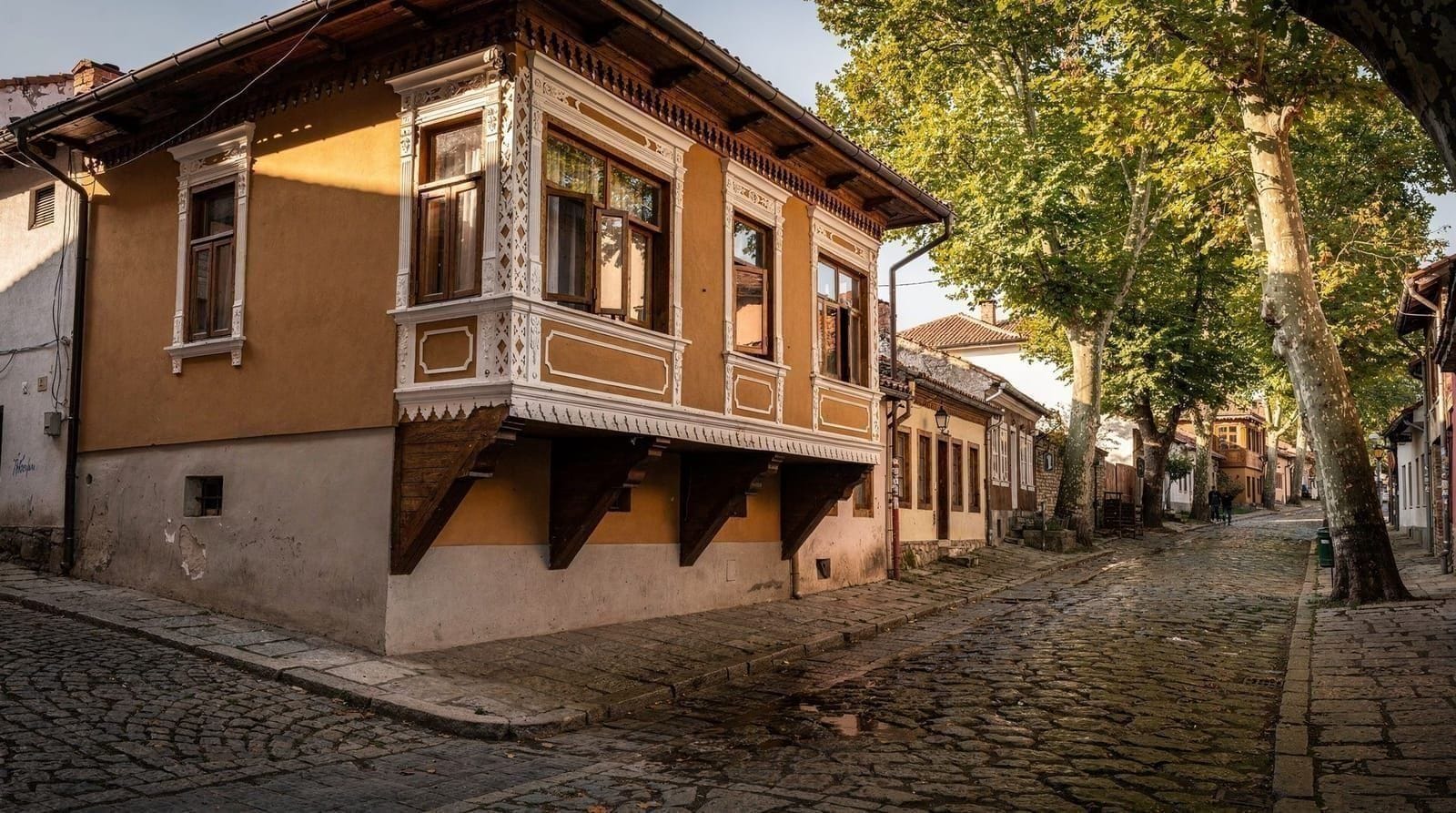
The town is a National Revival architectural ensemble, meaning it preserves the domestic architecture of mid-19th century provincial Bulgarian life with unusual completeness. Houses are typically two storeys, with the upper floor overhanging the lower, built in wood and plaster on stone foundations. Deep eaves shelter wide wooden balconies. Interiors feature elaborate painted wooden ceilings, tiled stoves, and built-in furniture of considerable craftsmanship.
The streets connecting the house-museums are cobbled and follow the contours of the hillside. The town is small enough to walk entirely — the central square, the old stone bridge over the Topolnitsa river, and all six house-museums are within comfortable walking distance of each other.
The setting is attractive in its own right: green hills surround the town, and the Sredna Gora mountains form the backdrop. In spring, the flowering orchards give the approach roads a theatrical quality. In autumn, the colours in the surrounding hills are excellent.
Getting there: the honest transport breakdown
By car (recommended)
The easiest and most flexible option. From central Sofia, take the E871 east (part of the Sofia ring road, then the Trakia motorway/E80 briefly before picking up the E871 toward Koprivshtitsa). The drive is approximately 100 km and takes 1.5 to 2 hours depending on traffic.
The final approach to Koprivshtitsa leaves the main road and follows a narrower valley route for the last 10–15 km. Parking in town is free and easy — there is a main car park near the central square and additional space along the approach roads. Arriving by 10am gives you a full day.
Car rental in Sofia runs €30–50 per day for a standard vehicle. If you are splitting between two or three people, this is the cheapest option by far and gives you complete freedom on timing — including the option to combine with other destinations on the return route.
By bus
Buses depart from Avtogara Yug (Sofia’s southern bus terminal, accessible by metro). There are only 2–3 departures per day in each direction, so check the current timetable carefully before you go. The journey takes approximately 2 hours. Critically, buy your return ticket when you board the outgoing bus — afternoon buses back to Sofia can be full.
The bus is a viable option for a solo traveller or a pair who are comfortable with the limited schedule. The main risk is the return: if the afternoon bus is full or you miss it, options are very limited. Mid-week travel (Tuesday to Thursday) is significantly less stressful than a summer weekend.
By train
Technically possible but effectively impractical. The train from Sofia Central Station runs to Koprivshtitsa station, but the station is 9 km outside the town with no reliable taxi or bus connection onward. Unless you are renting a car at the station (there is no car rental there) or are willing to walk 9 km on a mountain road, the train does not work for a day trip.
GetYourGuideKoprivshtitsa Full-Day Tour - Back to the 19th CenturyCheck availability → GetYourGuideFrom Sofia: Saeva Dupka and Ledenika Caves TourCheck availability →The six house-museums
The six house-museums are the core of a Koprivshtitsa visit. Each is a genuine residence of a specific historical figure or family, preserved in period condition with the original furnishings, documents, and personal effects of the inhabitants. They are small, intimate, and genuinely moving in a way that large national museums rarely are.
Opening hours: Tuesday to Sunday, 9am to 5:30pm. Closed Monday. A combined ticket covering all six costs €10 and is the sensible choice for most visitors. Individual tickets run €3–4 per house.
Allow approximately 20–30 minutes per house, plus walking time between them. Visiting all six takes around 3–4 hours at a comfortable pace. Most houses have explanatory text in English.
Oslekov House
The largest and most architecturally impressive of the six. Built in 1856 for the wealthy merchant Nencho Oslekov, it is a two-storey National Revival mansion with an elaborately painted façade and one of the most beautiful interiors in the town: carved wooden ceilings in the main salon, period textiles, and a fine collection of 19th-century domestic objects. The room known as the “summer salon” — with its painted walls, carved ceiling, and views over the courtyard — is the single most photographed interior in Koprivshtitsa. Entry: €4.
Kableshkov House
The birthplace and family home of Todor Kableshkov, the young revolutionary who effectively fired the starting gun of the April Uprising. The house is modest compared to the Oslekov mansion — Kableshkov’s family were comfortable but not wealthy by the standards of the town’s merchant class. The display covers his life, the events of April 1876, and the famous “bloody letter.” Entry: €3.
Benkovski House
Home of Georgi Benkovski, who commanded the cavalry unit (the “flying squadron”) of the April Uprising. Benkovski was one of the most charismatic figures of the revolt and was killed in the aftermath of its suppression. The house displays his personal effects and documents relating to his military command. Entry: €3.
Lyutov House
The best example in Koprivshtitsa of a wealthy merchant’s lifestyle in the mid-19th century. The Lyutov house features an ornate interior with high-quality European imported furniture alongside local craftsmanship — a combination typical of the prosperous Bulgarian merchants who had significant commercial networks across the Ottoman Empire and beyond. Entry: €4.
Topalovi House
A more modest house than Oslekov or Lyutov, showing the life of a middle-class family rather than the merchant elite. The Topalovi house gives a useful counterpoint: not every resident of Koprivshtitsa was wealthy, and the political radicalism of 1876 cut across economic classes. Entry: €3.
Karavelov House
The family home of Lyuben Karavelov, a writer, journalist, and political activist who played a major role in the intellectual preparation of the liberation movement — though he was in exile at the time of the 1876 uprising itself. The house is smaller and the display more literary and documentary in character, covering his published works and correspondence. Entry: €3.
The town centre: square, church, and stone bridge
Between and around the house-museums, the town itself is worth exploring without a fixed agenda. The central square is the social heart of Koprivshtitsa, ringed by small restaurants, a couple of hotels, and the traditional architecture that gives the whole place its coherence.
The Church of the Assumption of the Virgin (Uspenie Bogorodichno), built in 1817, stands near the river on the edge of the main square. The interior has a carved wooden iconostasis of considerable quality. The church is free to enter.
The old stone bridge over the Topolnitsa river — one of the most photographed spots in town — is a short walk from the square. The river runs through the centre and its banks are pleasant for a brief walk between museums.
Where to eat in Koprivshtitsa
Vodenitsata is the standout choice. The name means “the watermill,” which is what the building is — a working mill converted into a restaurant, sitting above the river with the sound of running water audible from the terrace. The menu is traditional Bulgarian: shopska salad, grilled meats, kavarma (slow-cooked pork or chicken), and seasonal dishes. The setting is the best in town. Book ahead if you’re visiting on a weekend — it fills quickly.
Dyado Liben Inn is a guesthouse that also serves as a restaurant, operating in a beautifully preserved 19th-century building near the town centre. The food is traditional and the atmosphere is very much in keeping with the National Revival character of the town.
Around the central square, several small mehanas (Bulgarian taverns) serve straightforward grilled meat, salads, and bread at reasonable prices. These are good for a quick lunch between museums. Budget €10–15 per person for a main course and a drink.
Koprivshtitsa versus other Sofia day trips
Koprivshtitsa is a specific kind of day trip — history-focused, small-scale, unhurried — and it is worth knowing how it compares before you commit a full day to it.
| Day trip | Distance from Sofia | Main draw | Best for |
|---|---|---|---|
| Koprivshtitsa | ~100 km, 1.5–2h | April Uprising history, house-museums | History enthusiasts, National Revival architecture |
| Plovdiv | ~145 km, 1.5h by train | Old Town, Roman Amphitheatre, city life | Urban culture, restaurants, longer sightseeing |
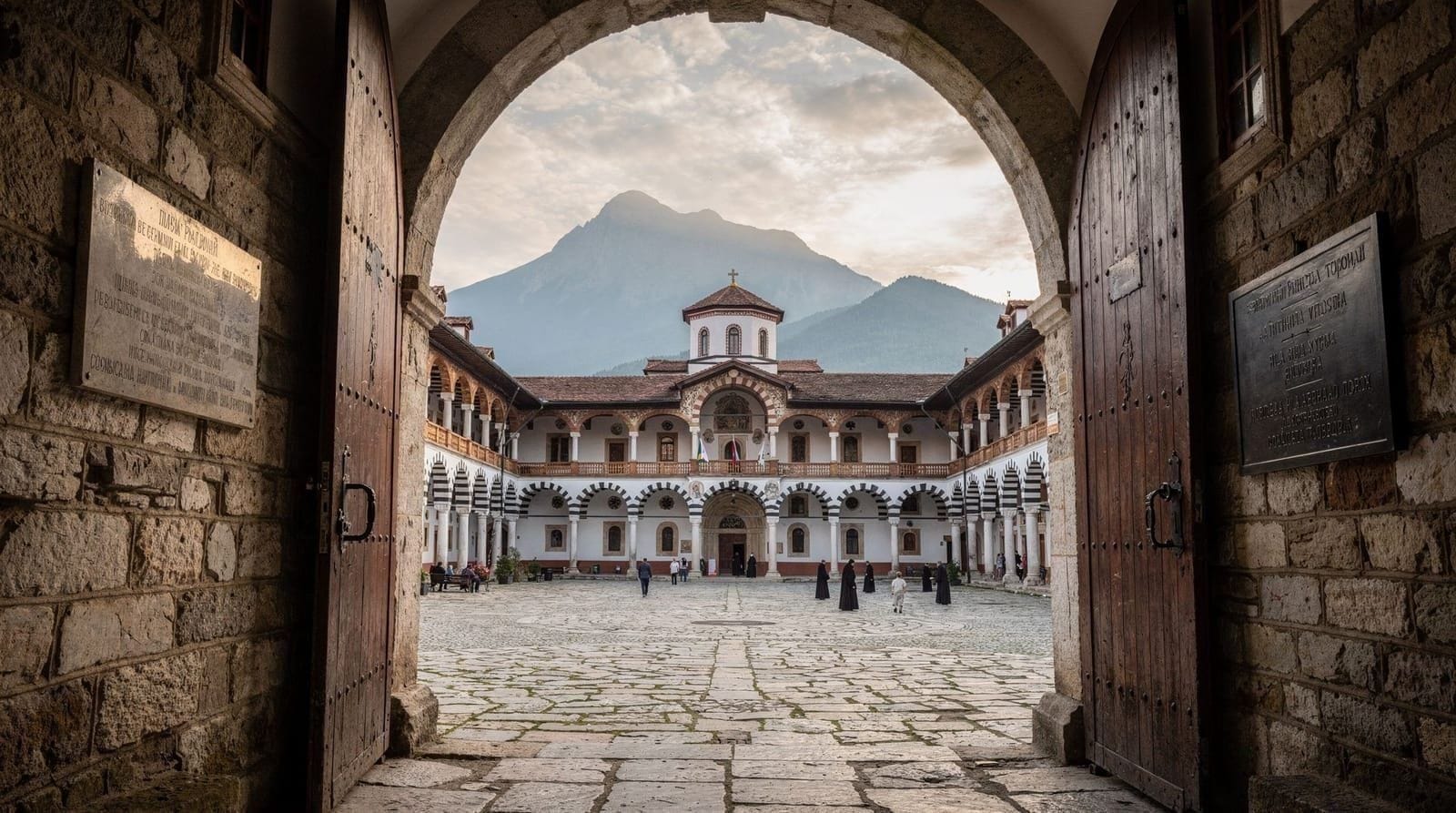
| Rila Monastery | ~120 km, 2h | Bulgaria’s most important religious site | First-time visitors, single unmissable sight |
| Melnik | ~144 km, 3h | Wine, sandstone pyramids | Wine lovers, slower travellers with a full day to spare |
Koprivshtitsa pairs best with visitors who have already done Rila Monastery or Plovdiv and want something quieter and more specific, rather than as a first-ever Bulgaria day trip.
Staying overnight in Koprivshtitsa
Most visitors do Koprivshtitsa as a day trip, but staying overnight changes the experience meaningfully — you get the town in the early morning and evening, after the day-tripper coaches have left, when the cobbled streets are close to empty and the light on the wooden facades is at its best.
Accommodation in Koprivshtitsa is almost entirely small guesthouses in restored National Revival houses rather than hotels. Expect to pay roughly 80–140 BGN (around €40–70) per night for a double room with breakfast in a family-run guesthouse near the centre; a handful of more polished boutique options run somewhat higher. Booking ahead is sensible for weekends between May and October and essential around the April 20–24 uprising re-enactment, when the town’s limited beds sell out months in advance.
An overnight stay also makes sense if you are combining Koprivshtitsa with Plovdiv or the Rose Valley — breaking the drive with a night in Koprivshtitsa turns two rushed day trips into a more comfortable two-day loop.
Combining Koprivshtitsa with other destinations
With Plovdiv
Adding Plovdiv makes a long but very worthwhile day. The city is roughly an hour’s drive south from Koprivshtitsa, and its Old Town — another National Revival ensemble but urban rather than village-scale — complements Koprivshtitsa well. Organised tours that combine both exist and are worth considering; doing it by car is also manageable if you leave Sofia early. See the Plovdiv day trip guide for what to prioritise in the city.
With the Rose Valley
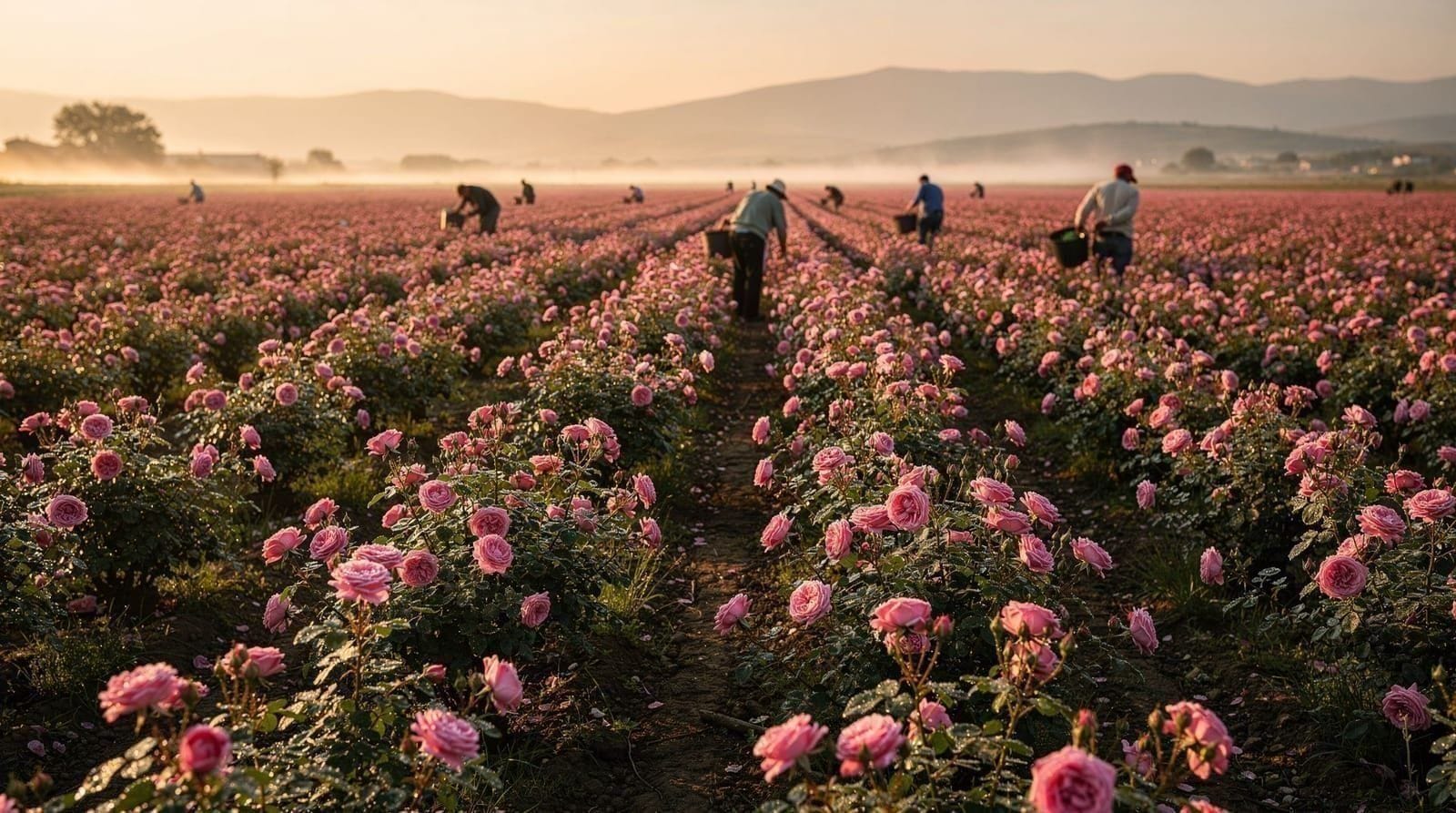
In May and early June, when the roses are in bloom around Kazanlak, combining Koprivshtitsa with the Rose Valley is a natural pairing — both lie east of Sofia and the routes overlap. Outside the bloom season, the Rose Valley is less compelling for a day trip, but the combination works well in the right window. Organised tours covering this combination are available for the festival season.
GetYourGuideFrom Sofia: The Rose Valley & Koprivshtitsa 12 hrs Day TourCheck availability →Best time to visit
May to October is the main visiting season. The weather is reliable, all museums are open on their full schedule, and the surrounding hills are at their best.
April 20–24 marks the anniversary of the uprising, and Koprivshtitsa hosts a major re-enactment during this period — period costumes, cavalry, cannon fire, public ceremonies at the key sites. This is the most atmospheric time to visit and draws a large crowd of Bulgarians from across the country. If you want to attend, book accommodation months in advance (day-tripping from Sofia is fine, as the event is centred in the town rather than requiring overnight presence, but the morning buses and roads will be very busy).
January and February are quiet. Some museums operate reduced hours or close entirely, and the town loses much of its warmth. Avoid unless you specifically want an empty, wintry atmosphere.
The best time to visit Sofia guide covers seasonal conditions across the wider region.
Budget breakdown
For a self-drive day trip from Sofia:
- Car fuel: approximately €10 round trip
- Parking: free
- Combined museum ticket: €10 per person
- Lunch: €10–15 per person at a mid-range mehana or Vodenitsata
- Coffee and incidentals: €5
- Total: approximately €30–35 per person (self-drive, two people sharing fuel)
On an organised tour from Sofia, budget €40–60 per person all-in, including transport and guide. Solo travellers or those without a car will find this the better value option compared to the bus plus individual museum tickets.
What to buy in Koprivshtitsa
Several small shops around the central square sell local crafts rather than generic souvenirs: hand-woven textiles, wood carvings, and jars of local honey and rose products from the wider Sredna Gora region. Prices are modest — a woven table runner or small wood carving typically costs €5–15. There are also a couple of shops selling local wine and rakia by the bottle, useful if you are driving and can carry it home without worrying about luggage restrictions.
The house-museums themselves sometimes have small gift counters selling books on the April Uprising (mostly in Bulgarian, some with English editions) and postcards reproducing period photographs. These are a better memento of the visit than generic magnets, and the proceeds support the museums’ upkeep.
Practical notes
Koprivshtitsa sits at around 1050m altitude, which means cooler temperatures than Sofia in summer (pleasant) and colder, potentially snowy conditions in winter. Bring a layer even in July.
The town has ATMs near the central square, but they can run low on busy summer weekends — bring cash. The house-museums accept cash only at most ticket offices.
Mobile signal is adequate in town but can drop in the surrounding hills.
The getting around Sofia guide covers the transport logistics from the city end. For building Koprivshtitsa into a wider Bulgarian trip, see day trips from Sofia, the Bulgaria highlights 7-day itinerary, and the medieval Bulgaria loop which connects several historically significant towns in this region.
For planning how much time to allocate to the Sofia area generally, see how many days in Sofia and the Sofia in 3 days itinerary.
Frequently asked questions about Koprivshtitsa day trip from Sofia
How far is Koprivshtitsa from Sofia?
Approximately 100 km east of Sofia via the E871 highway, taking around 1.5 to 2 hours by car depending on traffic. By bus from Avtogara Yug, allow 2 hours for the journey itself, plus time at the terminal.How do I get to Koprivshtitsa from Sofia without a car?
There are 2–3 buses daily from Avtogara Yug (Sofia's southern bus terminal) to Koprivshtitsa. The journey takes about 2 hours. Book the return journey when you board. There is also a train from Sofia Central Station, but the station is 9 km from the town with no reliable onward transport — the train is effectively impractical for a day trip.What are the six house-museums in Koprivshtitsa?
The six are: Oslekov House (largest, most ornate), Kableshkov House (birthplace of the uprising's first shot), Benkovski House (cavalry leader), Lyutov House (best merchant interior), Topalovi House (middle-class life), and Karavelov House (writer and activist). A combined ticket covering all six costs €10.When are the house-museums open in Koprivshtitsa?
Generally Tuesday to Sunday, 9am to 5:30pm. Most museums close on Monday. Hours may be reduced in winter (November to March). The April uprising re-enactment (April 20–24) draws large crowds and some venues adjust their usual hours during the event.What is the April Uprising and why does Koprivshtitsa matter?
The April Uprising of 1876 was a Bulgarian revolt against approximately 500 years of Ottoman rule. It began in Koprivshtitsa on April 20, 1876, when Todor Kableshkov sent his 'bloody letter' to neighbouring towns — famously sealing it with the blood of the first Ottoman casualty. The uprising was suppressed brutally, but the atrocities shocked European public opinion, prompted Russian intervention, and led to the Russo-Turkish War of 1877–78 and Bulgarian liberation in 1878.What is the best time to visit Koprivshtitsa?
May to October for a standard visit. April 20–24 for the uprising re-enactment — a major event with period costumes, cavalry, and cannon fire, but plan well ahead as accommodation books out months in advance. Avoid January and February when some museums reduce hours significantly or close.Where should I eat in Koprivshtitsa?
Vodenitsata (the old watermill restaurant) is the standout choice for traditional Bulgarian food in a historic setting — book ahead on weekends. Dyado Liben Inn also has a restaurant in a beautifully preserved 19th-century building. Several small mehanas (taverns) around the central square serve grilled meats and shopska salad at reasonable prices.What does a day trip to Koprivshtitsa cost?
Budget approximately €30–45 per person including transport. The combined museum ticket is €10. Lunch at a mid-range mehana costs €10–15. Car fuel for the round trip from Sofia is around €10. An organised tour costs €40–60 per person all-in.Is Koprivshtitsa a good first Bulgaria day trip, or should I do Rila Monastery first?
For most first-time visitors, Rila Monastery or Plovdiv should come first — they are Bulgaria's two most essential day trips and give a broader introduction to the country. Koprivshtitsa is a better second or third day trip, ideal for travellers with a specific interest in 19th-century history who have a few days to spend and want something quieter and more focused.
Top experiences
Bookable activities with verified prices and instant confirmation on GetYourGuide.