Alexander Nevsky Cathedral: what to know before you visit
Sofia from the Top and Alexander Nevski Cathedral
Is Alexander Nevsky Cathedral free to enter?
The main nave is free. The icon gallery in the crypt (Bulgaria's best collection of medieval icons) costs €3. Both are open 7am–7pm daily. Photography is restricted inside the nave; the crypt allows photography.
The Alexander Nevsky Cathedral is Sofia’s most recognisable building, but it is frequently misread. Tourists photograph the gold and copper domes from the square and move on. That is a mistake. The interior — the mosaic vault, the scale of the chandeliers, the carved wood iconostasis — takes your breath away in a way the exterior only hints at. And the icon crypt below contains what is genuinely one of the finest collections of medieval sacred art in the Balkans, almost always uncrowded.
This guide covers everything needed to visit properly: the history behind why it was built, what to look for inside, how the crypt differs from the nave, practical visiting logistics, and how the cathedral fits into a wider sofia old town walk.
| Where | pl. Alexander Nevski, Sofia city centre |
| Cost | Nave free; icon crypt around €3 (roughly 6 BGN) |
| Time needed | 20 min nave; +30–40 min for the icon crypt |
| Getting there | About 12 min on foot from Serdica metro station |
| Best time | Weekday mornings, 7–9am, before tour groups arrive |
Why the cathedral was built
The Alexander Nevsky Cathedral is not, strictly speaking, a Bulgarian church. It is a Russian church, built in Bulgaria, in memory of Russian soldiers — and that distinction matters for understanding what you’re looking at.
In 1877–78, Russia went to war with the Ottoman Empire in what Bulgarians call the War of Liberation. After nearly five centuries of Ottoman rule, Bulgarian autonomy had long been suppressed; a particularly brutal response to the April Uprising of 1876 — in which thousands of Bulgarian civilians were killed — prompted international outrage and eventually Russian military intervention.
The war ended Ottoman rule over Bulgaria. Approximately 200,000 Russian soldiers died in the campaign. When Bulgaria established its first post-liberation government, there was a question of how to memorialize that sacrifice. The answer, decided in 1882, was a cathedral on a scale commensurate with the debt — dedicated to Alexander Nevsky, the medieval Russian warrior-prince who had been canonized as a saint.
Construction began in 1882 but moved slowly; the cathedral was not consecrated until 1912. The lead architect was Alexander Pomerantsev, a Russian, working in the Neo-Byzantine style. The result is deeply Russian in character — the gold domes, the brick masonry, the dome proportions — built on Bulgarian soil as a permanent expression of a political and emotional alliance that has defined Bulgarian national identity ever since.
That relationship between Bulgaria and Russia is now more complicated. But the cathedral stands as a monument to a specific historical moment, and understanding that moment changes what you see when you look at it.
GetYourGuideSofia from the Top and Alexander Nevski CathedralCheck availability →Architecture and exterior
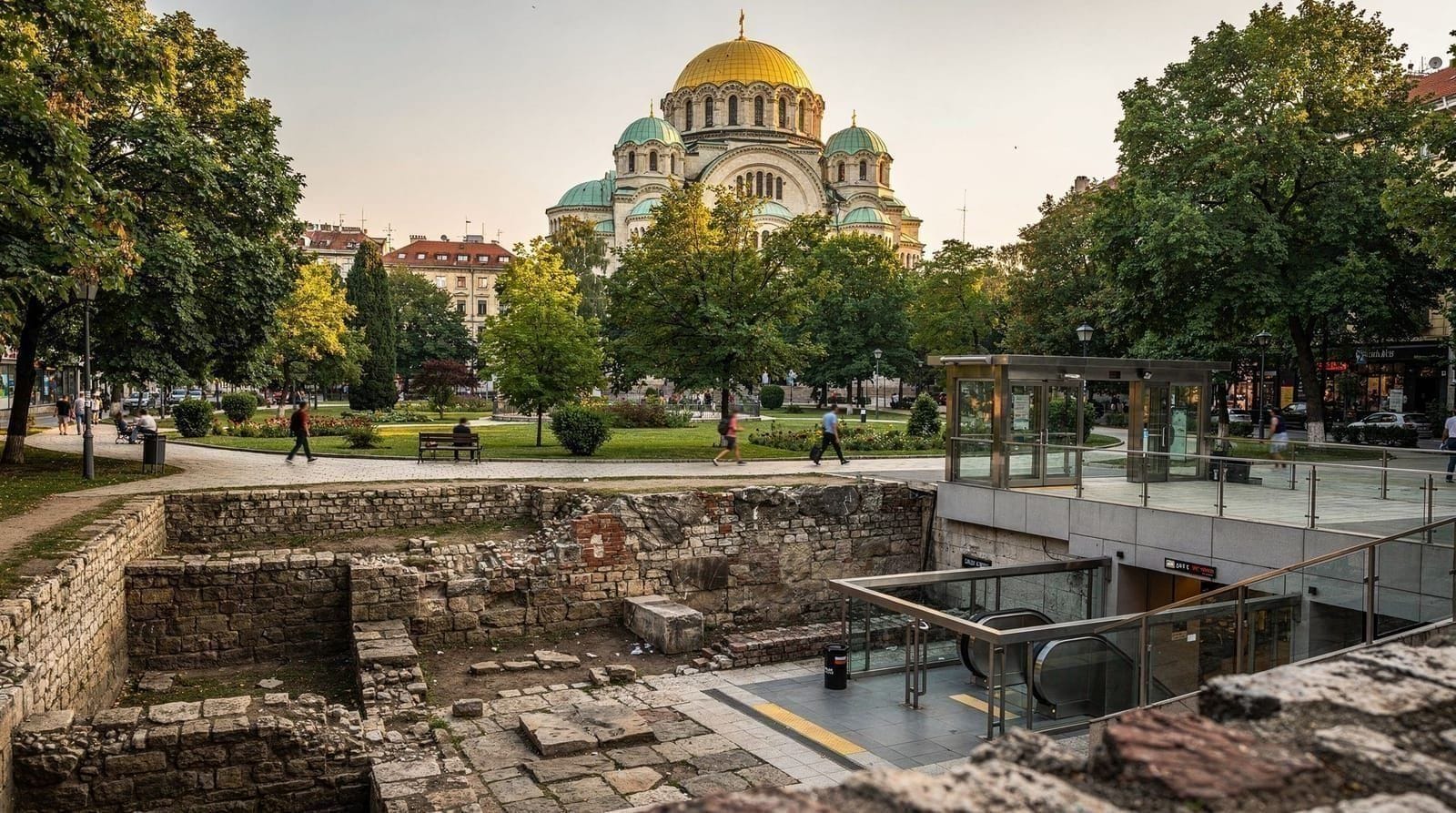
The cathedral occupies its own large square — pl. Alexander Nevski — which gives it the breathing room to be seen properly. Walk around it before entering.
The dome system is the visual centrepiece: a large central dome flanked by several smaller domes, covered in copper that has oxidized to a distinctive green-gold. The main bell tower, at 73 metres, is the tallest structure in the cathedral complex. The towers and dome profiles draw directly on Bulgarian medieval churches filtered through Russian nineteenth-century interpretations of Byzantine form.
The bells in the bell tower include a 12-tonne main bell donated by Russia. Bell-ringing at Alexander Nevsky on major Orthodox feast days — Easter in particular — is an event in itself.
The exterior stonework is a warm yellowish sandstone. The building covers about 3,170 square metres and can hold up to 5,000 worshippers, making it one of the fifty largest Orthodox cathedrals in the world.
Notice the relationship between the cathedral and the surrounding buildings. Directly west across the square is the National Gallery in the former royal palace. The Sofia University building faces the cathedral from a slight distance. This entire area was designed in the early post-liberation decades to project the institutions of a new European state — church, art, education — in a coherent spatial ensemble.
Inside the nave
The nave is free to enter and open from 7am to 7pm daily.
Your first impression will be of scale and gold. The interior is approximately 55 metres long and rises to 45 metres at the central dome. The eye moves upward involuntarily to the mosaic of Christ Pantocrator in the dome — gold ground, stern expression, the traditional Byzantine formula executed with late 19th-century technical precision.
Walk slowly. There is a great deal to see:
Mosaics. The walls and vaults are covered in mosaic cycles depicting scenes from the life of Christ, the Virgin, and various saints. These were designed by Russian and Bulgarian artists working in the Neo-Byzantine tradition. The colour palette — deep blues, warm ochres, gold — gives the interior its characteristic warmth despite the scale.
Chandeliers. The main chandelier weighs several tonnes. The lighting design was calibrated for candlelight and natural light; the chandeliers are as much about the quality of illumination as spectacle.
The iconostasis. The carved wood iconostasis (the screen separating the nave from the sanctuary) is an elaborate structure with gilded icons set into dark carved wood. This is where the active liturgical life of the cathedral is centred.
Side chapels. The cathedral has several side chapels, each dedicated to different saints. These are quieter spaces and worth a moment of your time. The chapel of Saints Cyril and Methodius — the ninth-century brothers who created the Cyrillic alphabet — holds particular significance in Bulgarian religious and cultural consciousness.
Photography inside the nave is officially restricted, though enforcement varies. Ask a staff member if unclear, and always avoid photographing during services.
The icon crypt: the real reason to stay longer
Below the cathedral, accessible via a separate entrance on the south side of the building, is the National Art Gallery’s icon collection — known informally as the icon crypt. Entry is €3.
This is the best collection of Bulgarian Orthodox icons in existence: roughly 300 works spanning the 10th through 19th centuries, drawn from monasteries, churches, and private collections across the country. The crypt’s stone vaults and dim lighting are appropriate for the material — these are objects that were made to be seen by candlelight, and the exhibition recreates something of that atmosphere.
What to look for:
The medieval works (10th–14th century) are the rarest and most important historically. Bulgarian medieval icon-painting developed in dialogue with Byzantium while maintaining distinct regional characteristics. The colour use and facial typology in these early works differs noticeably from later periods.
The Tarnovo school (14th century) produced some of the most sophisticated Bulgarian icon-painting before the Ottoman conquest. Several examples here show the influence of late Byzantine refinement — elongated figures, complex narrative compositions — that was cut short by the political catastrophe of 1393.
The Bulgarian National Revival period (17th–19th century) represents the largest section of the collection. These icons were made during Ottoman rule by craftsmen from the Bansko, Tryavna, and Samokov schools. They are more accessible to a modern eye — warmer colours, more naturalistic faces — and often show influence from Western European painting.
The crypt also holds some liturgical objects: processional crosses, embroidered vestments, and a few items of ecclesiastical silverwork. The labelling is in Bulgarian and English.
Photography is permitted in the crypt.
GetYourGuideSofia: Must-See Attractions Walking TourCheck availability →Understanding Bulgarian icon painting
The icon crypt is not just a collection of religious objects — it is a compressed history of Bulgarian art across a thousand years, and it rewards some basic contextual knowledge.
What an icon is. In Orthodox theology, an icon is not a painting in the Western art-historical sense. It is a window — a material object through which the divine presence of the person depicted becomes accessible to the worshipper. This theology shapes every aspect of how icons are made: the materials (specific pigments, egg tempera on prepared wood panels, gold leaf), the compositional conventions (frontal poses, gold grounds, specific gesture codes), and the production process (treated as a form of prayer). When you look at a Bulgarian medieval icon and it looks “flat” compared to Renaissance painting, that flatness is intentional — it signals that you are not looking at a naturalistic representation of a person but at a spiritual presence.
The National Revival period icons. The largest section of the crypt contains icons from the 17th to 19th centuries — the period of Bulgarian National Revival (Vazrazhdane), when Bulgarian culture, language, and craft traditions began to reassert themselves under late Ottoman rule. The icon-painters of this period worked in distinctive regional schools: Bansko in the Pirin mountains, Tryavna in the Balkan range, Samokov south of Sofia. Each school has recognisable characteristics: Bansko icons tend toward darker, richer colour palettes; Tryavna icons have more linear, decorative qualities; Samokov work shows stronger Western European influence through contact with Vienna and the Habsburg world.
Many of the Revival-period icons in the crypt came from churches and monasteries across Bulgaria — some collected by the socialist state, others donated or sold. The collection is comprehensive enough that if you have any interest in visiting Rila Monastery or smaller village churches on your Bulgaria trip, time spent in the crypt first gives you a vocabulary for what you’ll see.
Practical visiting information
Hours: 7am–7pm daily (nave). The icon crypt/gallery keeps similar hours but may close on Monday — check current hours when you arrive.
Cost: Nave — free. Icon crypt — €3.
Getting there: The cathedral is on pl. Alexander Nevski, approximately 800m east of Serdica metro station along Tsar Osvoboditel Boulevard. There is no metro directly at the cathedral; the walk from Serdica takes about 12 minutes.
Best time to visit: Weekday mornings. Sunday mornings are atmospheric but crowded; midday weekends in summer are the busiest period.
Dress code: Shoulders and knees covered for both genders. Shawls occasionally available at the entrance.
Luggage: No cloakroom in the nave; the crypt may allow bags at the entrance.
Bulgaria, Russia, and a complicated gratitude
The cathedral is named after a 13th-century Russian prince-saint who defended Orthodox Christianity against the Teutonic Knights, and it was built as a Bulgarian gift to Russia — or more precisely, as a Bulgarian acknowledgement of a Russian sacrifice. That relationship has never been simple, and it becomes less simple the more recent the history.
Bulgaria spent nearly five centuries under Ottoman rule (1396–1878). The Russian Empire’s decision to go to war with the Ottomans on Bulgaria’s behalf in 1877 was motivated by pan-Slavic ideology, Orthodox Christian solidarity, and geopolitical interest in the Balkans in roughly equal measure. Bulgarian gratitude to Russia for the liberation is genuine and deep — the holiday of the 3rd of March (Liberation Day) is one of the most important in the Bulgarian calendar, and it is marked at Alexander Nevsky every year with ceremonies attended by political leaders and large crowds.
At the same time, Bulgaria’s relationship with Russia has been complicated by the Soviet period (1944–1989), during which Bulgaria was one of the most closely aligned Warsaw Pact states; by post-1989 Bulgarian integration into NATO and the EU; and by more recent geopolitical events. The cathedral now stands at an interesting tension point: it is a monument to Russian-Bulgarian friendship built in a country that is now a NATO member and a Schengen state (Bulgaria joined Schengen in January 2025), navigating a relationship with Russia that is significantly different from the one the cathedral’s builders imagined.
This context is not a reason to view the cathedral cynically. The sacrifice it commemorates was real. But understanding it adds a layer to what you’re seeing.
Photography and the cathedral
The question of photography at Alexander Nevsky comes up constantly, and the answer is not straightforward.
Outside: No restrictions. The domes from the south-east corner of the square, particularly in the late afternoon when the copper glows, are the standard shot. The view from the far end of the square, including the National Gallery façade and the lime trees, gives the building proper context.
Inside the nave: Photography is officially restricted, meaning you should not photograph freely. In practice, enforcement is inconsistent — some staff enforce it strictly, others ignore tourists with cameras entirely. The respectful approach is to not photograph during any service, not to use flash at any time, and to ask a staff member if you want to photograph the iconostasis or specific artworks. Pulling out a large camera and walking up and down the nave photographing everything is not appropriate; a discreet photo of the overall interior space is usually tolerated.
Inside the crypt: Photography is permitted and the lighting is actually reasonable for it. The medieval icons photograph surprisingly well — the gold grounds catch the exhibition lighting. Use the time in the crypt properly rather than rushing the nave hoping for shots.
The cathedral in Bulgarian culture
Alexander Nevsky is not just a building in Sofia — it functions as a kind of national focal point. Major state occasions take place here. Political protests have gathered in the square. The New Year’s Eve fireworks are visible from the square. The September feast day of Alexander Nevsky draws believers from across the country.
The square has also been a site of political significance in the post-communist period. The large anti-government protest camps of 2013 gathered here. The square’s scale makes it the natural location for large public assemblies.
In popular culture, the cathedral appears on Bulgarian banknotes and in virtually every visual representation of Sofia. It has become so iconic that it risks being reduced to a logo — visitors photograph the domes and move on. The icon crypt, which requires deliberately seeking out and paying €3, filters out the purely cursory visitors and rewards those who stayed.
The square and surroundings
The square around Alexander Nevsky is itself worth time. On weekend mornings, a secondhand art and icons market sets up along the cathedral’s north and east flanks — dozens of stalls selling Soviet-era paraphernalia, old Bulgarian coins, paintings, and icon reproductions. The quality is mixed but it’s a genuine local flea market, not a sanitised tourist product.
The National Gallery directly across the square (entrance on the west side of the former royal palace) is a natural companion visit. Bulgarian art from the 19th century onward is displayed across two buildings; the permanent collection is free one day a week. Temporary exhibitions vary in admission. For a full overview of what’s in Sofia’s museums, see the sofia museums guide.
Café options around the square are reasonable without being spectacular. The better coffee is a few minutes west toward Vitosha Boulevard or down in the city centre, where Sofia’s genuinely good third-wave coffee culture is concentrated. The sofia coffee culture guide covers that.
Alexander Nevsky compared to Sofia’s other churches
Sofia’s religious buildings span nearly two millennia, and visitors often assume they are all roughly similar. They aren’t. Here is how the main ones stack up against Alexander Nevsky:
| Site | Era | Style | Time needed |
|---|---|---|---|
| Alexander Nevsky Cathedral | Consecrated 1912 | Neo-Byzantine, Russian | 20–60 min |
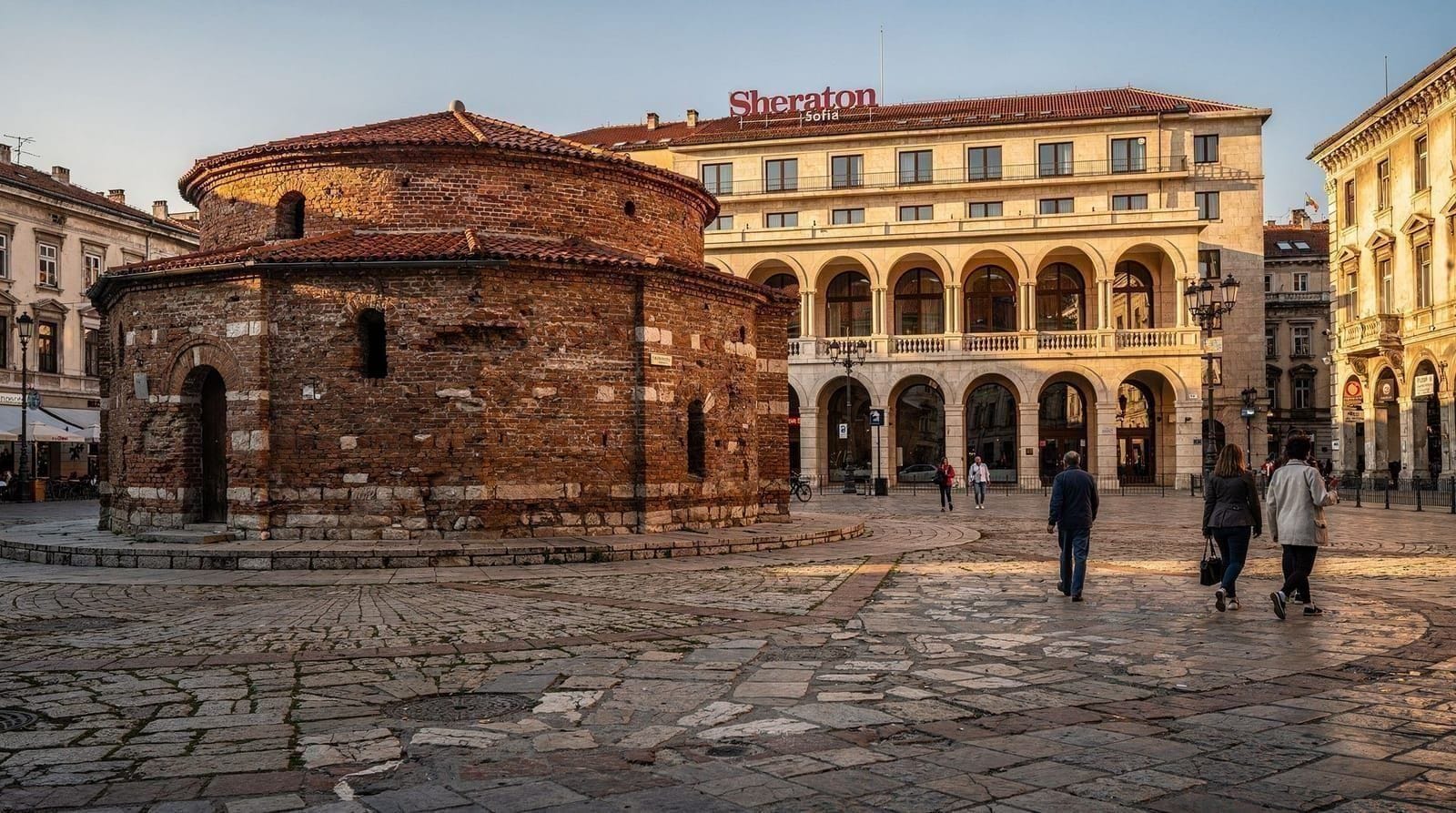
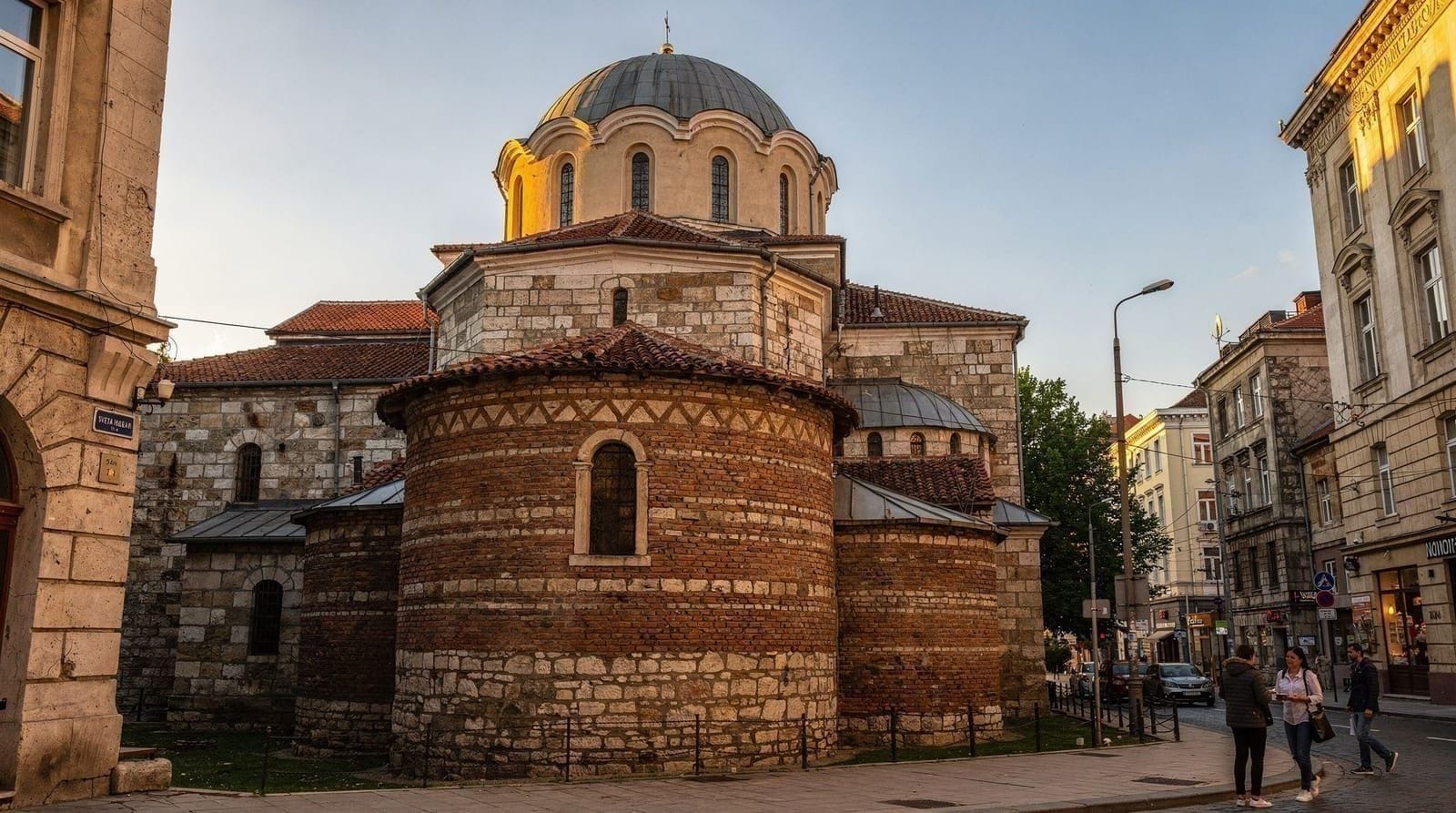
| Rotunda of St George | 4th century | Roman brickwork, medieval frescoes | 15–20 min |
| Boyana Church | 10th–13th century (frescoes 1259) | Medieval Bulgarian, UNESCO | 30–45 min |
| Banya Bashi Mosque | 16th century (1576) | Ottoman | 10–15 min |
If you only have time for one, Alexander Nevsky is the obvious choice for scale and the icon crypt. If you have a second stop, the Rotunda and the rest of Sofia’s churches show a completely different, older layer of the city.
How the cathedral fits into a Sofia visit
Alexander Nevsky naturally anchors a visit to sofia city centre. It pairs best with:
- The sofia old town walk route, which passes the cathedral at Stop 6 and contextualises it among the city’s other layers of history
- sofia churches guide, which covers the cathedral alongside the Rotunda, Banya Bashi, and Boyana in a single framework
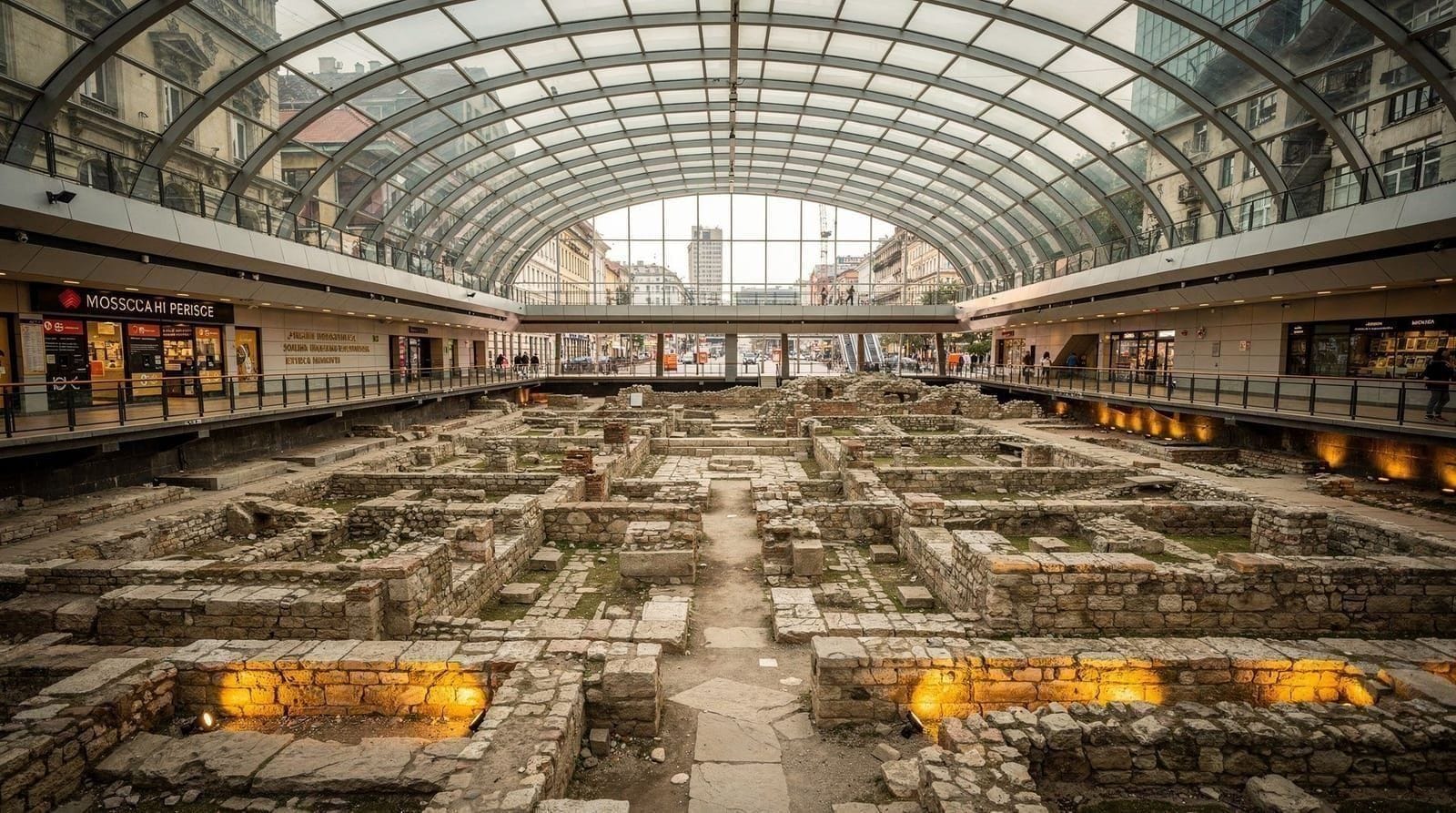
- The sofia in 2 days itinerary, which places Alexander Nevsky on Day 1 morning alongside Serdica and the Largo
- Boyana Church, 4km south — a UNESCO site with 13th-century frescoes that represent a different and arguably more intimate scale of Bulgarian religious art
For visitors with a specific interest in Byzantine and Orthodox art, the Thracian heritage guide and the Bulgarian Revival architecture guide extend the picture well beyond the cathedral.
GetYourGuideSofia: Night Walking Tour with GuideCheck availability →A note on Orthodox protocol
Alexander Nevsky is an active place of worship, not a museum. Liturgical services run according to the Orthodox calendar, with more frequent and elaborate services on Sundays and major feast days. During services:
- Do not walk around with a camera
- Stand or sit quietly at the back
- Visitors are welcome to observe but should not cross into the nave if a service is in progress and the space is clearly restricted
The larger Orthodox festivals — Christmas, Easter, the Feast of Alexander Nevsky in September — draw large congregations and are well worth witnessing if your visit coincides. Easter in particular involves a midnight procession around the cathedral that is one of the most striking annual events in Sofia.
For detailed etiquette advice covering all of Sofia’s religious buildings, see the sofia churches guide.
Frequently asked questions about Alexander Nevsky Cathedral
How long should I spend at Alexander Nevsky Cathedral?
Twenty minutes for the nave; add 30–40 minutes if you visit the icon crypt. If you're genuinely interested in Bulgarian Orthodox art, the crypt alone is worth an hour.When is the best time to visit Alexander Nevsky?
Early morning (7–9am) on a weekday is quietest. Sunday mornings have liturgies which are worth experiencing but the cathedral fills with worshippers and tourists simultaneously. Avoid midday on weekends in summer when tour groups peak.Can I attend an Orthodox service?
Yes, visitors are welcome during services but should stand quietly at the back, dress modestly, and not walk around taking photos. Services typically run on Sunday mornings from around 9am.What is the icon crypt?
A separate exhibition space in the cathedral's crypt housing Bulgaria's national collection of Orthodox icons from the 10th to 19th centuries. It includes pieces from monasteries across Bulgaria and is considered the finest such collection in the country. Entry is €3, separate from the main cathedral.Is there a dress code?
Yes. Shoulders and knees must be covered for both men and women. The cathedral sometimes has shawls available at the entrance, but bringing your own is more reliable. Shorts are not permitted.How far is Alexander Nevsky from the rest of Sofia's sights?
It sits on its own large square roughly 800m east of the Largo. The National Gallery is directly across the square. Banya Bashi Mosque and Sofia Synagogue are about 15 minutes' walk west. The cathedral fits naturally into the self-guided route described in the Sofia old town walk guide.How does Alexander Nevsky compare to the Rotunda of St George?
They sit at opposite ends of Sofia's religious architecture. Alexander Nevsky is a vast Neo-Byzantine Russian cathedral consecrated in 1912, built to memorialize a war. The Rotunda of St George, a short walk away behind the Presidency, is a small 4th-century Roman brick building with surviving medieval frescoes — Sofia's oldest standing structure. Visit both; combined they take under an hour and span nearly 1,600 years of building history.Is Alexander Nevsky worth visiting if I only have one day in Sofia?
Yes — it is the single most efficient sight in the city centre. Even a brief visit (nave only, 20 minutes) covers the most photographed building in Bulgaria and sits within the same walkable core as Serdica, the Rotunda, and the old town. If your day allows 30–40 extra minutes, add the icon crypt; it is the best small museum in Sofia.
Top experiences
Bookable activities with verified prices and instant confirmation on GetYourGuide.