Sofia's churches and religious buildings: a visitor's guide
Sofia: Must-See Attractions Walking Tour
What are the most important churches to visit in Sofia?
Alexander Nevsky Cathedral (iconic, free nave, €3 crypt), Rotunda of St George (4th century, oldest building in Sofia, free), Boyana Church (UNESCO frescoes, 4km from centre, €8, book ahead), Banya Bashi Mosque (16th century, functioning, free), Sofia Synagogue (€4, third largest in Europe). All can be visited in one full day.
| Where | City centre (most sites) plus Boyana, 4km south |
| Cost | Free to around €8 (Boyana Church) |
| Time needed | Half a day for the centre; add a half-day for Boyana |
| Getting there | Walkable in the centre; taxi or Bus 107 to Boyana |
| Best time | Weekday mornings, before tour groups arrive at Boyana |
Sofia’s religious buildings span seventeen centuries and four faiths. Within a two-kilometre radius of the city centre you can stand in front of a fourth-century Roman rotunda, walk into a sixteenth-century Ottoman mosque, and look up at the gold domes of a twentieth-century Orthodox cathedral. Twenty minutes outside the centre, a UNESCO-listed medieval church contains 13th-century frescoes that changed the course of European religious painting. This guide covers all of them: what they are, why they matter, and the practical information needed to visit each one.
Visiting etiquette: the basics
Before the individual buildings, a word on protocol that applies across all of Sofia’s religious sites.
Orthodox churches (Rotunda, Alexander Nevsky, St Nedelya, St Petka, Boyana): Shoulders and knees should be covered. Women traditionally cover their heads; while this is not rigorously enforced at most sites, bringing a light scarf is respectful. Photography of services is not acceptable. During active liturgy, visitors should stand quietly at the back.
Mosque (Banya Bashi): Remove shoes before entering. No shorts. Women should cover their hair when inside the prayer hall. No photography inside without permission.
Synagogue: Men must wear a kippah (provided at the entrance). Modest dress. Photography inside varies — ask at the entrance.
These are places of active worship, not museums. The guidance applies particularly when services are in progress.
GetYourGuideSofia: Must-See Attractions Walking TourCheck availability →Rotunda of St George: Sofia’s oldest building
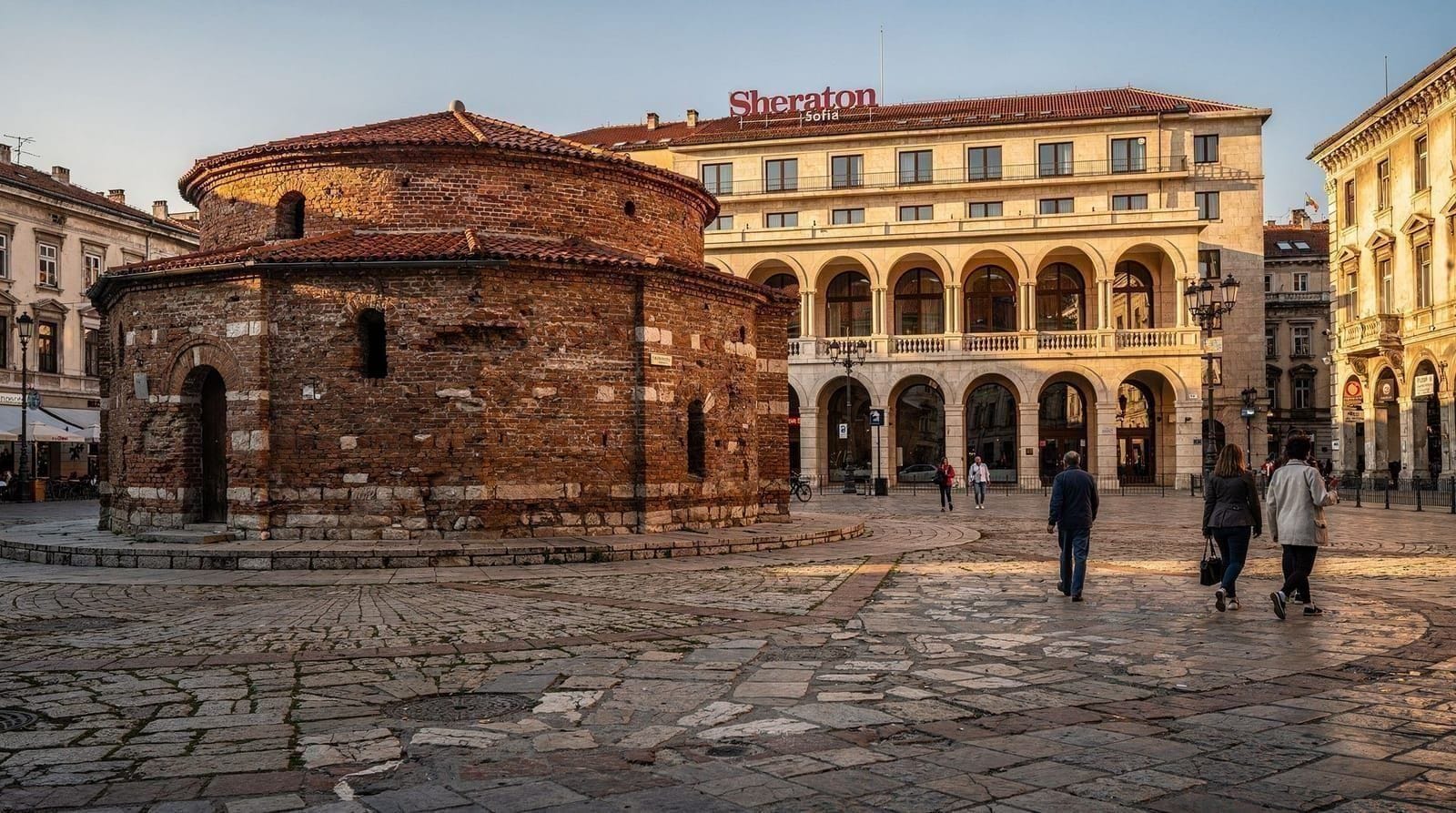
What it is: A small Roman-period brick rotunda in the courtyard of the Sheraton Hotel, built in the early fourth century AD — the oldest surviving building in Sofia and one of the most historically layered structures in the Balkans.
History: The rotunda was most likely built during the reign of Constantine the Great, who had a documented connection to Serdica (as ancient Sofia was known) and is believed to have described it as “my Rome.” Its original function is debated — a mausoleum, a ceremonial bath, a chapel associated with the imperial palace — but by the late fourth century it was serving as a Christian church. Under Ottoman rule it became a mosque. After Bulgarian independence it reverted to Orthodox use, and restoration work has revealed multiple layers of frescoes, some dating to the 10th–13th centuries, still partially visible inside.
Why visit: Because no other building in Bulgaria compresses this much history into such a small space. Walking inside, you are in a room that has been a Roman civic building, a Byzantine church, and an Ottoman mosque. The brick dome, the apse, the traces of fresco on the curved walls — it all registers differently once you know what you’re looking at.
Practical information:
Entry: Free
Hours: Variable, usually 9am–5pm; sometimes closed for events
Location: Sheraton Hotel courtyard, off Battenberg Square — the hotel entrance is publicly accessible
Time needed: 15 minutes
For more detail on the Rotunda’s Roman context, see serdica roman ruins.
Alexander Nevsky Cathedral: the national landmark
What it is: Sofia’s defining skyline, a Neo-Byzantine cathedral built between 1882 and 1912 to commemorate the Russian soldiers who died in the 1877–78 war that ended Ottoman rule in Bulgaria.
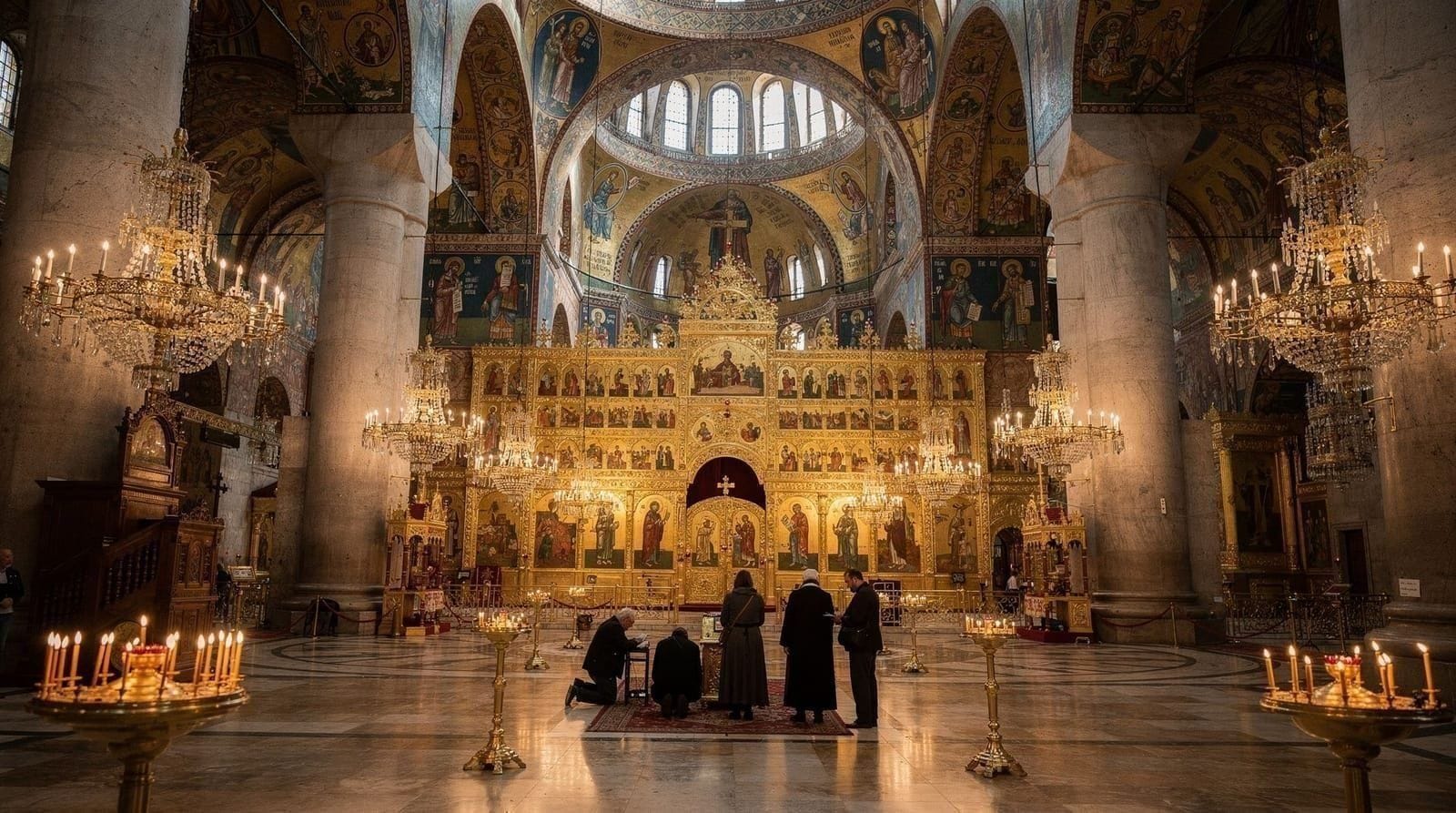
History: Nearly 200,000 Russian soldiers fell in the war that gave Bulgaria its independence. The cathedral was the Bulgarian state’s expression of gratitude — and its political alignment — built on a monumental scale (capacity 5,000, 73m bell tower, gold and copper domes visible from across the city) to a design by Russian architect Alexander Pomerantsev.
What to see: The free nave holds mosaics, a vast chandelier, and a carved iconostasis. The icon crypt (€3, separate entrance on the south side) contains Bulgaria’s finest collection of medieval icons — roughly 300 works from the 10th to 19th centuries, displayed in atmospheric vaulted spaces. The crypt is consistently undervisited and consistently more rewarding than visitors expect.
Practical information:
Entry: Nave free; icon crypt €3
Hours: 7am–7pm daily
Location: Pl. Alexander Nevski, about 800m east of Serdica metro
Time needed: 20 minutes for nave alone; 60–90 minutes including crypt
Photography: Restricted in nave; permitted in crypt
The full history and visitor guide is in the alexander nevsky cathedral article.
Banya Bashi Mosque: the Ottoman layer
What it is: A 16th-century Ottoman mosque — the only functioning mosque in Sofia — built in 1576 during the height of Ottoman rule and still serving Sofia’s Muslim community today.
History: The Banya Bashi (meaning “many baths”) Mosque was built in 1576, most likely by Mimar Sinan or his school — the same Ottoman court architect responsible for the Süleymaniye Mosque in Istanbul and Selimiye Mosque in Edirne. It takes its name from the hot mineral springs that flow beneath it: the mosque was built adjacent to the hammams that used the natural thermal water, some of which have been in use since Roman times.
The Ottoman period in Bulgaria is complicated historical territory. Five centuries of rule left deep marks — in the architecture, the food, the vocabulary, the population distribution — that are sometimes acknowledged with ambivalence in Bulgarian national memory. Banya Bashi is a useful reminder that the Ottoman presence was not a temporary interruption but a formative period. Bulgaria joined the Schengen area in January 2025, and the country’s relationship with its complex history is one of the more interesting dynamics visible to an attentive visitor.
What to see: The prayer hall is a single domed space, modest by Ottoman standards but well-proportioned. The courtyard contains the original ablution fountain. The yellow Art Nouveau building next door is the former Central Mineral Baths, now a museum about Sofia’s thermal springs — worth a look for the building’s exterior. For more on this, see the sofia mineral baths guide.
Practical information:
Entry: Free
Hours: Open outside prayer times (Fajr, Dhuhr, Asr, Maghrib, Isha — five times daily). Mid-morning on weekdays is safest.
Location: Maria Luisa Boulevard, a 5-minute walk west of the Largo
Time needed: 15–20 minutes
Dress: Shoes off, shoulders and knees covered, women cover hair inside prayer hall
Sofia Synagogue: one of Europe’s largest
What it is: A Moorish Revival synagogue built in 1909, one of the largest in Europe (seating 1,170, capacity ~2,000), still serving Sofia’s Jewish community.
History: Sofia’s Jewish community dates to the 15th century, when Sephardic Jews expelled from Spain were welcomed by the Ottoman sultan and settled across Ottoman territories including Bulgaria. By the early 20th century, Sofia had a substantial Jewish population — around 47,000 in all of Bulgaria. The synagogue was built to serve that community in a style influenced by Viennese Historicist architecture with strong Moorish elements: horseshoe arches, polychrome tilework, striped red-and-yellow masonry.
The most significant chapter of the synagogue’s history is also the most recent. During World War II, Bulgaria was allied with Germany and passed antisemitic legislation; German pressure mounted for the deportation of Bulgarian Jews. What followed was exceptional: a combination of popular protest, intervention by the Bulgarian Orthodox Church, parliamentary resistance, and the personal refusal of Tsar Boris III to sign deportation orders for Bulgarian Jews resulted in all 48,000 Bulgarian Jews surviving the war. (Jews in Bulgarian-occupied Thrace and Macedonia — territories not part of Bulgaria proper — were not protected and were deported.) The synagogue’s small museum documents this history, including a section on the rescue.
What to see: The interior is extraordinary — a 2,000-kg Austrian chandelier, painted galleries, elaborate ironwork, and the sense of a building designed for a community with ambitions. The museum downstairs is compact but well-organised.
Practical information:
Entry: €4
Hours: Sunday–Friday, approximately 9am–6pm (closed Saturday — Shabbat)
Location: On Ekzarh Yosif Street, a 5-minute walk south of Banya Bashi Mosque
Time needed: 30–45 minutes
Men: Kippah required (provided at entrance)
Church of St Nedelya: rebuilt after a bombing
What it is: A large Orthodox church at the centre of Sofia, on its own square, rebuilt in 1925 after one of the most dramatic events in the city’s modern history.
History: The current church is the fourth building on this site, but it is the story of the third building’s destruction that defines the place. On 16 April 1925, during the state funeral of a general who had recently been assassinated, a bomb was detonated in the roof of the then-church. The explosion killed 213 people and wounded more than 500 — deliberately targeting the political and military elite assembled for the funeral, including the Tsar and his cabinet, who survived only because they were late. The attack, by Bulgarian Communist and anarchist operatives, was the deadliest terrorist attack in European history to that point.
The current church was built in the aftermath. The interior is sober and deliberate — a memorial as much as a place of worship.
Practical information:
Entry: Free
Hours: Generally 7am–7pm
Location: Pl. Sveta Nedelya, at the west end of Vitosha Boulevard
Time needed: 15–20 minutes
Church of St Petka Samardzhiiyska: the underground medieval church
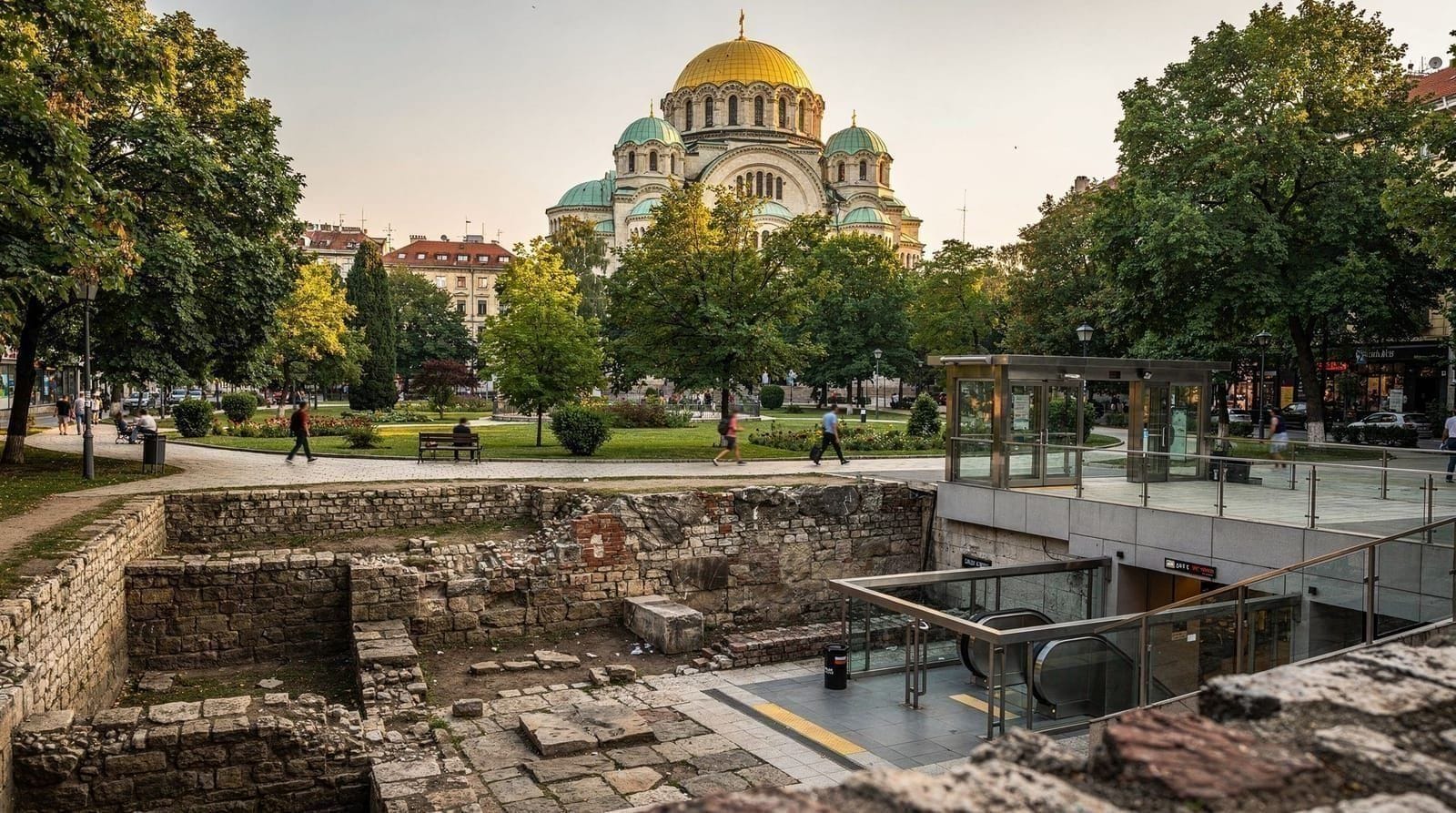
What it is: A tiny, partly subterranean medieval church immediately adjacent to the Serdika metro station, squeezed between the metro entrance stairs and the pedestrian underpasses of the Largo.
History: The church dates to the 14th or 15th century — accounts vary — and was built partly underground, most likely because Ottoman regulations restricted the height of non-Muslim religious buildings. It was dedicated to St Petka (Paraskeva), a Bulgarian female saint of the 10th century whose relics were held here for a period.
The building barely registers at street level: descend a short flight of stone steps beside the metro entrance and you find a small stone-vaulted nave with fragments of original frescoes on the walls. It is genuinely medieval, genuinely underground, and genuinely easy to miss if nobody tells you it’s there.
Practical information:
Entry: Free (donation box inside)
Hours: Variable; often open during daytime
Location: Beside the Serdika metro station entrance, on Maria Luisa Boulevard
Time needed: 10 minutes
Boyana Church: UNESCO frescoes, 4 km from the centre
What it is: A small 10th-century Orthodox church in the Boyana suburb of Sofia, housing 13th-century frescoes that are among the most significant works of medieval European painting and a UNESCO World Heritage Site since 1979.
History: The church was founded in the 10th century on a hillside at the edge of what is now Sofia. In 1259 — more than a century before the Italian Renaissance — a Bulgarian nobleman commissioned a new chapel addition, and the painter commissioned to decorate it produced something extraordinary: 89 scenes with 240 figures, painted in a naturalistic style that predates Giotto’s Florentine innovations by several decades. The figures have psychological depth, individual expressions, and spatial coherence that were genuinely unprecedented in European painting of the period. The identity of the painter is unknown.
UNESCO designated the church in 1979. The frescoes are in an exceptional state of preservation given their age.
Practical information:
Entry: €8
Hours: Tuesday–Sunday, 9am–5:30pm (winter hours shorter); closed Monday
Location: 4 km south of the city centre in Boyana; taxi about €5–7 from the Largo, or Bus 107 from Eagle Bridge
Time needed: The visit inside the frescoed rooms is strictly 10 minutes per group (maximum 10 people) to control humidity. The grounds outside can be explored freely.
Booking: Strongly recommended, especially in summer. Walk-ins are often turned away. Book via the official Boyana Church website.
Nearby: The National History Museum is 5 minutes away by car. Vitosha Mountain is directly above; Boyana destination page has hiking and visit details.
The combination of Boyana Church with the Vitosha foothills makes for a natural half-day away from the city centre. See day trips from sofia for how to structure the day.
GetYourGuideSofia: Vitosha Mountain, Boyana Church & History MuseumCheck availability →The Orthodox Church in Bulgarian history
To understand why Sofia has so many Orthodox churches — and why they were built with such insistence and scale — it helps to understand what the Orthodox Church meant to Bulgaria during the Ottoman period.
For nearly five centuries (1396–1878), the Bulgarian state did not exist. Bulgaria was a province of the Ottoman Empire, governed under Ottoman law, with the Bulgarian language largely absent from official life. During this period, the Bulgarian Orthodox Church — along with the monasteries that preserved manuscripts, educated clergy, and maintained liturgical traditions — was the primary institution through which Bulgarian cultural and national identity survived.
The Patriarchate of Tarnovo was abolished by the Ottomans after the conquest; Bulgarian Christians fell under the jurisdiction of the Ecumenical Patriarchate of Constantinople (which conducted services in Greek). The struggle for an independent Bulgarian church (an exarchate separate from Constantinople) that ran through the 19th century was simultaneously a religious, linguistic, and national movement. When the Bulgarian Exarchate was established in 1870 — eight years before political independence — it was a significant moment in Bulgarian national consciousness.
This is why the construction of Alexander Nevsky (1882–1912), the restoration of Boyana Church, and the careful preservation of the Rotunda mattered so much to the Bulgarian state after independence. These were not just religious buildings — they were statements of civilisational continuity, claims that Bulgaria had been here before the Ottomans and would be here after.
The Bulgarian Revival architecture guide explores how this same dynamic played out in secular buildings — the period from the late 18th century to independence produced a distinctive architectural style precisely because it was conscious of asserting Bulgarian identity.
What Boyana’s frescoes changed
The art-historical significance of Boyana Church is worth stating clearly because it tends to get lost in the phrase “13th-century frescoes.”
The standard account of the development of naturalistic painting in European art credits Giotto di Bondone (c.1267–1337) with the decisive move away from the stylised, frontal figures of Byzantine tradition toward more three-dimensional, psychologically individualised representations of human beings. The Boyana frescoes were painted in 1259 — at least a decade before Giotto’s earliest work.
The Boyana master (whose identity is unknown) painted portraits of individual figures with distinctive faces, emotional expressions, and spatial coherence that went substantially beyond what was being produced elsewhere in the Orthodox world at the time. The portrait of Sebastokrator Kaloyan and his wife Desislava — the donors who commissioned the chapel — shows two specific people with individual faces, not iconic types. The Christ figures and saints in the narrative scenes show suffering, tenderness, and interaction between figures that are recognisably human rather than hieratic.
Whether the Boyana master had any connection to developments in Italy, or whether this was an independent parallel development within the Bulgarian medieval painting tradition, is a matter of ongoing scholarly debate. What is not debated is that the Boyana frescoes are among the most significant works of European medieval painting, and that the strict visitor limits (10 people per session, 10 minutes per session) are the most honest acknowledgement you will encounter anywhere in Sofia of how precious something actually is.
Photography and behaviour inside active places of worship
All of the buildings covered here remain active places of worship, not museums frozen in time, and that distinction matters for how you behave inside them. Orthodox churches generally allow photography of the architecture and icons outside of active liturgy, but flash photography and photographing worshippers directly is discouraged and, during a service, best avoided altogether — stand quietly at the back rather than moving through the space.
Banya Bashi Mosque restricts photography inside the prayer hall without asking first, though the courtyard and ablution fountain are generally fine to photograph. The Sofia Synagogue’s policy varies by visit and staff on duty, so ask at the entrance rather than assuming. Boyana Church prohibits photography entirely inside the frescoed chapel, a rule tied directly to the conservation measures that limit visitor numbers and time — the humidity and light from cameras, multiplied across thousands of annual visitors, is exactly the kind of cumulative damage the strict session limits are designed to prevent.
Planning a full day of Sofia’s religious buildings
The city-centre buildings (Rotunda, Alexander Nevsky, Banya Bashi, Synagogue, St Nedelya, St Petka) can all be visited in a single day following the route in the sofia old town walk guide. Add two to three hours for the Alexander Nevsky crypt and the Synagogue museum, and the day fills naturally.
Boyana Church requires a separate half-day trip to the southern suburbs. The most efficient combination is Boyana in the morning (opening time, before the first tour groups), then Vitosha Mountain trails in the afternoon. Several tours combine these in one day; see the options below.
For a structured itinerary that includes all of the above across two or three days, see sofia in 2 days or sofia in 3 days.
Quick reference: entry fees and hours
| Building | Entry | Hours | Notes |
|---|---|---|---|
| Rotunda of St George | Free | ~9am–5pm | Variable, may close for events |
| Alexander Nevsky (nave) | Free | 7am–7pm | No photography during services |
| Alexander Nevsky (crypt) | €3 | 7am–7pm | Separate entrance south side |
| Banya Bashi Mosque | Free | Outside prayer times | Shoes off, modest dress |
| Sofia Synagogue | €4 | Sun–Fri ~9am–6pm | Closed Saturday |
| Church of St Nedelya | Free | ~7am–7pm | — |
| Church of St Petka | Free | Daytime | Beside Serdika metro |
| Boyana Church | €8 | Tue–Sun 9am–5:30pm | Book in advance; 10-min visit |
Visiting with children or limited mobility
Most of the city-centre sites are straightforward for families and travellers with mobility considerations: the Rotunda, Alexander Nevsky’s nave, St Nedelya, and Banya Bashi’s courtyard are all step-free or close to it, though the mosque’s shoes-off policy and the synagogue’s kippah requirement are worth explaining to children beforehand so the etiquette doesn’t feel like a surprise. St Petka’s underground setting involves a short flight of stone steps with no ramp alternative, and the space itself is small enough that it can feel crowded with more than a few visitors at once.
Boyana Church is the trickiest of the group: the strict 10-minute, 10-person session limit means large families or groups with young children who need more flexibility should manage expectations in advance, and the church’s hillside setting involves some uneven ground on the approach. None of the sites charge reduced family rates as standard, but children under a certain age are often admitted free at Boyana and the Synagogue — check current policy when booking rather than assuming.
Connecting Sofia’s religious buildings to the wider story
The geography of Sofia’s religious buildings is not accidental. The Rotunda and the Banya Bashi Mosque are 400 metres apart; the Mosque and the Synagogue are 200 metres apart; Alexander Nevsky anchors the eastern end of the central axis. This concentration reflects centuries of different communities occupying the same city and sometimes the same buildings — Roman converted to Byzantine, Byzantine plastered over for Ottoman use, Ottoman-era buildings repurposed after independence.
Sofia was part of the Ottoman Empire for nearly five centuries. Bulgarian national consciousness, forged in that period largely through the Orthodox Church, treated religious identity as inseparable from national identity. The sheer size of Alexander Nevsky — 5,000 capacity, built to dominate the skyline — was a statement about Orthodox Christian Bulgarian nationhood after independence, not just about religious devotion.
Walking through this geography in a single day gives you a picture of Sofia that no single museum can match: a city that has been Roman, Byzantine, Bulgarian, Ottoman, Bulgarian again, Communist, and now European (Bulgaria joined Schengen in January 2025), and that carries all of those layers simultaneously.
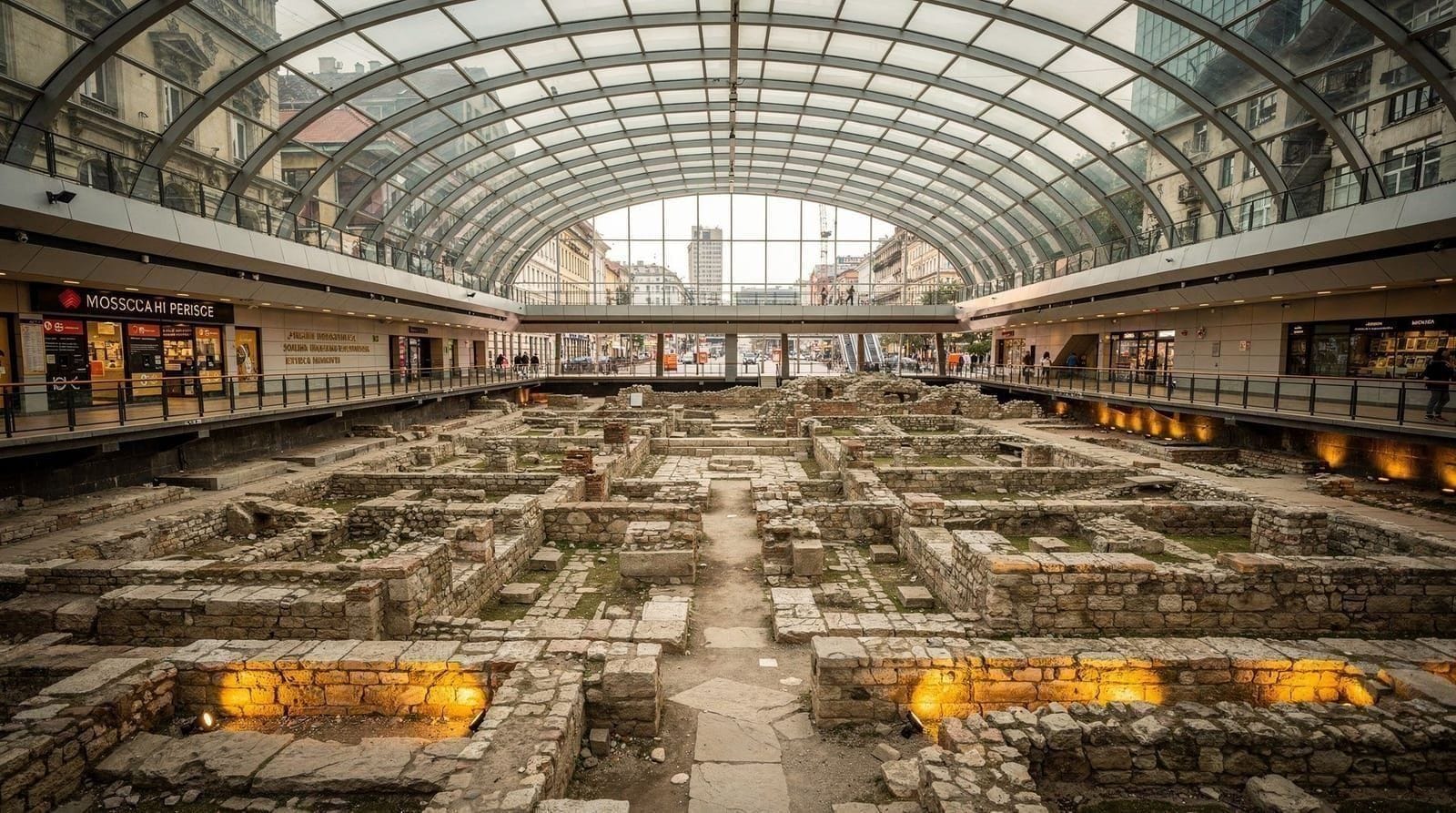
For the communist-era layer, which is missing from this religious-buildings circuit, see the communist Sofia tour and socialist monuments Sofia guides. For the archaeological layer beneath all of it, see serdica roman ruins.
What’s genuinely worth the detour
Not every site here deserves equal time, and being honest about that helps you plan. Boyana Church is worth the trip out even with the strict 10-minute visit limit — the frescoes are simply unlike anything else in Bulgaria, and the surrounding grounds and views make the detour worthwhile beyond the church itself. Alexander Nevsky’s crypt is the most underrated single stop on this list: most visitors photograph the exterior and skip the €3 icon collection inside, which is a genuine loss given the quality of what’s on display.
St Petka, by contrast, is a five-to-ten-minute curiosity rather than a destination in its own right — worth popping into if you’re passing the Serdika metro entrance anyway, not worth a special trip. If you have to cut something from a tight itinerary, the Rotunda and St Nedelya are the easiest to skip without losing much, since both are free, quick, and less visually distinctive than the others on this list.
Frequently asked questions about Sofia's churches and religious buildings
Do I need to cover my head in Sofia's Orthodox churches?
Women are traditionally expected to cover their heads in Bulgarian Orthodox churches, though enforcement is inconsistent and many churches have relaxed this in practice. It is respectful to bring a scarf. Men do not need head coverings in Orthodox churches. At the Sofia Synagogue, men must wear a kippah (provided at the entrance).Can I visit Boyana Church without booking in advance?
Technically yes, but you should book in advance. Boyana Church limits visitor numbers strictly to 10 people per session (sessions last about 10 minutes) to protect the 13th-century frescoes. In summer, walk-in visitors regularly find the day fully booked by morning. Book via the Boyana Church website or through a tour.Is Banya Bashi Mosque open to non-Muslim visitors?
Yes, outside prayer times. Remove shoes before entering. Dress modestly — shoulders and knees covered. Photography is permitted in the courtyard; ask before photographing inside the prayer hall. Prayer times change throughout the year; visiting mid-morning on a weekday is usually the easiest.Which Sofia church is the oldest?
The Rotunda of St George (4th century AD) is the oldest building in Sofia and the oldest continuously used religious structure in the country. It predates the Alexander Nevsky Cathedral by about 1,500 years.How long does it take to visit Boyana Church?
The visit itself is only 10 minutes (strict time limit inside the frescoed rooms). But getting there from the city centre takes 20–25 minutes each way by taxi or bus. Allow 1.5–2 hours for the round trip. Many visitors combine it with Vitosha Mountain or the National History Museum nearby.Are any of Sofia's churches free to enter?
Alexander Nevsky nave, the Rotunda of St George, Church of St Nedelya, and Banya Bashi Mosque are all free. The Alexander Nevsky icon crypt costs €3, the Sofia Synagogue €4, and Boyana Church €8.Which Sofia churches should I skip if I only have half a day?
Prioritise Alexander Nevsky Cathedral (including the crypt) and, if you can book ahead, Boyana Church — these are the two most distinctive stops. The Rotunda of St George and Church of St Nedelya are worthwhile but quick and easy to fit in on the way to somewhere else, while St Petka is best treated as a two-minute curiosity beside the Serdika metro entrance rather than a dedicated stop.Can I visit multiple religious sites in one walking route?
Yes. The Rotunda, Banya Bashi Mosque, Sofia Synagogue, St Nedelya, and St Petka are all within a 15–20 minute walk of each other in central Sofia, and Alexander Nevsky is a further 10–15 minutes east. The Sofia old town walk guide lays out an efficient route connecting them.
Top experiences
Bookable activities with verified prices and instant confirmation on GetYourGuide.