Sofia long weekend: 4 days in Sofia, Rila, and Plovdiv
Sofia: 16 Pirotska Street Bulgarian Food and Drinks Tasting
Four days is the point at which a trip to Bulgaria shifts from a city-break to something more substantial. This itinerary uses Sofia as a base for three consecutive excursions — one to Rila Monastery, one to Plovdiv, and one within the capital’s suburbs — while keeping Day 1 for the city center. No car required; all legs work on public transport or organized tours.
A note before you plan: Plovdiv deserves 1-2 nights of its own. The day-trip version in this itinerary is a genuine option and covers the main sights, but if you can extend to 5-6 days and spend a night in Plovdiv, the experience is richer. The structure below is the realistic long-weekend version.
Bulgaria joined the eurozone on 1 January 2026; all prices here are in EUR.
| Where | Sofia, Rila Monastery (120 km), Plovdiv (130 km) |
| Cost | Roughly €450–600/person, mid-range, excl. flights |
| Time needed | 4 days (5 if adding a Plovdiv overnight) |
| Getting there | Metro/bus in Sofia; tours or buses for the two day trips |
| Best time | April–June or September–October |
Day 1: Sofia city core
Morning: Roman Sofia and the central monuments
Begin at Serdica metro station, where underground passages display preserved ruins of the 2nd-to-4th-century Roman city that predates Sofia on this site. These are free, visible from the metro corridors, and often skipped by visitors in a hurry — worth 15 minutes before you emerge to street level. The Serdica Roman ruins guide provides context.
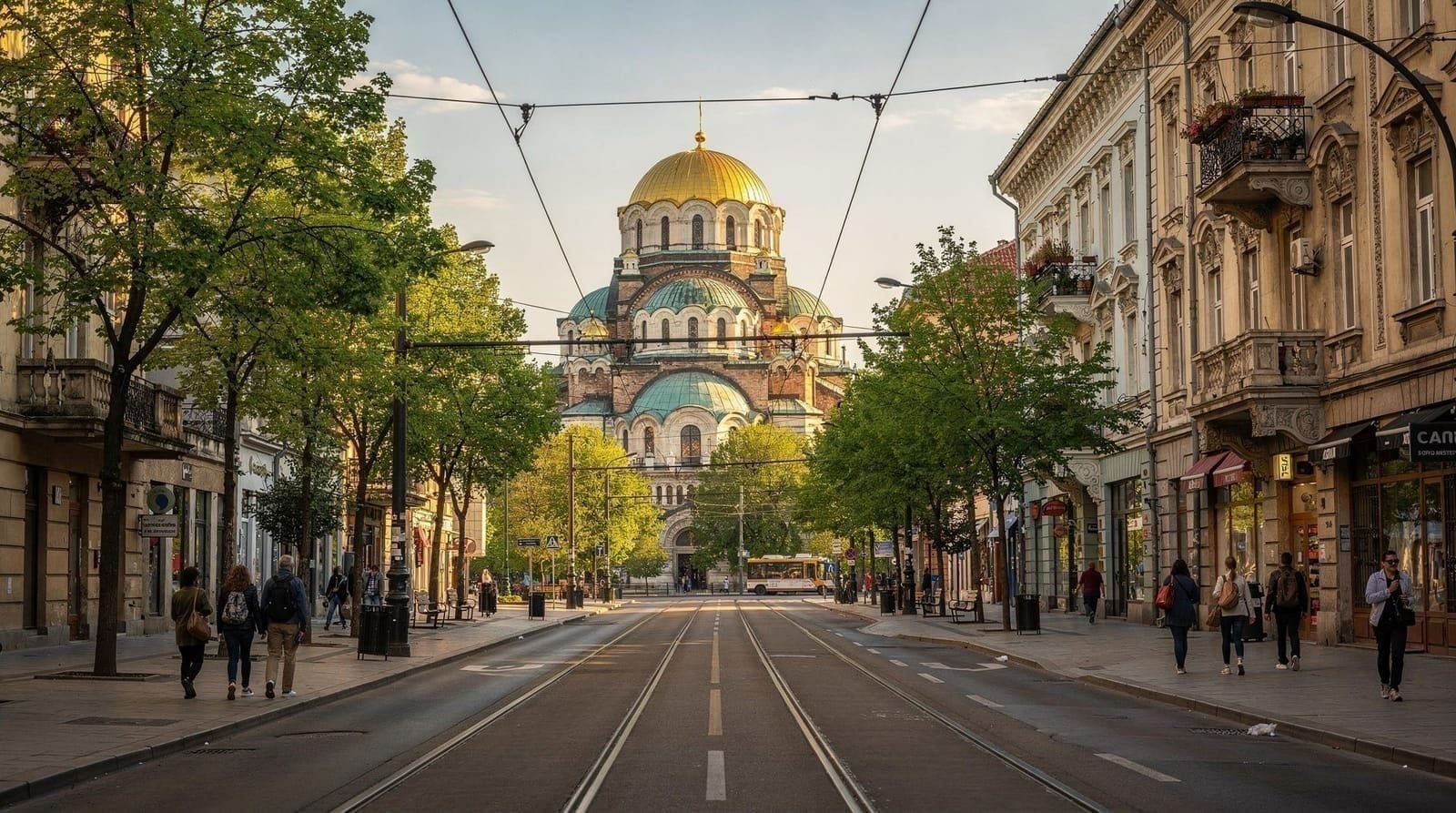
Surface at the Largo — Sofia’s Soviet-era monumental ensemble, three symmetrical Stalinist administrative buildings arranged in a horseshoe. Walk east along Tsar Osvoboditel Boulevard past the Presidency building (hourly changing of the guard) toward Alexander Nevsky Cathedral. Built 1882-1912, the cathedral is Sofia’s most recognizable landmark: Neo-Byzantine exterior with gold domes, interior with dark wood pews and gold mosaics covering the upper walls. The nave is free; the crypt museum of Bulgarian Orthodox icons costs around €4 and contains some of the finest medieval panel paintings in the country. Allow 45 minutes total.
Behind Alexander Nevsky, the St Sophia Church (6th century) gives the city its name. The National Assembly building and Sofia University are both on this central axis and form a coherent 19th-century urban set-piece worth looking at collectively.
Afternoon: Vitosha Boulevard, the old town, and markets
Lunch near the Women’s Market (Zhenski Pazar, north of the center near Lion’s Bridge) — a daily local market with cheap prepared food (€2-4 per plate). Then walk south to Vitosha Boulevard, Sofia’s main pedestrian shopping street, and follow it to the National Palace of Culture (NDK) plaza at the southern end.
The blocks east and west of Vitosha Boulevard contain most of the city’s better cafes, some surviving Bulgarian Revival architecture, and the area around Benkovski Street — a neighborhood worth walking through without a specific destination. The Sofia old town walk traces a logical route through the older parts of the center.
Evening: food and orientation
Dinner in the center, ideally at a restaurant doing Bulgarian food rather than international cuisine — this is the first evening, so getting a baseline for local cooking makes sense. The Bulgarian dishes to try guide covers what to order on a first night: shopska salata, tarator (cold yogurt and cucumber soup), then grilled meats or a clay-pot dish. The Sofia food guide recommends specific areas of the center for restaurants at different price points.
A guided food walk is an efficient way to combine eating with neighborhood exploration on this first evening:
Sofia food and culture walking tourFor drinks after dinner, the area around Stara Planina Street and the blocks off the main boulevard have bars ranging from craft beer spots to traditional mehanas. The Sofia nightlife guide covers the current options.
Day 2: Rila Monastery — full day
The most important day of the itinerary. Rila Monastery is 120 km south of Sofia at 1,147 m elevation, founded in the 10th century and a UNESCO World Heritage Site since 1983. The journey is long enough (2 hours each way) that only a full-day commitment makes sense.
Getting there
By organized tour (recommended for most visitors): Tours depart from central Sofia hotels and typically cost €25-45 per person including transport and an English-speaking guide. The Rila Monastery full-day group tour is the most common format. Groups are typically 10-20 people; private options cost more but allow flexibility.
By public bus: Buses from Ovcha Kupel bus terminal (metro line 1) run 1-2 times in the morning; the fare is around €6-8 each way and the journey takes about 2 hours. The last return bus departs around 17:00. Check current schedules at the terminal — rural bus timetables in Bulgaria change seasonally and online sources are frequently outdated. The Sofia to Rila transport guide covers current options.
At the monastery
Entry to the main complex is free. What you’re paying for in a tour is transport and the guide; the site itself charges only for specific sub-attractions.
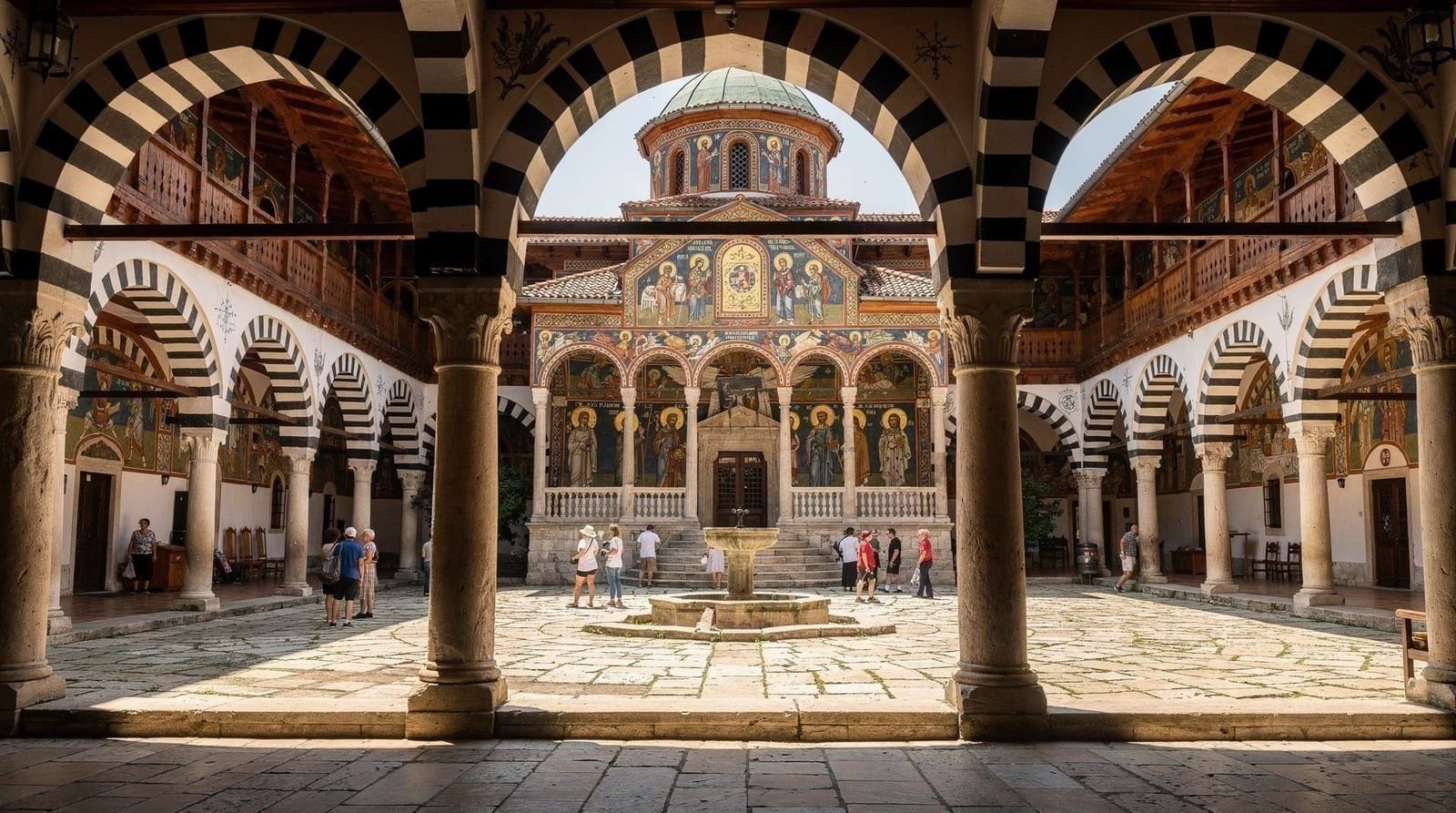
The courtyard and arcade: The main gate opens into a large courtyard ringed by 300 arches on four sides — monk cells above, stone-paved courtyard below. The Hrelyo Tower (14th century, the oldest surviving structure) costs around €2 to climb and offers the best overview of the complex from above.
The Church of the Nativity (1834-1837): Three porticos precede the nave, all covered floor-to-ceiling in frescoes by Bansko and Samokov school masters. Approximately 1,200 square meters of painted surface. The Last Judgment scene on the exterior west portico is particularly detailed — look for the specific categories of sinners being condemned, which include a range of occupational and social types. Entry to the church is free; photography rules vary by section.
The monastery museum: Entrance around €5. The centerpiece is Raphael’s Cross (1790-1802) — a wooden cross carved with 1,500 miniature biblical scenes over 12 years by a single monk who went blind from the work. The museum also holds church plate, manuscripts, and embroidery from the monastic treasury.
Nevyastata Waterfall: A 2 km walk upstream along the Rila River from the monastery complex. The path is straightforward and the waterfall is modest but the walk through the river valley is pleasant. Worth doing if you arrive early and have time before crowds peak.
Practical timing: Aim to arrive by 10:00. The main tour groups cluster between 11:00 and 14:00. If you can be there at 09:00 (earlier buses or a tour that departs Sofia at 07:30), you’ll have the courtyard nearly empty. Leave by 16:00-17:00 depending on transport.
The full Rila Monastery guide covers the monastic history and art in detail. The Rila Monastery day trip guide focuses on logistics.
Day 3: Plovdiv day trip
Plovdiv is 130 km west of Sofia — or rather, east; it sits in the Thracian Plain in the opposite direction from Rila. It’s the second largest city in Bulgaria and one of the oldest continuously inhabited cities in Europe (settled since at least 4000 BCE). The old town, on three hills above the river, is genuinely well-preserved and unlike Sofia in character and architecture.
Getting there
By bus: Direct buses run from Sofia’s Central Bus Station (Tsentralna Avtogara, near the central railway station, metro Serdika or a short taxi) to Plovdiv approximately every 30-60 minutes from 06:00 to 20:00. Journey time is around 2 hours. Fare: approximately €7-9 each way. Bus companies include Etap, Biomet, and Union Ivkoni — buy tickets at the terminal windows or through the respective websites. Return buses run with similar frequency.
By train: Trains are slower (2.5-3 hours) and less frequent. The bus is generally the better option for a day trip.
By organized tour: A Sofia-to-Plovdiv guided day tour handles transport and includes an English-speaking guide for the old town. This is useful if you prefer not to navigate independently:
Sofia to Plovdiv guided day tourThe Plovdiv day trip guide covers the full logistics including which bus terminal to use and return options.
In Plovdiv
The Old Town (Stariya Grad): Three hills — Nebet Tepe, Dzhambaz Tepe, and Taxim Tepe — are covered with National Revival-era houses in the style distinctive to 19th-century Bulgarian bourgeois architecture: projecting upper floors, wood detailing, painted facades. The main pedestrian street through the old town (Ulitsa Saborna) passes most of the key buildings.
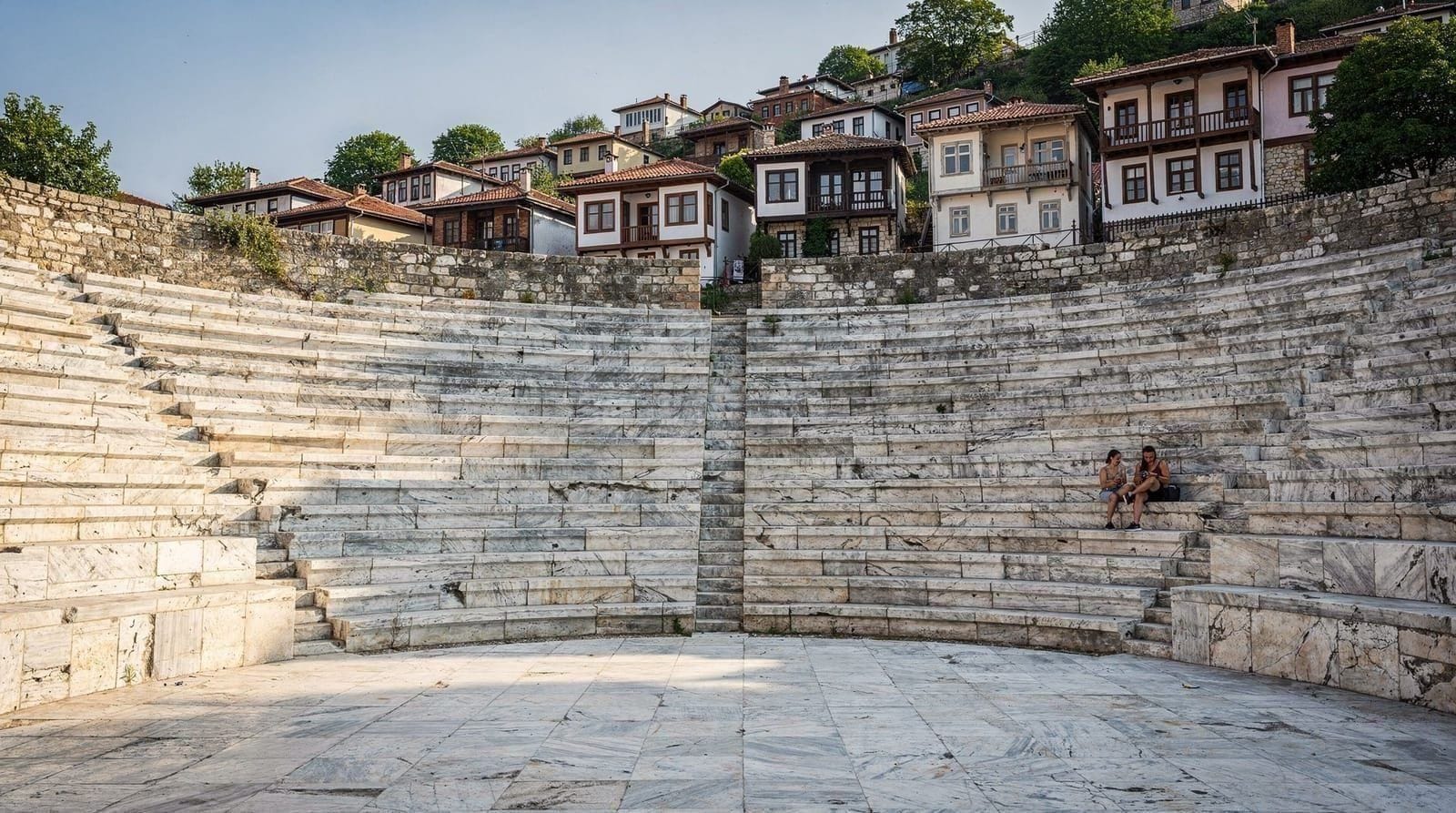
The Roman Amphitheater: Discovered during an accidental excavation in 1972, the amphitheater (2nd century CE) is largely intact and still used for concerts and events. Entry costs around €5. It’s visible from street level without paying; the interior requires a ticket. The size — capacity around 7,000 — gives a clearer sense of Philippopolis (the Roman name) as a significant provincial city than most museum displays can.
Kapana Creative District: The name means “The Trap” — referring to the maze of narrow streets in this neighborhood just west of the old town. Now a concentration of galleries, cafes, and independent shops. Less architecturally significant than the old town but more functionally alive; good for coffee and lunch.
Dzhumaya Mosque: The mosque (1364) is one of the oldest and largest surviving Ottoman mosques in the Balkans. It sits on the main central square (Ploshtad Tsentralen) alongside a Roman stadium section. Both are worth a look.
Lunch: Kapana has the widest range of restaurants. A sit-down meal at a mid-range Plovdiv restaurant costs €10-18 for a main and a drink — broadly comparable to Sofia mid-range.
Getting back
Evening buses from Plovdiv to Sofia run until 21:00-22:00. The last departures are around that time; check the specific schedule at the terminal on arrival. Give yourself an hour buffer before the last bus if you’re on a tight timeline.
Day 4: Boyana Church and the National Gallery
Morning: Boyana Church
Boyana Church sits 7 km southwest of central Sofia in the residential suburb of Boyana. Its 13th-century frescoes (1259) are UNESCO-listed and considered among the finest medieval paintings in Europe — painted several decades before Giotto’s comparable work in Padua and showing similar advances in naturalistic human expression.
Getting there: Bus 64 from Hladilnika metro station (line 1) to the Boyana Church stop, around 25 minutes, €1.60. Taxis from the center cost €4-6.
Entry: Approximately €10. The church is tiny — maximum 10-12 visitors at a time — and visits are strictly timed to 10 minutes per group to protect the painted surfaces. Book tickets online in advance for any visit between April and October; walk-up tickets are frequently unavailable in summer.
What makes the frescoes distinctive: the figures show individual physiognomies and emotional states — sorrow, concentration, doubt — rather than the flattened symbolic convention of contemporary Byzantine work. The portrait of Kaloyan, the Bulgarian noble who commissioned the church extension, and his wife Desislava are particularly specific faces. The Boyana destination page covers the art historical context.
The National History Museum is directly adjacent (housed in what was the Communist Party’s official state residence — a notably large and well-appointed building for an institution that officially rejected privilege). Bulgaria’s largest history collection: Thracian treasures, Byzantine religious art, Ottoman-period artifacts, and the National Revival period. Entry around €6. Allow 90 minutes minimum for a meaningful visit.
A private tour combining both sites with a specialist guide:
Vitosha, Boyana, and History Museum tourAfternoon: National Gallery and final Sofia time
The National Gallery of Bulgaria has two main branches in the center. The Kvadrat 500 building (near NDK) holds 19th and 20th-century Bulgarian art — the National Revival painters and the modernist period are both well-represented. Entry is around €4. The Sofia museums guide covers current hours and the relative merits of each branch.
Alternatively, the afternoon can be used for anything left undone: the Museum of Socialist Art southwest of the center has an outdoor collection of removed communist monuments (including a large Lenin statue and Georgi Dimitrov mausoleum pieces) — a 45-minute visit that adds context to the socialist monuments you’ve been walking past all trip.
Last meal: Budget extra time for a final dinner. If you haven’t had a proper Bulgarian wine experience, this is the evening for it. The afternoon wine and food tasting walk (also bookable for evenings) covers the main Bulgarian wine regions through a 5-6 wine tasting paired with food. The Bulgarian wine guide covers the context; the Melnik wine region guide is worth reading if you’re considering extending the trip.
The four days at a glance
| Day | Focus | Base |
|---|---|---|
| 1 | Sofia city core — Roman ruins, Alexander Nevsky, old town | Sofia |
| 2 | Rila Monastery, full day | Sofia |
| 3 | Plovdiv, full day | Sofia (or Plovdiv, see below) |
| 4 | Boyana Church, National Gallery, free time | Sofia |
Budgeting for two day trips in one long weekend
Rila and Plovdiv are the two costliest single-day items on this itinerary, and it’s worth understanding what drives the price before booking either. Rila’s cost is mostly the transport — the monastery itself is largely free to enter, so a €25–45 tour fee or a €6–8 bus fare each way is buying you the 120 km each direction, not site access. Plovdiv works the same way: the bus fare is modest, and the real cost is entry to specific sights like the Roman Amphitheatre.
If your budget is tighter than the mid-range figures below, the public bus option for both legs cuts the day-trip cost roughly in half compared to organized tours, at the expense of a fixed schedule and no built-in guide. Splitting the difference — bus for one leg, tour for the other — is a reasonable way to get a guide for the site that benefits most from context (most visitors find this is Rila) while keeping Plovdiv, which is easier to navigate independently, on the cheaper option.
Rila or Plovdiv first — does the order matter?
The itinerary above runs Rila on Day 2 and Plovdiv on Day 3, and that order is deliberate rather than arbitrary. Rila involves more total transit time and a longer day overall, so doing it before Plovdiv fatigue accumulates tends to work better than the reverse — arriving at Plovdiv’s old town tired from a long Rila day the day before is a worse experience than the other way around. That said, both excursions run daily and neither has a weekday-only constraint, so swapping them is entirely reasonable if, say, a Plovdiv tour only has availability on a specific date. What doesn’t work well is trying to combine them into a single day: they run in opposite directions from Sofia, and a same-day combination that some operators offer trades a genuine visit to either site for a long day mostly spent in transit.
Making Day 3 an overnight instead
This is the one structural change worth genuinely considering before you lock in your dates, since it affects hotel bookings for the whole trip rather than just one day.
If your dates have any flexibility at all, converting the Plovdiv day trip into an overnight is the single highest-value change to this itinerary. A guesthouse in the old town costs €50–80, only modestly more than a Sofia hotel night, and it buys you the old town in the early morning and evening — both meaningfully different from the midday version day-trippers see, with far fewer people on Ulitsa Saborna and softer light on the Revival-era facades. This turns the trip into five days rather than four, with the extra Sofia night simply removed rather than added. If you’re set on four days, the day-trip version in the main itinerary genuinely does cover the essentials — the Old Town, the Roman Amphitheatre, and Kapana — just at a brisker pace.
Practical information for 4 days
Budget breakdown (per person, mid-range):
- Accommodation: €70-90/night, so €280-360 for 4 nights
- Transport (metro passes, Rila bus, Plovdiv bus): approximately €35-45
- Tours (Rila tour if using one): €30-45
- Site entries (Boyana, Alexander Nevsky crypt, Rila museum, Roman amphitheater, History Museum, National Gallery): €30-40
- Food: €30-50/day mid-range
Total excluding flights: approximately €450-600 per person for 4 days.
What to book in advance:
- Boyana Church tickets (book 1-2 weeks ahead for summer visits)
- Rila Monastery tour if using an organized tour
- Plovdiv bus tickets don’t require advance booking but check departure times before the day
Day order flexibility: The itinerary above puts Rila on Day 2 and Plovdiv on Day 3. These can be swapped. Rila is longer and more tiring; putting it on Day 2 (before Plovdiv fatigue sets in) is usually better. Both excursions work on any day of the week.
Plovdiv overnight option: If you can extend to 5 days, spending night 3 in Plovdiv rather than returning to Sofia is significantly better. The old town in the evening and early morning — before day visitors arrive — is a different experience. One night in Plovdiv costs €50-80 for a guesthouse in the old town.
For further planning, the Sofia travel guide covers the full picture of the capital. The day trips from Sofia guide covers additional excursion options beyond what fits in this itinerary.
Frequently asked questions about the 4-day Sofia itinerary
Is 4 days enough for Sofia, Rila, and Plovdiv?
Four days covers the key elements without feeling rushed, provided you accept that Rila and Plovdiv each get one day rather than more. If Rila Monastery or Plovdiv is the main reason for the trip, a 5-day schedule allows a night in Plovdiv and more time at Rila.
Should I stay in Sofia or move to Plovdiv?
For a 4-day trip, staying in Sofia throughout is more practical — you avoid packing/unpacking and the bus between cities is cheap and frequent. For a 5+ day trip, a night in Plovdiv adds value. See the Sofia vs other Balkan capitals piece for a broader comparison.
Can I combine Rila and Plovdiv in one day?
Technically possible but not recommended. The distances are in opposite directions from Sofia (Rila is southeast, Plovdiv is east), so a combined day requires significant travel and gives you rushed time at both. Several operators offer combined tours but they tend to be surface-level visits.
Is Plovdiv worth a day trip from Sofia?
Yes. The old town is among the best-preserved Ottoman-era urban environments in Bulgaria, the Roman amphitheater is unusually complete, and Kapana provides a functional creative neighborhood that Sofia’s center lacks. Plovdiv is different enough from Sofia to feel like a separate destination rather than more of the same. The Plovdiv guided day tour from Sofia is worth considering if you want context for what you’re seeing in the old town.
What’s the weather like in Sofia in June?
June is one of the better months: warm (22-28°C in the city), occasional afternoon thunderstorms, long daylight hours. Vitosha Mountain is snow-free. Rila Monastery can still be cold in early June at elevation — bring a layer. The best time to visit Sofia guide covers all months.
Are there options for visiting with children?
The Rotunda of St George and the in-station Roman ruins at Serdica are accessible and engaging for older children. Boyana Church is very small and the timed visit format is difficult with young children. Vitosha Mountain (Day 2 if you swap in a hike) works well for children who can walk 3-4 km. The Sofia with kids guide covers family-specific logistics.
What’s the best neighborhood to stay in?
The area between Alexander Nevsky and the NDK, particularly around Ivan Vazov and Slaveykov Square, puts you within 20 minutes walk of everything on Day 1 and Day 4, and within easy metro range of the bus terminals for Days 2 and 3. This is the default recommendation for all durations.
How do I get from Sofia Airport to the city center?
Metro line 1 connects the airport to the city center in about 30 minutes for €1.60. Taxis are also available; use OK Supertrans or Yellow Taxi (apps or the desk in arrivals) to avoid overcharging. The Sofia airport to city guide covers the current options.
Top experiences
Bookable activities with verified prices and instant confirmation on GetYourGuide.